PancakeSwap v3 (Polygon zkEVM) Review: Discontinued in 2025 & Alternatives
If you are looking to trade on PancakeSwap v3 using the Polygon zkEVM network, there is a critical piece of news you need to know before connecting your wallet: this specific deployment is no longer active. As of September 30, 2025, PancakeSwap officially completed its phase-out of support for Polygon zkEVM. This means that if you try to access the platform today, July 13, 2026, you will find that the bridge routes and liquidity pools on this specific Layer 2 chain have been sunset.
This review serves two purposes. First, it explains what happened to this integration and why it matters for your assets. Second, it breaks down how the platform worked while it was live, so you can understand the technology behind the scenes. Finally, we will look at where you should go now to get similar low-fee, high-speed trading experiences without the risk of hitting a dead end.
The Sudden Sunset: What Happened to PancakeSwap on Polygon zkEVM?
To understand the current state of affairs, we have to look at the timeline. In mid-2025, PancakeSwap aggressively pushed users toward Polygon zkEVM. They ran a seven-week campaign on the Galxe platform from June 29 to August 17, 2025. The goal was clear: drive adoption of their Automated Market Maker (AMM) model on this specific Ethereum Layer 2 solution. Users were promised "flexible and beneficial trading" with faster confirmations than the mainnet.
However, just three days after the promotional period ended, the strategy shifted dramatically. On September 30, 2025, the team announced the discontinuation of Polygon zkEVM support. By October 3, 2025, the integration was effectively dead. For anyone holding CAKE tokens or other assets bridged to that specific chain, this created immediate friction. You couldn't just swap; you had to figure out how to move your funds back to a supported network like BNB Chain or Ethereum mainnet.
Why did this happen? Industry analysis suggests that user adoption metrics simply didn't meet the internal benchmarks required to justify the maintenance costs. While Polygon zkEVM offered technical advantages, it failed to attract enough daily active volume to compete with PancakeSwap's home turf, the BNB Smart Chain, or other dominant L2s like Arbitrum and Base. This rapid pivot highlights a key risk in DeFi: even major platforms can abandon networks quickly if the economics don't work out.
How It Worked: A Look Back at the Technology
Even though the service is discontinued, understanding how PancakeSwap v3 functioned on this network provides valuable context for evaluating other DEXs. The core engine was an Automated Market Maker. Unlike traditional exchanges that match buyers and sellers via an order book, PancakeSwap used liquidity pools. Prices were determined by the ratio of assets in each pool. If you wanted to swap USDC for ETH, you pulled from the existing pool of those tokens, and the price adjusted automatically based on supply and demand.
The "v3" designation referred to the version of the protocol code. Compared to earlier versions (V1 and V2), V3 introduced concentrated liquidity. This allowed liquidity providers to allocate their capital within specific price ranges rather than across the entire curve. Theoretically, this increased capital efficiency and reduced slippage for traders. During its operational window, the platform handled millions of daily transactions across its various chains, leveraging the throughput capabilities of the underlying blockchain.
User experience was streamlined for speed. You connected a browser extension wallet-like MetaMask or Trust Wallet-and selected Polygon zkEVM from the network dropdown. The interface presented a simple "Swap" tab where you could input amounts and review transaction details. A "Confirm Swap" prompt served as the final check before execution. For more advanced users, there was limit order functionality, allowing preset price targets for automated execution. However, these limit orders did not support tokens with transfer fees or taxes, a common limitation in AMM systems.

Technical Pros and Cons: Why It Was Popular (And Why It Failed)
When it was live, the combination of PancakeSwap and Polygon zkEVM offered distinct advantages over trading directly on Ethereum mainnet. Here is a breakdown of the technical attributes:
- Speed: Transactions confirmed significantly faster than on Ethereum L1, often in seconds rather than minutes.
- Cost: Gas fees were a fraction of Ethereum mainnet costs, making small trades economically viable.
- Security Model: Polygon zkEVM uses zero-knowledge proofs to batch transactions before posting them to Ethereum, inheriting the security of the mainnet while scaling throughput.
- Ecosystem Integration: It connected to the broader PancakeSwap suite, including yield farming and Syrup Pools, though the zkEVM deployment focused primarily on swaps.
Despite these pros, the cons became apparent over time. The primary issue was fragmentation. By spreading liquidity across dozens of chains, PancakeSwap diluted its depth. A token might have deep liquidity on BNB Chain but shallow pools on Polygon zkEVM, leading to higher slippage for larger trades. Additionally, the need to bridge assets added complexity. Users had to trust the bridge mechanism to move funds between chains, introducing another point of potential failure or delay.
| Feature | PancakeSwap on BNB Chain | PancakeSwap on Polygon zkEVM (Discontinued) | Uniswap on Ethereum L2 (e.g., Arbitrum) |
|---|---|---|---|
| Status | Active & Primary | Sunset (Sept 2025) | Active & Growing |
| Avg. Gas Fee | Low (<$0.10) | Very Low (<$0.05) | Low ($0.10 - $0.50) |
| Liquidity Depth | High | Moderate/Low | High |
| Native Token | BNB | MATIC (Polygon) | ETH |
| Best For | General DeFi Users | N/A (Historical) | Ethereum Ecosystem Purists |
Market Position: Where Does PancakeSwap Stand Today?
As of mid-2026, PancakeSwap remains one of the largest decentralized exchanges by volume, but its identity is firmly tied to the BNB Smart Chain. The decision to drop Polygon zkEVM was part of a strategic consolidation. Rather than trying to be everywhere, the team focused on networks where they held a dominant market share and strong community engagement.
In the broader DEX landscape, competition has intensified. Uniswap v4 launched with hooks that allow for customizable pool logic, offering flexibility that rigid AMMs struggle to match. dYdX continues to dominate the derivatives space, providing perpetual futures with institutional-grade infrastructure. Jupiter has become the go-to aggregator for Solana users. PancakeSwap’s strength lies in its cross-chain routing capabilities and its comprehensive service ecosystem-yield farming, lottery, NFTs, and IFOs (Initial Farm Offerings) all under one roof.
The CAKE token, which powers governance and rewards within the ecosystem, saw volatility during the transition period. In late 2025, CAKE traded around $3.33, with technical analysts predicting a range of $2.13-$2.17 due to market uncertainty surrounding the multichain strategy. By 2026, the token has stabilized, reflecting the platform's focus on sustainable growth rather than aggressive expansion into every new Layer 2 solution.
Where Should You Trade Now? Best Alternatives
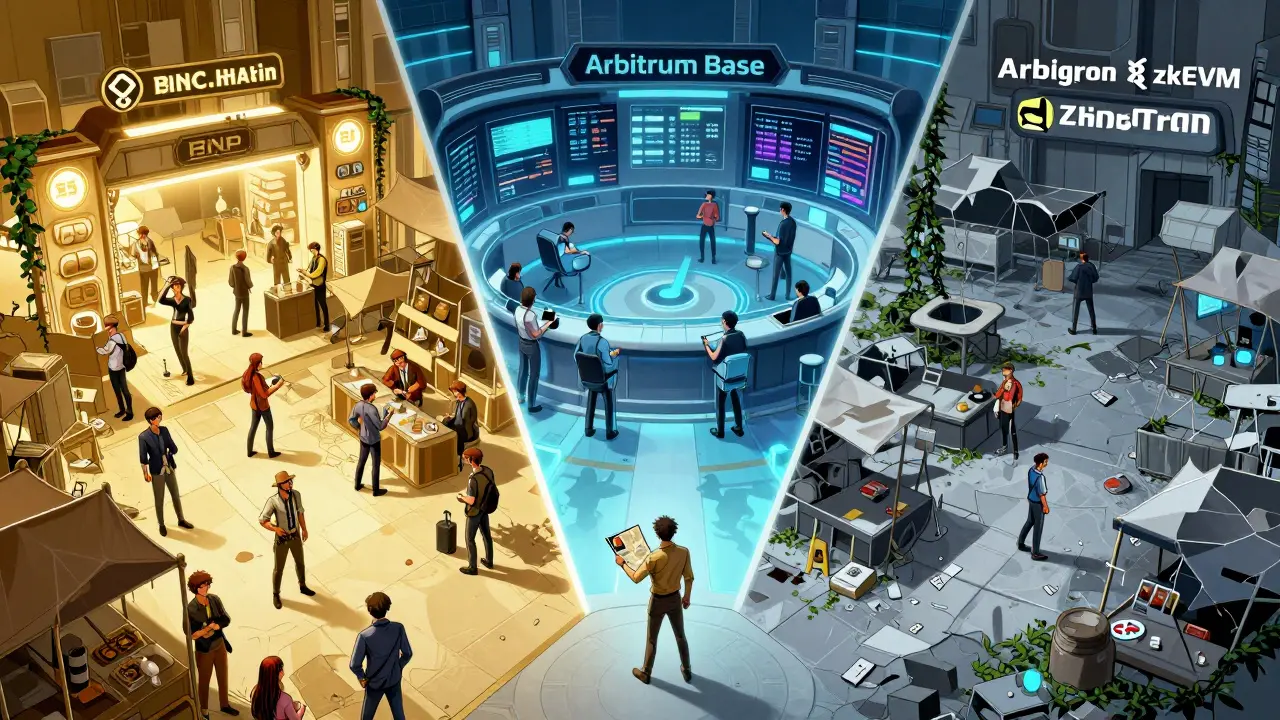
If you were relying on PancakeSwap’s Polygon zkEVM integration, you need a new home for your trades. Your choice depends on your priorities: lowest fees, deepest liquidity, or specific asset availability.
1. Stick with PancakeSwap on BNB Chain
If you already use PancakeSwap, the easiest transition is to switch your network selector to BNB Smart Chain. You will get the same interface, the same features, and arguably better liquidity. The gas fees are still negligible compared to Ethereum, and the ecosystem is mature. This is the best option for users who want continuity and don’t mind staying within the Binance ecosystem.
2. Move to Uniswap on Arbitrum or Base
If you prefer the Ethereum ecosystem but want low fees, Uniswap on Arbitrum One or Base is the standard. These Layer 2 networks offer near-instant transactions and fees comparable to what you experienced on Polygon zkEVM. Uniswap generally has deeper liquidity for blue-chip tokens like ETH, WBTC, and stablecoins. Use a bridge like Across Protocol or Stargate to move your assets efficiently.
3. Explore Aggregators like 1inch or Jupiter
For the absolute best price, consider using an aggregator. 1inch scans multiple DEXs (including Uniswap, SushiSwap, and Curve) to split your trade across different pools, minimizing slippage. If you are on Solana, Jupiter is the undisputed king, offering seamless routing across the entire Solana DEX landscape. These tools remove the guesswork from finding the right pool.
Key Takeaways for Traders
The discontinuation of PancakeSwap on Polygon zkEVM is a reminder that DeFi infrastructure is dynamic. Networks rise and fall based on adoption, cost-efficiency, and developer support. As a trader, you must stay agile. Always verify the status of the network you are using before bridging large amounts of capital. Diversify your exposure across multiple chains to mitigate the risk of a single-point failure.
Focus on platforms with proven track records and transparent roadmaps. While new Layer 2 solutions promise innovation, established networks like BNB Chain, Arbitrum, and Optimism currently offer the best balance of security, liquidity, and usability. Keep an eye on the CAKE token’s performance as a barometer for PancakeSwap’s health, but remember that the platform’s value lies in its utility, not just its native asset.
Is PancakeSwap v3 on Polygon zkEVM still available in 2026?
No. PancakeSwap officially discontinued support for Polygon zkEVM on September 30, 2025. The integration is no longer active, and users cannot access swaps or liquidity pools on this specific network through the PancakeSwap interface.
What happened to my assets bridged to Polygon zkEVM?
Your assets are still on the Polygon zkEVM blockchain, but you can no longer interact with them via PancakeSwap. You will need to use a dedicated bridge service or a multi-chain wallet to withdraw your funds back to Ethereum mainnet or another supported network. Check official Polygon bridges or third-party services like Stargate for withdrawal options.
Why did PancakeSwap discontinue Polygon zkEVM support?
The discontinuation was likely due to insufficient user adoption and liquidity depth to justify the maintenance costs. Despite promotional campaigns, the network failed to achieve the transaction volume necessary to compete with PancakeSwap’s primary chains like BNB Smart Chain.
What is the best alternative to PancakeSwap on Polygon zkEVM?
For similar low-fee trading, consider using PancakeSwap on BNB Smart Chain, Uniswap on Arbitrum, or Uniswap on Base. These platforms offer robust liquidity, fast transactions, and lower gas fees compared to Ethereum mainnet.
Does PancakeSwap still operate on other networks?
Yes. PancakeSwap remains highly active on BNB Smart Chain, Ethereum, Arbitrum, Optimism, and several other EVM-compatible chains. Its core functionality, including swaps, farming, and staking, continues to operate normally on these supported networks.



Alicia Hull
July 14, 2026 AT 19:08I have been closely monitoring the DeFi landscape for several months, and this discontinuation is a significant development that warrants serious attention. It is quite alarming how quickly major platforms can abandon entire ecosystems when the metrics do not align with their internal benchmarks. The sudden sunset of Polygon zkEVM support leaves many users in a precarious position regarding their bridged assets. I find it deeply concerning that there was such a short window between the end of the promotional campaign and the complete cessation of support. This lack of foresight suggests a broader issue within the governance structures of these decentralized exchanges. We must demand more transparency from protocols before we commit our capital to their networks. The fragmentation of liquidity across dozens of chains has clearly proven to be an unsustainable model for PancakeSwap. It is imperative that traders verify the long-term viability of any network they choose to utilize. The risks associated with bridge mechanisms are often underestimated by casual participants. This event serves as a harsh reminder that decentralization does not equate to immutability or permanence. Users need to remain vigilant and adaptable in this rapidly evolving sector.
Johan Otto
July 15, 2026 AT 18:32Typical corporate move. They hype it up then ghost you.
Andrew Schneider
July 15, 2026 AT 23:13Oh wow, talk about a plot twist! 🎭 Just when you thought you had it all figured out, boom, the rug pulls out from under your feet. It’s like watching a soap opera but with real money on the line. 😂 The drama king inside me is just loving this narrative arc. Who knew trading pancakes could be so theatrical? I mean, really, who saw this coming? Not me! I was busy stacking sats while everyone else was chasing low gas fees on a sinking ship. 🚢💸 But hey, at least we got some good content out of it. Now we can all bond over our shared trauma of lost liquidity. Isn’t community building wonderful? Let’s give it up for the clowns in charge! 🤡👏
Eric Braddock
July 16, 2026 AT 13:19You think this is just about adoption metrics? Please. This is a classic example of coordinated suppression by central banking entities trying to stifle true decentralization. Polygon zkEVM was getting too close to exposing the flaws in the traditional financial infrastructure. By pulling the plug, they ensure that liquidity remains fragmented and controlled by the elites on BNB Chain. It’s not a coincidence; it’s a calculated maneuver to maintain hegemony over the crypto narrative. Wake up, sheeple. They don’t want you to trade freely on neutral ground. They want you trapped in their walled gardens where they can monitor every transaction. The zk-proofs were becoming too efficient, threatening the bloated fee structures of the old guard. This is war, and you are losing because you trust these 'decentralized' fronts.
Mark Tuason
July 17, 2026 AT 06:53I appreciate the detailed analysis provided in this post. It is important to acknowledge the strategic decisions made by development teams, even if they result in short-term inconvenience for users. The shift towards consolidating resources on networks with higher activity levels is a logical business decision. However, it is crucial for investors to diversify their holdings across multiple platforms to mitigate such risks. I believe that maintaining a respectful dialogue about these changes helps the community adapt more effectively. We should focus on the available alternatives rather than dwelling on the discontinued services. Thank you for sharing this informative overview.
Ray Arney
July 18, 2026 AT 19:29I switched to Arbitrum last month. Works fine.
Michelle Walker
July 18, 2026 AT 21:17The article misses the obvious point. Liquidity fragmentation is a fatal flaw. Stop using PancakeSwap. Use Uniswap. End of story.
Kat Barr
July 20, 2026 AT 09:41Ugh,, this is so frustrating!! 😫 I literally just bridged my funds last week!!! Why did they do this?? It feels so unfair to us small holders who just wanted cheap gas fees!! 😭 I hope everyone stays strong though!! We’ll figure it out!! 💪✨ Don’t let them get you down!! Keep smiling!! 😊
Logan Edmison
July 21, 2026 AT 10:03its all part of the grand design man. the matrix wants u to trade on bnb chain. dont fight it. just accept ur fate. lol jk maybe not jk. deep thoughts r needed here.
Nick G
July 21, 2026 AT 12:29It is truly fascinating to observe how different cultural approaches to technology manifest in the blockchain space. In many communities, the rapid iteration of platforms is seen as a sign of vitality, whereas others view it as instability. This divergence in perspective highlights the importance of understanding one's own risk tolerance and values. For those who prioritize stability, the consolidation of PancakeSwap onto BNB Chain may seem prudent. However, for advocates of open-source innovation, the loss of Polygon zkEVM integration represents a setback for interoperability efforts. We must strive to listen to all sides of this debate with empathy and an open mind. The emotional toll of such transitions cannot be understated, and supporting fellow traders during these times is essential. Let us come together to build a more inclusive and resilient DeFi ecosystem that respects diverse viewpoints and experiences.
Nick Wengel
July 22, 2026 AT 21:29I used to trade on Polygon zkEVM. Now I use Base. It is okay.
Antony Lopez
July 23, 2026 AT 17:18Another failure of foreign tech. If they stuck to American standards, this wouldn't happen. Our infrastructure is superior. Stay away from these overseas experiments.
Shay Thomson
July 25, 2026 AT 07:55What a devastating turn of events! The sheer magnitude of this decision echoes through the halls of DeFi history. One can only imagine the shockwaves rippling through the community as bridges collapse and pools dry up. It is a tragic tale of ambition meeting reality. Yet, in this darkness, we find the light of adaptation. We rise again!