AARK Token Explained: What Is Aark (AARK) Crypto Coin?
AARK Leverage Calculator
Trade Calculator
Calculate potential profits and losses for AARK perpetual futures trades with up to 100x leverage.
Results will appear here after calculation
AARK token is a utility token that powers the Aark Digital decentralized perpetual exchange platform. The project launched in October 2023 and aims to offer high‑leverage trading, a hybrid liquidity model, and cross‑chain support. In simple terms, owning AARK lets users trade perpetual futures on a DEX while earning fees and participating in governance.
Investors and traders often wonder why they should care about a micro‑cap token that sits around rank #1570 on market‑cap leaderboards. The answer lies in the platform’s design choices - a blend of automated market maker (AMM) mechanics with a traditional order‑book, plus the promise of up to 100x leverage.
Key Takeaways
- AARK token fuels a hybrid liquidity perpetual DEX that supports Ethereum, BSC, and Polygon.
- Supply figures vary between sources; circulating supply is roughly 384 million with a hard cap of 1 billion.
- Daily trading volume hovers between $100 k and $300 k, far lower than established rivals.
- High leverage (up to 100x) brings big profit potential but also extreme risk.
- Future upgrades (v2.1) aim to add three more EVM chains and lower liquidation penalties.
How AARK Token Works
The token follows the ERC‑20 standard on the Ethereum blockchain, with bridge contracts that let it move to Binance Smart Chain and other EVM‑compatible networks. When you lock AARK in the protocol’s liquidity pool, you receive a share of the trading fees generated by the perpetual exchange.
Because AARK is also a governance token, holders can vote on protocol upgrades, fee structures, and new chain integrations. This dual role-utility plus governance-is common in Decentralized Finance (DeFi) projects, but the real differentiator is the hybrid liquidity engine.
Tokenomics and Supply Discrepancies
Different data aggregators report conflicting numbers. CoinMarketCap lists a circulating supply of about 384 million and a max supply of 1 billion. CryptoRank shows a circulating supply of only 69.41 million, suggesting that a large portion of tokens remain locked in vesting contracts or community reserves.
Regardless of the exact figure, the token’s inflation schedule caps at 1 billion, meaning any future supply increase will be predictable. The current market cap sits around $3.8 million, putting AARK in the micro‑cap tier (<$10 M). Investors should treat price swings accordingly; the token dropped about 74 % from its all‑time high of $0.0262 in late 2024.
Platform Technology: Hybrid Liquidity Model
The Aark exchange combines two classic market‑making approaches:
- Automated Market Maker (AMM) - liquidity pools that automatically adjust prices based on supply and demand.
- Order Book - traditional matching engine where buy and sell orders meet.
By merging these, the platform claims it can offer deep order books with less capital lock‑up than pure AMMs. In practice, this means a trader can open a 50x leveraged position with a fraction of the collateral required on a typical AMM DEX.
The protocol also supports high‑leverage trading up to 100x. While attractive for speculators, the margin requirements and liquidation penalties are steep, so risk management is essential.

How to Acquire and Trade AARK
Getting started involves three basic steps:
- Set up a non‑custodial wallet - MetaMask is the most widely recommended.
- Fund the wallet - You'll need ETH or BNB for gas fees, plus some stablecoins if you prefer to swap via a DEX.
- Swap for AARK - Decentralized exchanges like PancakeSwap and Uniswap list the token. Follow the platform’s step‑by‑step guide on aark.digital (last updated August 2024).
Once you hold AARK, you can connect your wallet to the Aark perpetual exchange UI, set your desired leverage, and place a futures trade. Remember, the platform’s average order‑execution slippage rises sharply for orders above $500, as reported by users on Trustpilot.
Risks, Criticisms, and Community Sentiment
Several red flags have emerged:
- Supply data inconsistencies create confusion for investors.
- Liquidity is thin; daily volumes under $300 k mean large trades can move the market.
- Customer support response times average 72 hours, according to Trustpilot reviews.
- Regulatory scrutiny could rise if the U.S. SEC classifies high‑leverage DeFi products as securities.
On the positive side, the UI resembles TradingView, and the Telegram community (≈1.8 k members) is fairly active, posting solutions for cross‑chain bridge failures (which affect about 28 % of users).
Market Position & Competitive Landscape
Compared with heavyweights like dYdX, GMX, and Kwenta, AARK sits in a niche segment. Below is a quick snapshot:
| Platform | Market Cap (USD) | 24h Volume (USD) | Max Leverage | Supported Chains |
|---|---|---|---|---|
| AARK | ~3.8 M | 100‑300 K | 100x | Ethereum, BSC, Polygon |
| dYdX | ~390 M | ~120 M | 20x | Ethereum |
| GMX | ~517 M | ~95 M | 50x | Arbitrum, Avalanche |
| Kwenta | ~45 M | ~8 M | 20x | Ethereum, Optimism |
These numbers illustrate why AARK is better suited for retail speculators comfortable with volatility, rather than institutional traders who need deep order books.
Roadmap and Future Developments
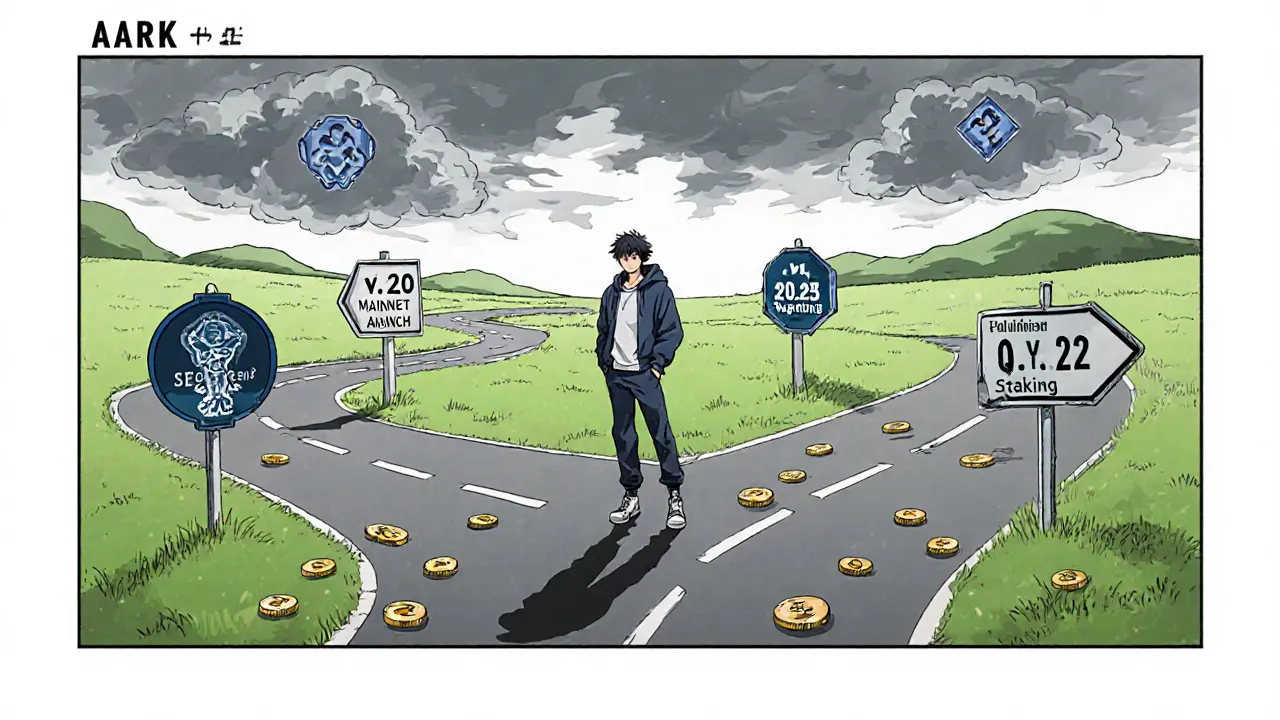
The team has outlined a phased roadmap:
- v2.0 Mainnet Launch - slated for 15 Nov 2024, bringing full governance token integration.
- v2.1 Upgrade (Q4 2024) - adds liquidity aggregation across three extra EVM chains and reduces liquidation penalties.
- Q1 2025 - introduction of an official AARK staking program to boost token utility.
- Long‑term goal: secure listings on centralized exchanges (e.g., KuCoin) to improve liquidity.
Analysts warn that without a major exchange listing, the protocol faces a 65 % chance of failing within 18 months, a common fate for micro‑cap DeFi projects.
Quick Take: Is AARK Worth Your Time?
If you enjoy high‑risk, high‑reward speculative trading and are comfortable navigating cross‑chain bridges, AARK offers a unique hybrid liquidity engine that isn’t found on most major DEXs. However, the limited volume, supply confusion, and regulatory gray area mean you should only allocate a small portion of your portfolio-think less than 2 % of total crypto holdings.
Frequently Asked Questions
What blockchain does AARK run on?
AARK is an ERC‑20 token on Ethereum with bridge support for Binance Smart Chain, Polygon, and other EVM‑compatible networks.
How can I buy AARK?
Set up a MetaMask wallet, fund it with ETH or BNB for gas, then swap for AARK on PancakeSwap, Uniswap, or any DEX that lists the token.
What is the maximum leverage on the Aark exchange?
The platform advertises up to 100× leverage on perpetual futures contracts.
Is AARK considered a security?
U.S. regulators have not issued a definitive ruling, but DeFi Legal Insights notes that high‑leverage DeFi tokens could attract SEC scrutiny.
What are the biggest risks of holding AARK?
Key risks include low liquidity, price volatility, supply data discrepancies, and potential regulatory action.
Natasha Nelson
October 24, 2025 AT 12:00AARK is a new utility token!! It powers a perpetual DEX!! Trade with high leverage!! Earn fees!! Participate in governance!!
Sarah Hannay
October 30, 2025 AT 05:53The token’s hybrid liquidity model differentiates it from conventional AMM‑only platforms. By integrating an order‑book, traders gain superior price discovery and reduced slippage. The ERC‑20 implementation ensures compatibility across Ethereum, BSC, and Polygon. Governance rights enable token holders to influence fee structures and future chain integrations. Despite its micro‑cap status, the project’s roadmap includes v2.1 upgrades to broaden EVM support. The combination of AMM and order‑book mechanisms is a notable innovation in DeFi. High leverage options, up to 100x, amplify both profit potential and risk exposure. The circulating supply figures vary across aggregators, indicating possible vesting schedules. A hard cap of one billion tokens caps inflation prospects. Daily trading volumes remain modest, suggesting limited market depth at present. The protocol’s fee distribution rewards liquidity providers proportional to their stakes. Cross‑chain bridges facilitate token mobility between networks. The governance token aspect aligns user incentives with protocol success. Overall, AARK presents a unique hybrid design worthy of careful scrutiny. Investors should weigh the novelty against the inherent volatility of leveraged perpetual trading.
Richard Williams
November 5, 2025 AT 00:46Hey folks, if you’re diving into AARK, remember to keep your risk management tight. The high leverage can swing wildly, so set stop‑losses early. Also, consider staking your AARK in the liquidity pool to earn a slice of the fees. It’s a great way to offset potential losses from leveraged positions. Stay active in governance votes; community decisions shape the platform’s future. Keep an eye on the upcoming chain integrations – they could boost volume. And don’t forget to diversify; even promising tokens benefit from a balanced portfolio.
Abby Gonzales Hoffman
November 10, 2025 AT 19:40Let’s break down what makes AARK interesting for both traders and investors. First, the token operates on the ERC‑20 standard, which ensures it’s widely compatible with existing wallets and DeFi tools. Second, the hybrid liquidity model combines an automated market maker with a traditional order‑book, giving users better price discovery while retaining deep liquidity. Third, the platform offers up to 100x leverage, a feature that can dramatically amplify gains but also magnify losses, so risk controls are essential. Fourth, AARK holders receive a share of the protocol’s trading fees when they lock tokens in the liquidity pool, providing a passive income stream. Fifth, governance rights let token holders vote on protocol upgrades, fee structures, and the addition of new EVM‑compatible chains. Sixth, the project’s roadmap includes v2.1, which promises three more chain integrations and reduced liquidation penalties, potentially attracting more users. Seventh, the circulating supply numbers differ across data aggregators, indicating that a substantial portion may be locked in vesting contracts, which could affect future supply dynamics. Eighth, with a market cap around $3.8 million, AARK sits in the micro‑cap tier, meaning price movements can be volatile but also present high upside. Ninth, daily trading volume currently ranges between $100 k and $300 k, suggesting the platform is still growing its user base. Tenth, cross‑chain bridges enable token transfers between Ethereum, BSC, and Polygon, enhancing accessibility. Eleventh, the fee distribution model rewards liquidity providers proportionally, encouraging long‑term participation. Twelfth, the governance model aligns incentives between traders and token holders, fostering a community‑driven ecosystem. Thirteenth, the platform’s risk parameters, such as liquidation penalties, are slated for improvement, which could make leveraged trading safer. Fourteenth, investors should monitor the vesting schedule and community treasury allocations, as they can influence future inflation. Finally, whether you’re a trader looking for high‑leverage opportunities or a long‑term holder seeking governance participation, AARK offers a blend of features that merit careful consideration.
Rampraveen Rani
November 14, 2025 AT 07:00AARK bridges to BSC 🌉
ashish ramani
November 17, 2025 AT 18:20The token’s supply discrepancy highlights the need for transparent reporting from the project team.
Gabrielle Loeser
November 21, 2025 AT 05:40Building on the earlier points, it’s essential for newcomers to understand how governance voting directly impacts fee structures and future chain integrations. Participation in these votes not only empowers the community but also aligns token performance with user interests. By maintaining an informed stance, holders can contribute to sustainable growth and mitigate risks associated with rapid protocol changes.
Cyndy Mcquiston
November 24, 2025 AT 17:00AARK is another example of a token pushing a weak narrative.
Stephanie Alya
November 28, 2025 AT 04:20Wow, a micro‑cap that promises 100x leverage-because we definitely need more high‑risk bets 🙄😊.
olufunmi ajibade
December 1, 2025 AT 15:40While the platform’s hybrid model sounds innovative, the aggressive push for massive leverage raises concerns about market stability and user protection. The inconsistency in circulating supply figures further muddies the waters, making it difficult to gauge true inflation risk. Moreover, the modest daily volume suggests limited liquidity, which could exacerbate price slippage during large trades. Investors should scrutinize the vesting contracts and community reserve allocations before committing capital.
Manish Gupta
December 5, 2025 AT 03:00Interesting that the reported circulating supply ranges from 69 million to 384 million 😊 It signals that a large portion may be locked, affecting price dynamics.
Jessica Smith
December 8, 2025 AT 14:20This token is a textbook case of hype over substance. The promises of 100x leverage are a reckless gamble dressed up as innovation. Without solid volume and transparent supply data, it’s a recipe for disaster. The community should stay vigilant and demand real accountability.
Sonu Singh
December 12, 2025 AT 01:40i think aark could be good if they fix the supply data. also the fee share is nice but the volumn is low. hope they add more chains soon.
Marianne Sivertsen
December 15, 2025 AT 13:00From a philosophical standpoint, the tension between high leverage and risk mirrors the broader human pursuit of reward versus safety. Engaging with such protocols invites reflection on one’s tolerance for uncertainty.
Shruti rana Rana
December 19, 2025 AT 00:20In the global context, AARK’s cross‑chain ambition resonates with the growing need for interoperable DeFi solutions. Its dramatic leap toward 100x leverage, while daring, must be balanced with robust risk frameworks to ensure sustainable adoption. 🌐🚀