BAKECOIN Airdrop: What You Need to Know About Bake Coin’s Token Distribution
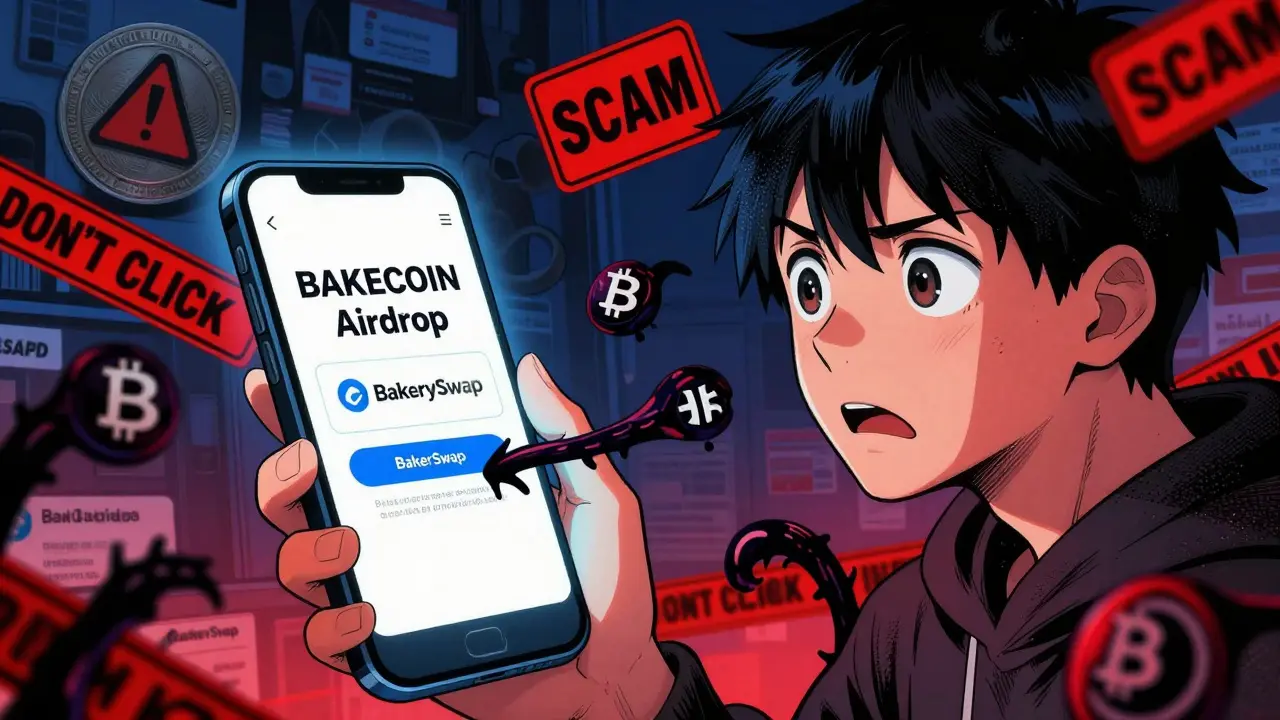
There’s no official BAKECOIN airdrop by Bake Coin - at least not one that’s verified, active, or recognized by credible sources as of January 2026. If you’ve seen ads, Telegram groups, or YouTube videos promising free BAKECOIN tokens, you’re likely being targeted by a scam. The name sounds similar to BAKE, the native token of BakerySwap, but they are not the same thing. Confusing the two is a common tactic used by fraudsters to lure unsuspecting crypto users.
BAKE, short for BakeryToken, is a real token built on the BNB Chain. It’s used for governance, staking, and fees within the BakerySwap ecosystem - a decentralized exchange with NFT trading and yield farming features. BAKE has been around since 2021 and has real utility. Its price has fluctuated based on market conditions, with analysts projecting it could reach $0.60 by late 2026 if adoption grows and new integrations launch. But BAKE has never run a token called BAKECOIN.
So where did BAKECOIN come from? It’s a made-up name. Scammers often create fake tokens with names that sound like popular ones - BAKECOIN, BAKETOKEN, BAKECOIN2026 - hoping you’ll click a link, connect your wallet, and hand over your private keys or ETH/BNB. Once you do, your funds are gone. No recovery. No refund.
How to Spot a Fake Airdrop
Not all airdrops are scams. Legit ones exist - like the ones from Berachain, Kaito AI, or Meteora in 2025. But they follow clear rules:
- They never ask you to send crypto to claim tokens
- They don’t require you to connect your wallet to unknown websites
- They announce details on official channels only: Twitter (X), Discord, or the project’s website - never random Telegram groups
- They use smart contracts that are publicly audited and verifiable on blockchain explorers like BscScan or Etherscan
BAKECOIN does none of this. There’s no official website. No whitepaper. No GitHub. No team members listed. No audit reports. That’s not an oversight - it’s a red flag.
What Real Crypto Airdrops Look Like in 2026
Legit airdrops in 2026 are more structured than ever. Projects use point systems to reward activity. For example:
- You earn points for holding a specific token in your wallet before a snapshot date
- You get bonus points for referring friends who complete tasks
- You unlock eligibility by using a protocol’s swap, liquidity pool, or NFT marketplace
Once the snapshot is taken, tokens are automatically sent to qualifying wallets. No action needed from you beyond holding or using the service. That’s how it works. No upfront payments. No private keys to share.
Compare that to BAKECOIN’s fake claims: “Send 0.1 BNB to claim 10,000 BAKECOIN.” That’s not an airdrop - that’s a trap. The moment you send that BNB, you’re funding the scammer’s wallet. The BAKECOIN tokens you’re promised? They don’t exist. Even if a token appears in your wallet, it’s worthless - no exchange lists it, no wallet supports it, and no one will buy it.
Why People Fall for BAKECOIN Scams
The psychology is simple. Crypto moves fast. People hear “free tokens,” “limited time,” “early access,” and their FOMO kicks in. They don’t check the source. They don’t Google the project. They just click.
Scammers exploit this. They use fake logos that mimic BakerySwap’s branding. They copy-paste blog posts from real sites. They even create fake Twitter accounts with blue checks bought from shady services. One scammer in late 2025 used a fake Bake Coin Discord server with 12,000 members - all of them thinking they were part of a real airdrop. When the scam was exposed, over $3.2 million had been stolen from wallets connected to that server.
Real projects don’t need to trick you. They build trust over time. BakerySwap has been around for years. Its team is public. Its code is open. Its token is listed on major exchanges like Binance and KuCoin. If they wanted to run an airdrop, they’d announce it on their official site and Twitter - not through a random TikTok video.
What You Should Do Instead
If you’re interested in real BAKE token opportunities, here’s what to do:
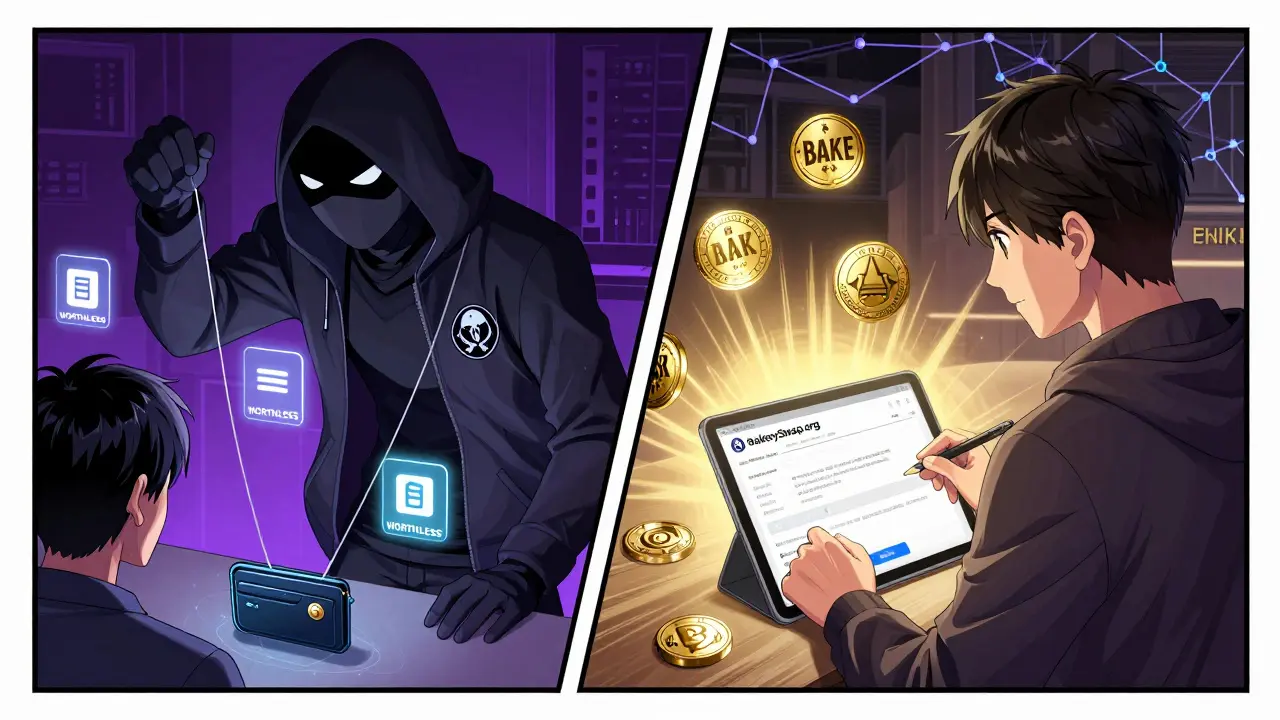
- Go to bakeryswap.org - that’s the only official site
- Check their Twitter (@BakerySwap) for announcements
- Use a non-custodial wallet like MetaMask or Trust Wallet
- Never connect your wallet to a site you didn’t type yourself
- Look for audits from CertiK or PeckShield - real projects get these
If you already sent funds to a BAKECOIN site, stop. Don’t try to “recover” your money by sending more. That’s how scams escalate. Report the site to the BNB Chain fraud team and change your wallet’s private key if you connected it.
How to Stay Safe in 2026’s Airdrop Landscape
Here’s a quick checklist before you even think about joining any airdrop:
- ✅ Is the project on CoinGecko or CoinMarketCap?
- ✅ Is there a live, verifiable smart contract address?
- ✅ Can you find the team’s LinkedIn profiles or real names?
- ✅ Has the project been covered by CoinDesk, Cointelegraph, or Decrypt?
- ❌ Does it ask for your seed phrase or private key?
- ❌ Does it say “claim now” with a countdown timer?
- ❌ Is the website domain misspelled? (e.g., bakecoin.co vs bakeryswap.org)
If even one of the red flags is present - walk away.

What Happens If You Get Scammed?
Unfortunately, crypto transactions are irreversible. Once you send tokens or gas fees to a scam address, there’s no central authority to reverse it. Blockchain doesn’t care who you are. It only follows the code.
Your best move is to:
- Report the scam to the platform where you saw it (Twitter, Telegram, etc.)
- Flag the wallet address on blockchain explorers like BscScan
- Warn others in crypto communities - don’t let them fall for the same trap
- Consider using a hardware wallet like Ledger or Trezor for future holdings
There’s no magic tool to recover lost funds. Prevention is the only real defense.
Final Thoughts
BAKECOIN doesn’t exist as a real project. It’s a name borrowed to steal. The real opportunity lies in BAKE - the actual token behind BakerySwap - and in the next wave of legitimate airdrops from projects like Monad, Hyperliquid, or Eclipse. But those won’t come through shady links. They’ll come through research, patience, and caution.
If you want free tokens, learn how to spot real ones. Don’t chase names that sound familiar. Trust the process, not the promise.
Is BAKECOIN a real cryptocurrency?
No, BAKECOIN is not a real cryptocurrency. There is no official project, team, or blockchain associated with the name. It is a scam name designed to mimic BakeryToken (BAKE), which is a legitimate token on the BNB Chain. Any airdrop claiming to distribute BAKECOIN is fraudulent.
Can I get free BAKE tokens from an airdrop?
BakerySwap has not announced any new BAKE airdrops as of early 2026. Past airdrops were limited to early users and liquidity providers. If you see a current BAKE airdrop, verify it on their official website (bakeryswap.org) or Twitter before participating. Never send crypto to claim tokens.
How do I know if an airdrop is legitimate?
Legit airdrops never ask for your private key, seed phrase, or payment. They announce details on official channels, use audited smart contracts, and list token distribution dates on platforms like CoinGecko. Check for team transparency, community size, and media coverage. If it feels too good to be true, it is.
What’s the difference between BAKE and BAKECOIN?
BAKE is the native token of BakerySwap, a real DeFi platform on BNB Chain with active trading, staking, and NFT features. BAKECOIN is a fake name used by scammers to trick users into connecting wallets or sending funds. There is no BAKECOIN blockchain, token, or team.
Are there any upcoming airdrops in 2026 I should watch?
Yes. Projects like Monad, Hyperliquid, Meteora, and Abstract are expected to launch airdrops in early 2026 based on their testnet activity and community growth. Track them through their official blogs and Twitter accounts. Avoid any project that asks for upfront payments or wallet access without clear documentation.
Charlotte Parker
January 7, 2026 AT 16:58Oh wow, another ‘free crypto’ scam? Shocking. I guess when your financial literacy is as thin as a TikTok ad, you’ll believe anything that glows and says ‘claim now.’ At this point, the only thing more dangerous than a fake airdrop is the person who thinks they’re too smart to get scammed. 🤡
Frank Heili
January 8, 2026 AT 01:38Good breakdown. Just to add - if you see a ‘BAKECOIN’ token on any wallet, check the contract address on BscScan. Legit BAKE is 0xe0c1b8c485706232299f9a483177614e85391a58. Anything else? Trash. Also, real airdrops don’t have countdown timers. That’s like a car salesman yelling ‘LAST CHANCE!’ - it’s not urgency, it’s manipulation.
Mujibur Rahman
January 9, 2026 AT 02:55Let me be blunt - if you're connecting your wallet to some Telegram bot promising BAKECOIN you're not just being scammed you're actively participating in your own financial suicide. The BNB Chain has over 100M transactions a month and 80% of scams are built on name confusion. BAKECOIN? More like BAKE-SCAM. No audit? No team? No GitHub? That’s not a project that’s lazy - it’s a crime scene waiting for victims.
And don’t get me started on the ‘blue check’ fakes. I’ve seen scammers buy verified Twitter accounts for $500 on dark web forums and use them to impersonate BakerySwap. People still fall for it. We’re not in 2017 anymore. Do your due diligence or get left behind.
Dennis Mbuthia
January 10, 2026 AT 15:13Oh my GOD. Are you serious? You people still don’t get it? This isn’t some ‘oops I clicked a link’ thing - this is a WAR. Scammers are running full-on military ops now: fake Discord servers, deepfake videos, AI-generated whitepapers, even fake Reddit threads with bot armies upvoting them. And you? You’re still clicking ‘claim now’ like it’s a free donut coupon. I’m not even mad - I’m just disappointed. America’s crypto literacy is a national embarrassment. You think your ‘degen’ lifestyle is cool? You’re just funding Russian and Nigerian crime rings. Wake up.
Becky Chenier
January 10, 2026 AT 19:56Thanks for the clear breakdown. I’ve seen so many people lose money to these fake airdrops - especially new entrants to crypto. It’s heartbreaking. I always tell them: if it’s too easy, it’s too good to be true. The real rewards come from patience, not panic.
Staci Armezzani
January 10, 2026 AT 23:36Biggest tip I give my students: never trust a link in a DM. Ever. Even if it looks legit. Always type the URL yourself. And if you’re unsure, Google the project name + ‘scam’ - you’ll usually find someone who already got burned. I’ve saved at least 12 people this year just by asking, ‘Did you check the official site?’
Also - if you see ‘BAKECOIN’ on a list of tokens, it’s 100% fake. Real tokens don’t need to be ‘claimed’ with a button. They’re airdropped automatically if you qualify.
sathish kumar
January 11, 2026 AT 05:49It is imperative to underscore that the veracity of any cryptocurrency initiative must be validated through official documentation, audited smart contracts, and transparent governance structures. The absence of these foundational elements unequivocally indicates a fraudulent scheme. The conflation of BAKE and BAKECOIN constitutes a deliberate obfuscation tactic, which exploits cognitive biases prevalent among novice participants in the digital asset ecosystem.
Veronica Mead
January 12, 2026 AT 13:31It is deeply troubling that so many individuals willingly surrender their private keys to strangers on the internet. This is not a ‘mistake.’ This is moral negligence. You are not ‘taking risks’ - you are enabling criminal activity. If you do not take the time to verify a project’s legitimacy, you do not deserve to hold crypto. Your ignorance is not a virtue. It is a liability - to yourself, and to the entire community.
Surendra Chopde
January 12, 2026 AT 17:37Wait - so you're saying BAKECOIN doesn't exist? 😮 I saw a video from a guy with 200k followers saying he got 50k tokens... is that fake too? I thought he was legit. I'm confused now.
Tiffani Frey
January 13, 2026 AT 10:30...I just checked the BscScan address for BAKECOIN. It’s a new contract, deployed 3 days ago. No token name. No decimals. 0 holders. 0 transactions. Just a blank wallet with a 0.01 BNB deposit from a known scam address. I’m not even sure why I’m writing this. But if it helps one person avoid it…
Tre Smith
January 14, 2026 AT 18:42Let’s be honest - the fact that you’re even asking if BAKECOIN is real means you’re already part of the problem. You didn’t research. You didn’t verify. You didn’t even check the domain. You saw a flashy ad, felt FOMO, and clicked. Congratulations. You’re exactly who these scammers target. And now you’re here, whining about it in a forum. Pathetic. The only thing worse than getting scammed is pretending you didn’t deserve it.
Ritu Singh
January 16, 2026 AT 08:56But what if BAKECOIN is a stealth launch by the Fed? I mean… think about it. They’ve been quietly preparing for a crypto crackdown since 2023. What if this is a honey trap? A test to see who’s still holding onto ‘decentralized’ fantasies? Maybe the real airdrop is the one that never happens - the one that exposes the gullible. Maybe we’re all being monitored. Maybe BAKECOIN is a government algorithm. Maybe… it’s all a simulation.
kris serafin
January 17, 2026 AT 08:14Just got this from a friend who got scammed - he sent 0.2 BNB to a ‘BAKECOIN’ site. Lost it all. But here’s the kicker: he didn’t even know what BAKE was. He thought it was a new coin. 😅 So yeah - education > fear. Here’s the real BAKE contract: 0xe0c1b8c485706232299f9a483177614e85391a58. Bookmark it. Share it. Save someone.
And if you see a fake airdrop? Report it. Don’t just scroll past. 🛡️