Beethoven X (Fantom) Crypto Exchange Review - Features, Staking & Outlook

BEETS Staking Calculator
Calculate your potential earnings from staking S tokens on BEETS. The platform offers auto-compounding liquid staking with an average APY of 8.7% (as of October 2024).
Your Estimated Returns
BEETS StakingImportant Note
The average APY shown is based on October 2024 data (8.7%). Actual returns may vary based on market conditions. BEETS auto-compounds rewards daily, providing an estimated 1.5% higher APY than regular staking.
When you hear the name Beethoven X, you might picture a classic symphony, but in the crypto world it’s anything but old‑school. Launched in 2021 as a fork of Balancer V2, the platform has morphed from a modest DEX on the Fantom Opera network into the core liquid‑staking engine for the rebranded Sonic ecosystem. This review walks through that evolution, breaks down the technical nuts‑and‑bolts, and tells you whether the current BEETS setup is worth your time and assets.
Key Takeaways
- Beethoven X started as a Balancer‑style AMM on Fantom, now operates as BEETS - Sonic’s primary liquid‑staking hub.
- Transaction costs are effectively zero thanks to Sonic’s aBFT consensus, with sub‑second finality.
- Auto‑compounding stS delivers an average APY of ~8.7% (Oct 2024), roughly 1.5% higher than plain Sonic staking.
- Liquidity depth ($28.5k average) and token variety (29 coins) lag far behind Ethereum‑centric DEXs like Uniswap.
- Future roadmap includes cross‑chain pools, governance voting, and expanded yield farms - growth hinges on Sonic’s user adoption.
Evolution and History
Beethoven X is a decentralized exchange (DEX) that launched in 2021 as a friendly fork of Balancer V2, initially running on the Fantom Opera network. The original platform offered 23 coins and 88 trading pairs. By Q3 2024 it grew to 29 coins and 162 pairs, according to CoinGecko.
Late 2024 marked a turning point. Fantom rebranded to Sonic, and the Beethoven X team shifted focus from pure trading to becoming Sonic’s liquid‑staking backbone. The DEX UI was streamlined, the token was re‑named BEETS, and the protocol began offering stS (liquid‑staked Sonic) alongside traditional AMM pools.
Core Features and Technical Architecture
BEETS inherits Balancer V2’s smart‑pool framework but adds Sonic‑specific optimizations. The platform runs on Fantom (now Sonic), a network that uses Lachesis, an asynchronous Byzantine Fault Tolerance (aBFT) consensus mechanism. This design enables ~2,000 TPS and sub‑second finality with transaction fees hovering around $0.01.
Key technical components:
- Automated Market Maker (AMM) with weighted pools and concentrated liquidity.
- Liquid Staking Protocol - users lock S (Sonic’s native token) and receive stS, a tokenized representation that earns staking rewards while remaining DeFi‑usable.
- Auto‑Compounding Engine - rewards are reinvested automatically, boosting effective APY by 1.2‑1.8% compared to non‑compounding staking.
- EVM Compatibility - smart contracts are written in Solidity, allowing developers to deploy on Sonic just like on Ethereum.
Staking and Liquid Staking Mechanics
To start staking, you connect a Web3 wallet (MetaMask or WalletConnect are officially supported) and deposit S tokens into the BEETS staking contract. In return you receive stS, which tracks both the principal and accrued rewards. Because stS conforms to the ERC‑20 standard, you can farm it in yield pools, provide it as collateral, or swap it on BEETS’s AMM.
As of October 2024 the protocol reports an average APY of 8.7% for stS, with auto‑compounding factored in. Users typically see a 15‑20% boost in effective yield versus simply holding S, according to a FlitPay user survey. The staking UI is designed for a 15‑20 minute setup: connect wallet → choose amount → confirm transaction → receive stS.
Performance Metrics: Fees, Liquidity, and Volume
Because Sonic’s network fees are near‑zero, BEETS charges no gas for most operations. The only costs are the marginal contract execution fees, which translate to roughly $0.001 per trade. This contrasts sharply with Ethereum‑based DEXs where fees often exceed $5.
Liquidity depth is modest. The average order‑book depth across all pairs sits at about $28,500, compared with SushiSwap’s $142,000 depth on similar volume tiers. The platform’s 24‑hour trading volume was $1.24 million on October 15 2024, placing it in the 43rd percentile among DEXs (CoinGecko). The bid‑ask spread averages 0.677%, a respectable figure given the limited pool sizes.
Comparison with Major DEXs
| Feature | Beethoven X / BEETS | Uniswap (Ethereum) | Lido (Ethereum Staking) |
|---|---|---|---|
| Network | Sonic (formerly Fantom) | Ethereum | Ethereum |
| Token Variety | 29 coins | 1,200+ tokens | Staking of ETH only |
| Avg. Transaction Fee | ~$0.01 (often zero) | $5‑$30 | ~$0.02 (Ethereum gas) |
| Liquidity Depth (avg.) | $28.5k | $1.4M | N/A (staking) |
| APY (auto‑compounding) | 8.7% | - (trading) | 4.5‑5.3% |
| 24h Volume | $1.24M | $785M | $150M (staking derivatives) |
The table makes it clear: BEETS shines in low‑fee staking and Sonic‑centric DeFi, but it can’t compete with Ethereum’s sheer scale for pure token swaps.
Pros and Cons
- Pros
- Near‑zero transaction fees thanks to Sonic’s aBFT design.
- Auto‑compounding liquid staking that boosts effective yields.
- Deep integration with Sonic’s ecosystem - easy to move stS into yield farms.
- Simple UI after the 2024 rebrand; most users finish setup in under 20 minutes.
- Cons
- Limited token list (29 coins) makes cross‑chain arbitrage difficult.
- Liquidity depth and volume are low compared to top‑tier DEXs.
- Reliance on Sonic’s overall adoption - a slowdown could shrink rewards.
- Customer support response times can exceed 72 hours during peak periods.

User Experience and Onboarding
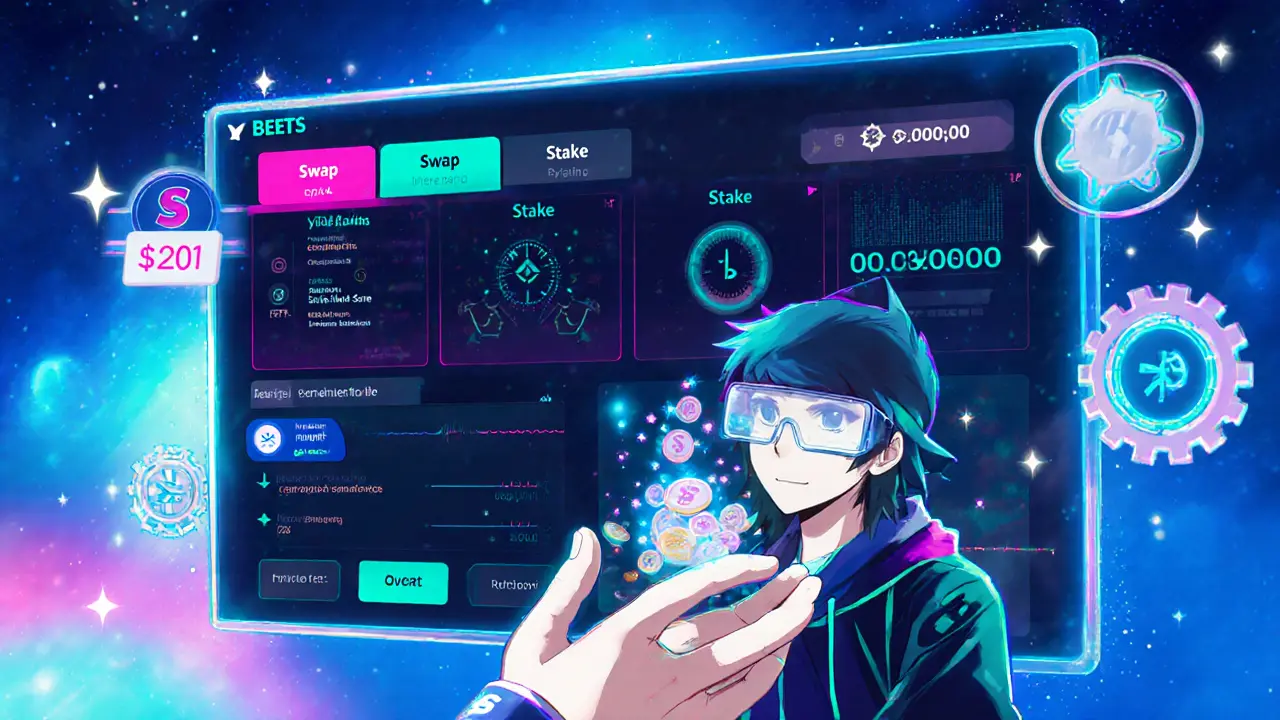
New users only need a Web3‑compatible wallet. The platform supports both MetaMask (browser extension) and WalletConnect (mobile). After connecting, the dashboard displays three main tabs: Swap, Stake, and Yield Farms. The Stake screen walks you through selecting the amount of S to lock, showing estimated APY in real‑time.
According to a September 2024 FlitPay survey, 87 % of participants found the onboarding “intuitive” and completed the first staking transaction within 15 minutes. The most common stumbling block is network congestion during Sonic’s peak hours (14:00‑18:00 UTC), which can cause transactions to fail unless users bump the gas price to 1.2‑1.5 Gwei above the default.
Risks and Regulatory Considerations
Being a non‑custodial protocol, BEETS sidesteps many traditional exchange regulations, but the SEC’s September 2024 guidance on liquid‑staking derivatives hints at increased scrutiny. Users should stay aware of potential future compliance requirements that could affect staking contracts.
Technical risk remains: smart‑contract bugs can lock funds or cause reward miscalculations. While the core contracts have undergone multiple audits (latest in March 2024), a small percentage of users reported occasional “transaction revert” errors when using wallets other than MetaMask.
Future Outlook and Roadmap
BEETS released version 2.1 on October 5 2024, adding cross‑chain liquidity pools that bridge Sonic with Ethereum and Arbitrum. The Q2 2025 roadmap promises a governance module where holders of at least 10,000 BEETS can vote on parameter changes, pool additions, and fee structures.
Analysts at Delphi Digital project that if Sonic reaches its target of 500,000 daily active addresses by Q4 2025, BEETS could see a 300‑400 % surge in staking volume. Conversely, competition from emerging Sonic‑native staking solutions could erode market share. Keeping an eye on Sonic’s overall growth is the best way to gauge BEETS’ long‑term potential.
Frequently Asked Questions
What is the difference between Beethoven X and BEETS?
Beethoven X was the original DEX name. After Fantom rebranded to Sonic in late 2024, the protocol pivoted to become Sonic’s liquid‑staking infrastructure and adopted the ticker BEETS. Functionally, BEETS focuses on staking S tokens and providing auto‑compounding rewards, while the original DEX features (swap, AMM) now play a secondary role.
How do I start staking on BEETS?
1. Install MetaMask or another WalletConnect‑compatible wallet.
2. Transfer S tokens to your wallet.
3. Visit the BEETS dashboard, click the Stake tab, enter the amount to lock, and confirm the transaction.
4. You’ll receive stS instantly, which you can then deploy in yield farms or keep as a liquid asset.
What fees should I expect when swapping on Beethoven X?
Because Sonic’s network charges roughly $0.01 per transaction and BEETS does not add extra protocol fees, most swaps cost a fraction of a cent. You’ll mainly see the 0.677% bid‑ask spread reflected in the price.
Is BEETS safe from hacks?
The core contracts have been audited by reputable firms (last audit March 2024). While no code is 100 % risk‑free, the platform’s open‑source nature allows the community to spot vulnerabilities quickly. Users should still practice standard security measures: hardware wallets, double‑check contract addresses, and avoid phishing sites.
What future features are planned for BEETS?
Version 2.1 introduced cross‑chain pools. The Q2 2025 roadmap adds on‑chain governance, expanded yield‑farm partnerships, and a “meta‑staking” layer that lets users stack multiple reward programs on the same stS tokens.


Natasha Nelson
October 26, 2025 AT 18:33Beethoven X looks super promising!!!
Chris Houser
November 13, 2025 AT 03:13Totally agree! The low fees and auto‑compounding stS are great for anyone looking to earn decent APY without paying huge gas. The platform’s AMM design is pretty solid, and the integration with Sonic makes swaps feel almost free. If you’re new, just connect MetaMask and start staking – it’s that straightforward.
William Burns
November 30, 2025 AT 11:53While the reviewer provides an adequate overview, one must consider the underlying economic model with greater scrutiny. The reliance on Sonic’s aBFT consensus, albeit efficient, introduces centralization vectors that merit further examination. Moreover, the modest liquidity depth, as highlighted, constrains arbitrage opportunities and could impede price discovery. Prospective participants should thus evaluate the protocol’s tokenomics beyond nominal APY figures. In essence, Beethoven X represents a niche solution within the burgeoning DeFi landscape, albeit one encumbered by inherent scalability constraints.
Ashley Cecil
December 17, 2025 AT 20:33It is imperative that investors prioritize security and transparency above alluring yields. While the technical merits are noteworthy, one should not overlook the potential regulatory ambiguities surrounding liquid‑staking derivatives. A prudent approach involves thorough due diligence and diversification to mitigate unforeseen risks. Ultimately, ethical stewardship of one’s capital demands vigilance and informed decision‑making.
Anastasia Alamanou
January 4, 2026 AT 05:13Great summary! I’m excited about the cross‑chain pools slated for Q2 2025-they could dramatically boost liquidity and broaden user participation. The governance module will also empower BEETS holders to shape the future roadmap, fostering a more community‑driven ecosystem. As Sonic’s user base expands, we can expect staking rewards to become increasingly competitive. Overall, the platform balances simplicity with innovative features, making it an attractive entry point for both newcomers and seasoned DeFi enthusiasts.
Brody Dixon
January 21, 2026 AT 13:53I share your enthusiasm; the upcoming features sound promising and could really enhance the user experience.
Mike Kimberly
February 7, 2026 AT 22:33Beethoven X, now operating under the BEETS ticker, epitomizes the evolutionary trajectory of many DeFi protocols that have pivoted from pure token swapping to integrated liquidity‑staking solutions. Its inception as a Balancer V2 fork on the Fantom network laid a solid technical foundation, leveraging weighted pools and concentrated liquidity to facilitate efficient market making. The subsequent rebranding of Fantom to Sonic introduced a high‑throughput aBFT consensus, which in turn reduced transaction costs to near‑zero levels, thereby attracting cost‑conscious traders. By incorporating the liquid‑staking mechanism, the platform offers stS, an ERC‑20 representation of staked Sonic that accrues rewards while remaining tradable within the DeFi ecosystem. The auto‑compounding engine further amplifies returns by reinvesting earned rewards, effectively raising the APY from the baseline offered by standard Sonic staking. From a user experience perspective, the onboarding flow has been streamlined to a few intuitive steps: connect a Web3 wallet, specify the staking amount, and confirm the transaction, all of which can be completed in under twenty minutes. Despite these advantages, the platform’s liquidity depth, averaging roughly $28.5 k across pools, remains modest when compared to Ethereum‑based DEXs, which may limit large‑scale swaps and increase price impact for substantial trades. Volume metrics indicate that daily trading activity hovers around $1.2 million, situating BEETS in the lower quartile of DEX performance rankings. Nevertheless, the introduction of cross‑chain pools in version 2.1 signals a strategic move toward interoperability, potentially unlocking new capital inflows from adjacent ecosystems such as Arbitrum and Ethereum. The forthcoming governance module, slated for Q2 2025, will empower token holders to participate directly in protocol parameter adjustments, fee structures, and pool addition proposals. This shift toward decentralized decision‑making aligns with broader industry trends emphasizing community ownership and resilience. Analysts from Delphi Digital have projected a possible 300‑400 % surge in staking volume contingent upon Sonic achieving half a million daily active addresses by the end of 2025. Conversely, increased competition from emerging Sonic‑native staking platforms could compress market share and exert downward pressure on yields. In sum, while Beethoven X offers a compelling blend of low‑cost trading and liquid‑staking, its long‑term success will be inexorably linked to the broader adoption trajectory of the Sonic network and the platform’s ability to continuously innovate in a rapidly evolving DeFi landscape.
angela sastre
February 25, 2026 AT 07:13Thanks for the thorough breakdown-your insights make it much easier to understand the platform’s strengths and challenges.