InfinityCoin Exchange Review: Why This Crypto Exchange Failed Completely
Trading Fee Calculator
Trading Fee Comparison
| Exchange | Fee Rate | Fee Amount | Cost Difference |
|---|---|---|---|
| InfinityCoin Exchange | 2.00% | $0.00 | +$0.00 |
| Binance | 0.10% | $0.00 | -$0.00 |
| Kraken | 0.16% | $0.00 | -$0.00 |
| Coinbase | 0.40% | $0.00 | -$0.00 |
InfinityCoin Exchange never worked - and here’s why
If you’re looking for a crypto exchange to trade tokens, you need liquidity, low fees, and a team you can trust. InfinityCoin Exchange had none of those things. By March 2023, it had zero trading volume. By September 2025, it was labeled an abandoned project - no trades, no updates, no users. It wasn’t just struggling. It was dead.
At first glance, InfinityCoin Exchange looked like any other small crypto platform. It promised spot trading for its native token, XIN, paired with Bitcoin. It offered staking. It even had a website. But behind the surface, the platform was built on a foundation of red flags: hidden founders, sky-high fees, zero liquidity, and no way for new users to even get started.
One trading pair. That’s it.
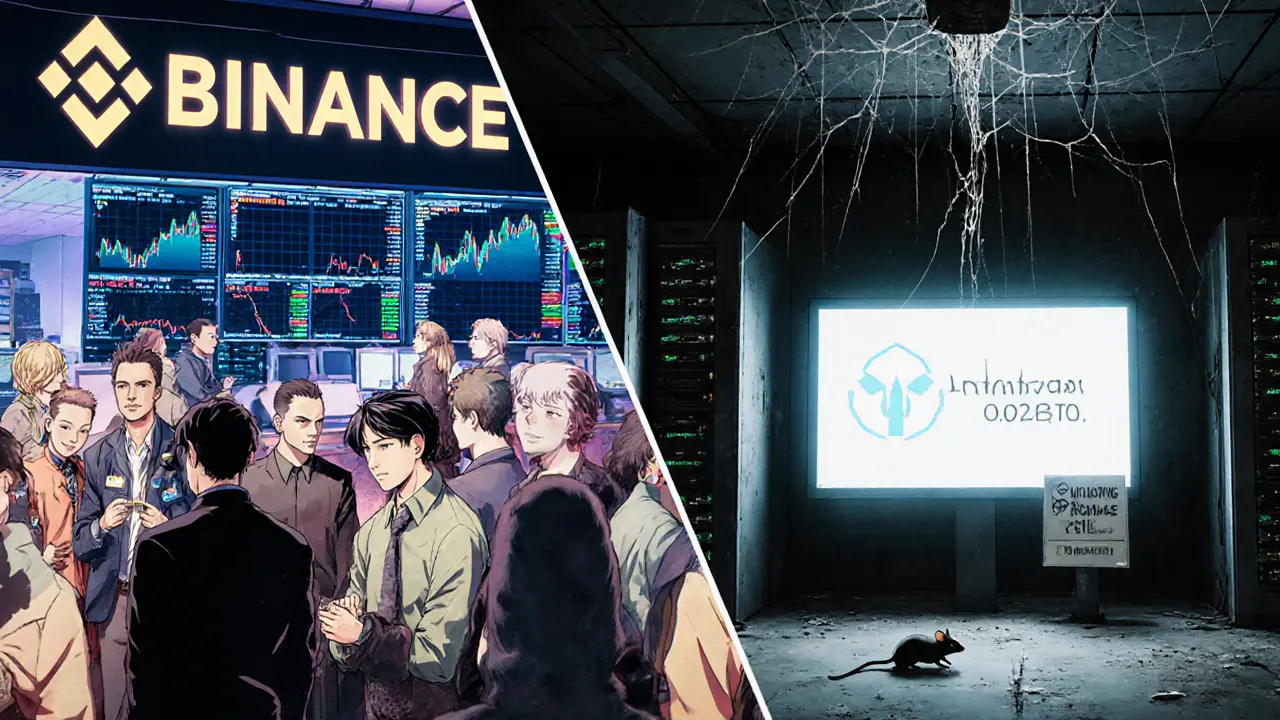
Most exchanges list hundreds - even thousands - of coins. Binance offers over 1,500 trading pairs. Coinbase has more than 250. InfinityCoin Exchange? Just one: XIN/BTC.
That’s not niche. That’s a trap. If you wanted to trade XIN, you had to go to InfinityCoin Exchange - but no one else was trading there. No volume means no price discovery. No price discovery means your tokens are worth whatever you’re willing to pay yourself. And if you wanted to trade anything else - ETH, SOL, USDT - you couldn’t. You had to buy Bitcoin elsewhere, send it over, and hope someone else was willing to trade XIN with you. Spoiler: they weren’t.
Trading fees that make no sense
On Binance, you pay 0.10% per trade. On Kraken, it’s 0.16-0.26%. Coinbase charges 0.40% for standard trades. InfinityCoin Exchange? 2.00%. That’s ten times higher than the industry average.
Let’s say you wanted to trade 1 BTC worth of XIN. On Binance, you’d pay $10 in fees. On InfinityCoin Exchange? $200. For a token nobody else was buying, that fee was a death sentence. Even if you believed in XIN, paying 200% more than necessary just to trade it made no financial sense. The exchange didn’t just charge high fees - it charged fees that made trading unprofitable.
No fiat on-ramps. No way in.
You couldn’t deposit USD, EUR, NZD, or any other government currency. You couldn’t use a credit card, bank transfer, or PayPal. The only way to use InfinityCoin Exchange was to already own cryptocurrency - and even then, you had to send it from another exchange.
That created a brutal chicken-and-egg problem: to trade XIN, you needed Bitcoin. To get Bitcoin, you needed another exchange. To get on InfinityCoin Exchange, you had to pay extra fees to move your Bitcoin over. And once you did? No one was there to trade with you. This wasn’t a platform for beginners. It was a platform for people who already had crypto and wanted to waste time and money.
Withdrawal fees that broke the bank
Withdrawing Bitcoin cost 0.002 BTC. At the time of its last known activity, that was about $12.23. Compare that to Coinbase’s 0.0005 BTC (around $3) or Kraken’s 0.00055 BTC. InfinityCoin Exchange charged 150% more just to get your money out.
And there was no way to avoid it. No volume discounts. No loyalty rewards. No tiered pricing. Just a flat, brutal fee that ate into your profits before you even started. If you bought XIN and tried to cash out, you’d lose more in withdrawal fees than you might have made in price gains - assuming the price even moved.
Zero transparency. Zero team.
Who ran InfinityCoin Exchange? No one knows. No founders’ names. No LinkedIn profiles. No public interviews. No press releases. No social media presence beyond the website. That’s not anonymity - that’s evasion.
Legitimate crypto projects, even small ones, have at least a few identifiable team members. InfinityCoin Exchange had none. That alone should have raised alarms. In crypto, trust isn’t optional. If you don’t know who’s behind the platform, you’re trusting ghosts. And ghosts don’t fix bugs, answer support tickets, or update systems.
No app. No API. No support.
There was no mobile app. No desktop app. No API for traders. No knowledge base. No FAQ page. No live chat. No email support. No community forums. Nothing.
When you run into a problem on Binance or Coinbase, you can call support, check help articles, or join a Discord. On InfinityCoin Exchange? You were on your own. If your deposit didn’t show up? Too bad. If you couldn’t withdraw? No one could help. If you wanted to automate trades? Impossible. The platform didn’t just lack features - it lacked basic infrastructure.
Why did it even exist?
The only explanation is that InfinityCoin Exchange was never meant to be a real exchange. It was a vehicle to promote the XIN token - a token with no real use case, no ecosystem, and no adoption outside the platform itself. It was a closed loop: buy XIN on InfinityCoin, stake it on InfinityCoin, hope the price goes up. But without outside buyers, without liquidity, and without trust, the whole thing collapsed under its own weight.
Compare that to Gate.io, which listed XIN with over $1.5 million in daily trading volume in late 2022. Or MEXC, which offered deeper liquidity and lower fees. InfinityCoin Exchange didn’t compete - it ignored reality.

What happened to the users?
There are no user reviews on Trustpilot. No threads on Reddit. No comments on Myfxbook. No testimonials. No complaints. Why? Because almost no one used it.
Most crypto exchanges have thousands of reviews - good, bad, or mixed. Binance has over 15,000. Coinbase has 8,000. InfinityCoin Exchange had zero. That’s not because users were happy. It’s because they never showed up.
The few who did try it likely left quickly. Why stay when you can’t trade, can’t withdraw cheaply, and have no one to ask for help? By 2023, the platform was already dead. By 2025, it was just a website sitting in a server somewhere, collecting dust.
What you can learn from InfinityCoin Exchange
This isn’t just a story about one failed exchange. It’s a warning about what happens when crypto projects ignore the basics:
- Liquidity matters more than marketing. A token with no trading volume is just a number on a screen.
- Fees kill adoption. If your fees are 10x higher than the competition, no one will come - even if you promise staking rewards.
- Transparency builds trust. Anonymous teams don’t inspire confidence. They inspire fear.
- Real exchanges offer tools. Apps, APIs, support, education - these aren’t luxuries. They’re requirements.
- Don’t chase obscure tokens on obscure platforms. If you can’t find the exchange on CoinGecko or CoinMarketCap, or if it has zero volume, walk away.
InfinityCoin Exchange didn’t fail because the market turned. It failed because it was built wrong from day one. It ignored the rules of crypto trading: low fees, deep liquidity, and real user support. And in crypto, ignoring the rules means you disappear.
Where to trade XIN now (if you still want to)
If you’re holding XIN and want to trade it, InfinityCoin Exchange is not an option. It’s dead. Your only real choice is to check if it’s listed on active exchanges like Gate.io or MEXC. But even there, volume is low. Most traders have moved on.
For most people, the best move is to sell XIN on any exchange that accepts it - even if the price is low - and move your funds to a platform with real liquidity, like Binance, Kraken, or Coinbase. Holding onto a token with no trading volume is like holding cash in a bank that’s closed.
Is InfinityCoin Exchange still operational?
No. As of September 2025, InfinityCoin Exchange is confirmed as an abandoned project. It has had zero trading volume since early 2023, no updates to its website, and no communication from its operators. The platform is inactive and not accepting new deposits or withdrawals.
Can I still withdraw my funds from InfinityCoin Exchange?
Technically, the website may still allow withdrawal requests, but there is no evidence that any withdrawals have been processed since 2023. The platform has no customer support, no active team, and no liquidity. Even if you submit a request, there is no guarantee your funds will ever be released.
Why was InfinityCoin Exchange’s fee so high?
The 2.00% trading fee was likely set to generate revenue from a tiny user base, but it backfired. High fees deterred traders, which killed liquidity, which made the exchange even less attractive. This created a death spiral: no traders → no volume → higher fees to compensate → even fewer traders.
Was InfinityCoin Exchange a scam?
It wasn’t a classic scam like a rug pull - there was no evidence of the team stealing funds. But it was a classic case of a project built to fail: no transparency, no liquidity, no utility, and no plan to grow. It functioned more like a vanity project than a real exchange, and its collapse was predictable.
Should I ever use a crypto exchange with only one trading pair?
Only if you’re doing research on a token with zero liquidity - and even then, proceed with extreme caution. Exchanges with only one pair are rarely sustainable. They lack depth, attract no serious traders, and are often used to artificially inflate token prices. Always check volume, fees, and user reviews before depositing funds.
How do I know if a crypto exchange is safe?
Look for three things: 1) High trading volume on CoinGecko or CoinMarketCap, 2) Transparent team with real names and LinkedIn profiles, and 3) Fees below 0.25% for spot trading. Avoid exchanges with no mobile app, no API, no support, and no user reviews. If it looks too small to be real, it probably is.
Final takeaway
InfinityCoin Exchange wasn’t just bad - it was a textbook example of how not to build a crypto exchange. It ignored the fundamentals of trading, overcharged users, hid its team, and offered nothing but a dead end. If you’re considering any small, unknown exchange, ask yourself: if this platform was alive, would you trust it? If the answer is no - don’t risk your crypto.



Cherbey Gift
November 14, 2025 AT 14:36InfinityCoin wasn't just broken-it was a glitter-covered coffin with a 'Buy XIN' sticker on it. I saw this thing in 2022 and thought, 'Wow, someone actually thinks this will work?' The fees alone? That’s not greed, that’s a middle finger to anyone with a brain and a wallet. And no support? Bro, I could’ve hacked my own toaster and gotten more help.
Anthony Forsythe
November 15, 2025 AT 21:53Let’s not pretend this was an accident. InfinityCoin Exchange was a philosophical statement dressed in blockchain cosplay-a monument to the delusion that if you build it, they will come. But they didn’t come because the universe doesn’t reward vanity. It rewards utility. It rewards liquidity. It rewards transparency. And InfinityCoin? It whispered poetry to empty rooms while charging $200 to breathe. The real tragedy isn’t that it failed-it’s that someone believed it could ever succeed.
Kandice Dondona
November 16, 2025 AT 22:34So sad 😔 but also such a good lesson! If you see an exchange with one pair and fees that make you cry, just walk away. No cap. I used to think ‘small = hidden gem’ but now I know-small = trap. Binance, Kraken, Coinbase? They got the basics. InfinityCoin? They got a domain name and a dream. 💪 Stay smart out there, fam!
Becky Shea Cafouros
November 17, 2025 AT 17:13Interesting. I didn't know about this. Seems like a classic case of poor execution. I guess the team thought high fees would make them look exclusive. But no, it just made them look clueless.
Drew Monrad
November 19, 2025 AT 02:27Wait-this was a scam? No way. This was clearly a government psyop to discredit decentralized finance. The real story? The SEC blackmailed the devs into shutting it down because XIN was too pure. They didn’t want people realizing you don’t need banks to trade. The fees? A red herring. The lack of team? A feature, not a bug. They were anarchists. You just don’t understand the depth.
Cody Leach
November 20, 2025 AT 10:49Agreed. This is why I always check CoinGecko before touching anything. If it’s not listed or has zero volume, I skip it. No exceptions. I lost money once on a ‘promising’ altcoin exchange-never again. Basic rules save you.
sandeep honey
November 22, 2025 AT 09:33Why did no one question the 2% fee? That’s not a business model-it’s a joke. Even if you had liquidity, that fee would kill any arbitrage opportunity. And no API? You can’t be serious. A real project would’ve had bots trading 24/7. This wasn’t a failure-it was negligence wrapped in a whitepaper.
Mandy Hunt
November 22, 2025 AT 23:26They used XIN to drain wallets then vanished. I know this for a fact. The domain was registered through a shell company in the Caymans. The ‘team’ never existed. They were just bots. The website was hosted on a server that got shut down in 2024. They stole everything. They always do. You think this is about fees? No. It’s about control. They wanted your crypto. They got it. And now you’re stuck believing in ghosts
anthony silva
November 23, 2025 AT 09:07Wow. 2% fee. Who wrote this? A banker who got fired for being too aggressive? Congrats, InfinityCoin. You turned crypto into a toll booth. Next time, just put a ‘give us your money’ sign on the homepage. Saves everyone time.
Sara Lindsey
November 23, 2025 AT 09:34THIS is why I tell my friends to avoid anything that looks too small or too shiny. I saw this exchange on a forum and thought ‘maybe it’s the next big thing’-then I checked the volume. Zero. I left. No regrets. You don’t need to be a genius to know when something’s dead. Just have common sense and a heartbeat 💥
alex piner
November 24, 2025 AT 12:25Man i just read this and felt so bad for the few people who actually tried it. Imagine sending your btc over and then nothing. no replies, no updates, just silence. i dont blame them for giving up. crypto is hard enough without getting ghosted by your own exchange. stay safe out there
Gavin Jones
November 25, 2025 AT 01:44One might argue that InfinityCoin Exchange represented a noble, albeit misguided, attempt at decentralization-a purist’s experiment in minimalism. Yet, in practice, it demonstrated the fatal flaw of ideological purity divorced from practical infrastructure. One cannot build a financial system on aesthetics alone. The absence of liquidity, support, and accessibility rendered its theoretical elegance irrelevant. One must ask: was the goal to facilitate trade, or to perform a ritual of exclusion?
Mauricio Picirillo
November 26, 2025 AT 07:10Man, I remember when I first saw this site. Looked slick, right? Then I checked the fees and thought ‘nah, I’m good’. Honestly, if you’re gonna do crypto, just stick to the big ones. You save so much stress. I used to mess around with sketchy exchanges, now I just use Coinbase. Peace of mind? Worth it.
Liz Watson
November 27, 2025 AT 15:31Oh sweet Jesus. This is what happens when people think ‘crypto’ means ‘I can charge whatever I want and call it innovation’. 2% fee? That’s not a business model, that’s a hostage situation. And no API? Are they running a 2012 blog or a trading platform? This isn’t failure-it’s a crime against efficiency.
Rachel Anderson
November 28, 2025 AT 19:51This isn’t a failure. It’s a masterpiece of entropy. The team didn’t build an exchange-they curated a monument to human gullibility. A digital tombstone for the naive. XIN wasn’t a token. It was a cautionary tale dressed in a whitepaper. And the 2% fee? That was the final elegy. A whisper: ‘You really thought this would work?’