Best Spot Trading Strategies for 2025: Proven Methods for Crypto and Stocks

Spot Trading Strategy Finder
Find Your Ideal Trading Strategy
Answer these 3 questions to discover which spot trading strategy aligns with your personality and lifestyle. Based on the article: "Best Spot Trading Strategies for 2025: Proven Methods for Crypto and Stocks"
Spot trading is simple: you buy an asset and own it right away. No futures, no leverage, no expiration dates. You’re not betting on where the price might go-you’re buying the real thing and hoping it goes up. In 2025, with 24/7 crypto markets and AI tools in every trader’s toolkit, spot trading has never been more accessible. But that doesn’t mean it’s easy. The real edge now comes from knowing which strategy fits your life, not just which one looks flashy.
Day Trading: Fast, Demanding, and High-Stakes
Day trading means opening and closing positions within the same day. No overnight risk, no sleepless nights wondering if a tweet tanked your coin. But it demands focus. You’re staring at charts for hours, watching ticks move in seconds. In 2025, platforms like TradingView and ThinkOrSwim give you real-time alerts, AI-powered pattern recognition, and automated volume filters. But all that tech won’t help if you’re trading on emotion. Successful day traders target small moves-0.5% to 2% per trade. They don’t chase big wins. They take 10 small wins and avoid one big loss. Volume spikes, candlestick patterns, and 5-minute chart breakouts are their bread and butter. If you’ve got a full-time job, this isn’t for you. If you can sit in front of a screen for 6+ hours, handle stress like a pro, and stick to a checklist, day trading can work.Swing Trading: The Sweet Spot for Most People
Swing trading is where most serious retail traders land. You hold positions for days or weeks, riding medium-term trends. You’re not glued to your screen. You check charts in the morning and evening. You let the market breathe. In 2025, swing trading has gotten smarter. AI tools scan hundreds of assets and flag consolidation patterns-symmetrical triangles, bull flags, cup-and-handle formations-before they break out. Backtesting lets you see if your strategy would’ve worked over the last 12 months. You don’t need to predict the future. You just need to recognize patterns that have worked before. A typical swing trade might start when Bitcoin pulls back to its 20-day moving average after a strong uptrend. You buy. You set a stop-loss 3% below. You aim for a 6-8% gain. That’s a 1:2 or 1:3 risk-reward ratio. Professionals don’t guess. They measure. They track every trade in a journal. Did you enter on volume? Did the trend hold? Did you stick to your plan?Momentum Trading: Ride the Wave, Don’t Fight It
Momentum trading is simple: buy what’s going up, sell what’s going down. It’s not about fundamentals. It’s about speed. If Ethereum spikes 8% in an hour because of a new exchange listing, momentum traders jump in. They don’t care why. They care that it’s moving. This strategy thrives in volatile markets-especially crypto. News moves prices fast. AI tools now monitor Twitter, Reddit, and news wires in real time, alerting traders to sudden sentiment shifts. But momentum is dangerous. A 10% run can reverse in minutes. That’s why you need tight stops. And you need to exit fast when the momentum fades. The key? Don’t try to catch the top. Don’t try to catch the bottom. Jump on when the trend starts, and get out when it slows. Use RSI above 70 as a warning sign. Watch for declining volume on up-candles. Those are your exit signals.Breakout Trading: Catch the Big Moves
Breakouts are where big profits happen. You wait for an asset to squeeze into a tight range-like a spring being compressed. Then, when it bursts out, you ride it. The most reliable patterns? Ascending triangles, bull flags, and rectangles. They form after strong trends, and they signal continuation. The trick isn’t just entering. It’s knowing which breakouts are real. A fake breakout happens when price spikes above resistance but quickly falls back. Real breakouts come with volume. If the breakout candle has 2x the average volume, that’s a green flag. If volume is weak? You’re being fooled. In 2025, breakout scanners auto-detect these patterns across 50+ assets. But you still have to decide: do you enter on the first breakout? Or wait for a retest? Professionals wait. They let price retest the broken level-now acting as support-and then enter. It’s slower. It’s safer. It’s more profitable.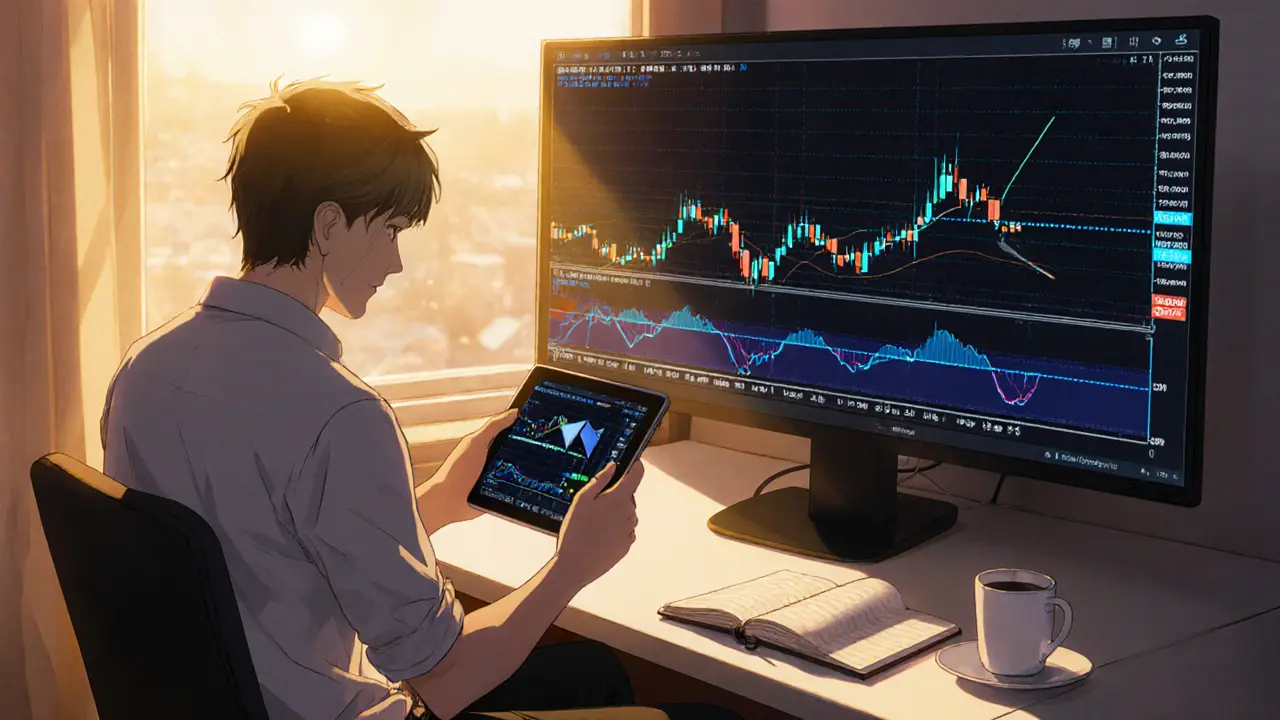
Scalping: For the Hyper-Focused Only
Scalping is the extreme. You make 10-50 trades a day. Each one lasts seconds or minutes. You profit from 0.1% to 0.5% moves. It’s like fishing for minnows while everyone else is hunting for whales. This isn’t for beginners. You need a direct market access (DMA) broker with low fees. You need a fiber-optic internet connection. You need to react faster than your emotions. Most scalpers use Level 2 data and tick charts. They watch order flow-where buyers and sellers are stacking up. The problem? Costs add up. Spreads, commissions, slippage-they eat your tiny profits. And one bad trade can wipe out five good ones. Scalping works only if you’re disciplined, fast, and have a system that wins 60% of the time with a 1:1.5 risk-reward ratio. Most people quit after a month.Trend Following: The Long Game
Trend following is the oldest strategy-and still one of the most powerful. You don’t try to time the top or bottom. You follow the trend until it breaks. If BTC is making higher highs and higher lows, you’re long. When it starts making lower highs, you get out. In 2025, AI filters out noise. Instead of reacting to every 1% dip, your system waits for a confirmed 5% reversal. You use 50-day and 200-day moving averages. You use ADX to measure trend strength. You don’t trade sideways markets. You wait. This strategy is slow. You might wait weeks for a setup. But when it hits, you ride it for weeks. Bitcoin’s 2024 bull run? Trend followers captured 80% of it. They didn’t try to predict it. They just followed it.What Strategy Should You Use?
There’s no “best” strategy. Only the best one for you. - If you have 6+ hours a day and handle stress well → Day trading or scalping.- If you have 30 minutes a day and want steady gains → Swing trading.
- If you’re patient and want to catch big moves → Trend following.
- If you love speed and news-driven markets → Momentum trading.
- If you want to avoid overnight risk → Avoid swing trading. Stick to day trading.

Rules That Separate Pros from Amateurs
Everyone talks about strategy. Pros know it’s about rules.- Never risk more than 1-2% of your account on one trade. If you lose five in a row, you’re still in the game.
- Use stop-losses on every trade. No exceptions. Even if you “feel” it’s going up.
- Only trade with a 1:2 or better risk-reward ratio. If you’re risking $100, aim for $200+ profit.
- Keep a trading journal. Write down why you entered, what you expected, and what happened. Review it weekly.
- Practice first. Paper trade for 3-6 months. Don’t risk real money until you’ve proven you can win consistently.
Tools You Need in 2025
You don’t need expensive software. But you need the right ones.- TradingView - Best charting tool. Free plan works. Pro plan unlocks alerts and backtesting.
- ThinkOrSwim - Powerful for backtesting and scanning patterns.
- CoinGecko or CoinMarketCap - Track on-chain data and market sentiment.
- Telegram bots - Set up alerts for volume spikes or price breaks.
Final Thought: It’s Not About the Strategy. It’s About You.
The market doesn’t care if you’re smart. It doesn’t care if you read every blog. It only cares if you follow your plan. Most traders fail because they chase the next big thing. They switch strategies every month. They blame the market when they lose. The real winners? They pick one strategy. They master it. They stick to it-even when it’s boring. In 2025, the tools are better. The data is faster. The competition is fiercer. But the core hasn’t changed: Control your risk. Stick to your plan. Let the market come to you.What’s the difference between spot trading and futures trading?
Spot trading means buying an asset and owning it right away. You pay the current price and hold the actual coin or stock. Futures trading is a contract to buy or sell an asset at a future date and price. With futures, you don’t own the asset-you’re betting on its price movement, often with leverage. Spot trading has no expiration, no margin calls, and no risk of liquidation. Futures are more complex and riskier.
Can you make money with spot trading in a bear market?
Yes, but it’s harder. Spot trading doesn’t let you profit from falling prices unless you sell and wait to buy back lower. In a bear market, focus on swing trading pullbacks to support levels, or hold stablecoins and wait for the next uptrend. Avoid chasing dead rallies. The best move in a bear market is often doing nothing and preserving capital.
How much money do I need to start spot trading?
You can start with as little as $50-$100 on most platforms. But to make meaningful profits and use proper risk management, $500-$1,000 is a better starting point. The key isn’t how much you start with-it’s how well you manage risk. A $200 account with strict 1% risk rules can grow steadily. A $10,000 account with no stops can vanish in days.
Is AI replacing human traders in spot trading?
Not replacing-augmenting. AI helps you spot patterns faster, filter noise, and backtest strategies. But it doesn’t replace discipline. A trader using AI without a plan will still lose. The best traders use AI as a tool, not a crutch. They still make the final call, manage risk, and stick to their rules. AI gives you an edge-but you still have to play the game right.
How long does it take to become profitable in spot trading?
Most traders take 6-12 months to become consistently profitable. Beginners often lose money in the first 3-6 months while learning. The key is paper trading first, then small real-money trades. Track every trade. Learn from mistakes. Don’t rush. Profitability comes from repetition, not luck.
Should I trade crypto or stocks for spot trading?
Both work. Crypto offers 24/7 trading, higher volatility, and faster moves-great for day and swing traders. Stocks trade only during market hours but are less volatile and often tied to fundamentals. If you like speed and news-driven moves, crypto is better. If you prefer slower, more predictable trends, stocks may suit you. Many traders do both.
Clarice Coelho Marlière Arruda
October 30, 2025 AT 13:27man i just started spot trading last month and i keep forgetting to set stop losses 😅
Alisa Rosner
October 31, 2025 AT 11:50STOP LOSSES ARE NON-NEGOTIABLE!!! 🚨 If you're not using them, you're not trading-you're gambling. I've seen so many people blow up accounts because they "felt" it would bounce back. It won't. Always. Set. The. Stop. Loss. 💪📈
Kirsten McCallum
November 1, 2025 AT 13:37Strategy is irrelevant. The market doesn't care about your checklist. It only cares if you're emotionally stable enough to lose money without crying.
Brian Collett
November 2, 2025 AT 19:18I’ve been swing trading BTC for 8 months now-paper traded for 5 months first. My first real trade was $300, now I’m up 140%. The journal saved me. Writing down why I entered and why I exited? Game changer. Also, don’t trade when you’re tired. I lost $120 in 3 minutes once because I was scrolling TikTok while trading. Don’t be me.
Allison Andrews
November 3, 2025 AT 09:06There’s a deeper truth here: the market is a mirror. It doesn’t reveal opportunities-it reveals your discipline. The strategy is just the language you use to speak to it. If you’re chaotic inside, your trades will be chaotic. If you’re calm, even a simple moving average can make you rich. The tools are just extensions of your inner state.
Henry Gómez Lascarro
November 4, 2025 AT 04:47Everyone talks about AI tools like they’re magic wands. Newsflash: AI doesn’t have skin in the game. It doesn’t feel fear. It doesn’t know what it means to lose your rent money because you trusted a bot that said "BUY." I’ve seen guys with $20k in TradingView alerts lose it all because they didn’t understand volume. AI is a calculator, not a crystal ball. The real edge? Discipline. Patience. And knowing when to walk away. If you think tech is the answer, you’re already losing.
MICHELLE SANTOYO
November 5, 2025 AT 02:43So you’re telling me the secret to trading is... not being a fool? Shocking. I mean, who knew? After 3 years of losing money, I finally realized: I was chasing hype like a dog chasing cars. Now I just sit. Wait. Watch. And when the market moves? I move with it. No alerts. No bots. Just me, my journal, and a cup of coffee. Turns out, the market rewards boredom.
jummy santh
November 6, 2025 AT 01:37As a trader from Nigeria, I appreciate this breakdown. In our markets, leverage is everywhere-and most people lose everything. Spot trading is the only way to survive. I use TradingView with free alerts, and I trade only during Lagos market hours (which overlaps with US evening). I don’t chase pumps. I wait for pullbacks to support. I keep my risk at 1%. I’ve turned $200 into $1,800 in 10 months. It’s slow. It’s quiet. But it’s mine. No drama. No hype. Just consistency.
Wayne Overton
November 7, 2025 AT 14:32you’re all wrong. the real edge is knowing when to quit. not trading. quitting. life is too short for this noise.