Biswap v2 Review: Fees, Risks, and Who Should Use This DEX in 2026
Do you want to trade crypto without handing over your keys to a central company? That is the promise of Biswap v2, a decentralized exchange built on the BNB Chain that lets users swap tokens directly from their wallets using automated market makers instead of traditional order books. It sounds great until you realize there is no customer support hotline if things go wrong. So, is this platform worth your time in 2026, or should you stick to safer, regulated options?
I have looked at the numbers, the risks, and the user experience. Here is what you need to know before connecting your wallet.
The Quick Truth About Biswap v2
- Best for: Experienced DeFi users who want low fees and full control over their assets.
- Avoid if: You are new to crypto, need fiat currency deposits (like USD or EUR), or want regulatory protection.
- Key Risk: No regulatory oversight means no insurance on your funds and limited recourse if smart contracts fail.
- Fee Structure: Standard 0.25% trading fee, which is competitive but higher than some top-tier centralized exchanges.
How Biswap v2 Actually Works
To understand Biswap v2, you first need to forget how traditional stock trading works. There is no middleman matching buyers and sellers here. Instead, the platform uses an Automated Market Maker (AMM) model where users trade against liquidity pools funded by other participants. When you swap a token, you are pulling it from a pool and adding another token to it. The price is determined by a mathematical formula based on the ratio of assets in that pool.
This system runs entirely on smart contracts deployed on the BNB Chain, a blockchain network known for high speed and low transaction costs compared to Ethereum. Because it is decentralized, Biswap does not hold your money. You connect your wallet-usually MetaMask or Trust Wallet-and approve transactions directly. This non-custodial nature is both its biggest strength and its biggest weakness. You own your assets, but you also bear 100% of the risk.
Fees and Costs: What You Really Pay
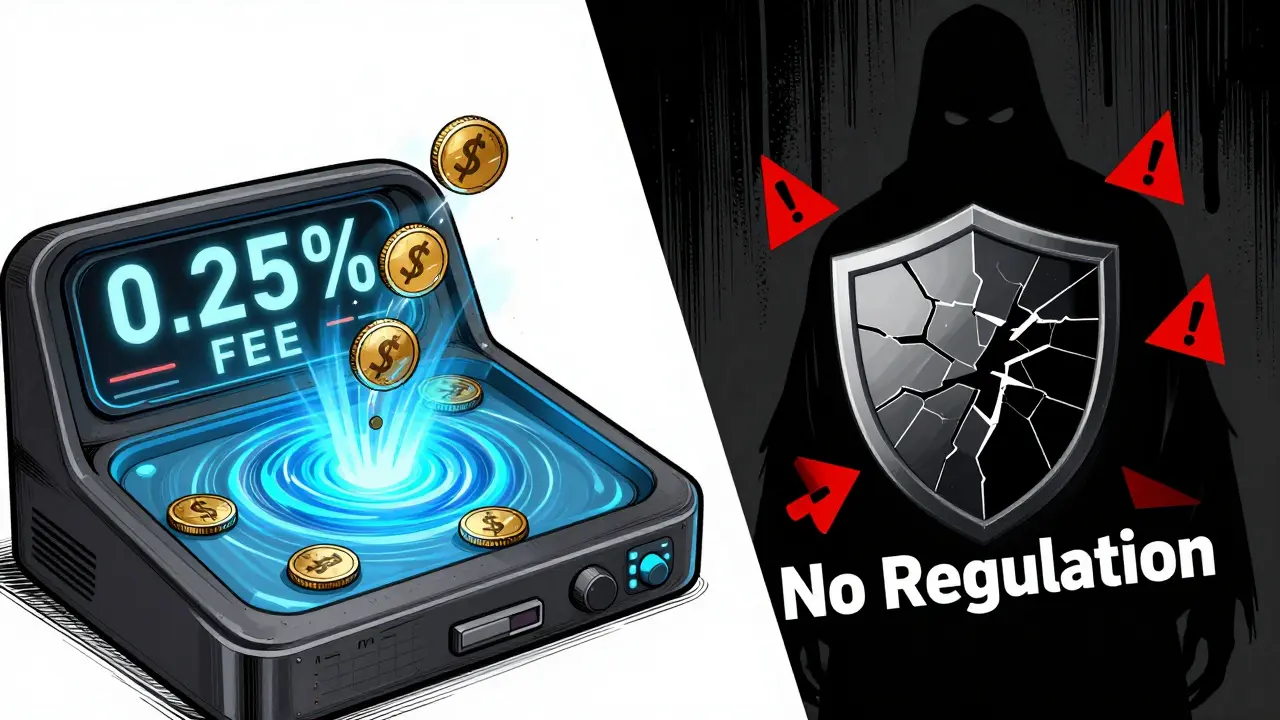
Let’s talk about the money leaving your pocket. Biswap v2 charges a flat 0.25% trading fee on every swap. Here is how that fee gets split:
- 0.17% goes to the liquidity providers-the people funding the pools so you can trade.
- 0.08% goes to the protocol treasury to support development and operations.
Is 0.25% expensive? Compared to centralized giants like Binance or Coinbase, which often charge 0.1% or less for VIP traders, it is slightly higher. However, compared to many smaller DEXs charging 0.3% or more, it is quite reasonable. But remember, this is just the swap fee. You also pay Gas fees, which are network transaction costs paid in BNB. On BNB Chain, these gas fees are usually very low (often under $0.10), making small trades viable. If you were doing this on Ethereum, gas fees could easily eat up your profits.
Safety and Regulation: The Elephant in the Room
Here is the hard truth: Biswap v2 is not regulated by any government authority. According to reviews from platforms like FXVerify, the exchange operates without licenses from bodies like the SEC or European financial regulators. This matters because if the platform gets hacked, or if a smart contract bug drains the liquidity pool, there is no insurance fund to reimburse you. Unlike Bitvavo, a regulated Dutch exchange that holds client funds in segregated accounts and complies with AML laws, Biswap offers zero legal protection.
This lack of regulation also means there is no KYC (Know Your Customer) verification process. You do not need to upload your passport or ID. For privacy advocates, this is a feature. For security-conscious investors, it is a red flag. It makes the platform attractive to those wanting anonymity but risky for institutional investors who require compliance.
Biswap v2 vs. The Competition
You have choices. Why pick Biswap over PancakeSwap, the dominant DEX on BNB Chain, or a centralized exchange like Bitstamp?
| Feature | Biswap v2 | PancakeSwap | Bitvavo (CEX) |
|---|---|---|---|
| Type | Decentralized (DEX) | Decentralized (DEX) | Centralized (CEX) |
| Trading Fee | 0.25% | 0.25% - 1% (varies) | ~0.25% - 0.4% |
| Fiat Support | No | No | Yes (EUR only) |
| Regulation | None | None | Dutch Central Bank (DNB) |
| KYC Required | No | No | Yes |
| User Control | Full (Non-custodial) | Full (Non-custodial) | Limited (Custodial) |
Biswap often tries to differentiate itself by offering lower fees or better yield farming opportunities than PancakeSwap, but PancakeSwap still dominates in terms of liquidity and brand recognition. If you prioritize safety and ease of use, a regulated CEX like Bitvavo is safer, but you give up control of your private keys. Biswap sits in the middle: safer than obscure DEXs, but riskier than established banks or licensed exchanges.

User Experience: Is It Beginner Friendly?
Not really. Connecting to Biswap requires intermediate knowledge. You need to set up a wallet, buy BNB for gas fees, and add the correct RPC settings if you are not using a default provider. The interface is clean, but it lacks the hand-holding you get from apps like Coinbase. There is no "Buy Bitcoin with Credit Card" button. You must already own crypto to start trading.
Support is another weak point. Since there is no central team, you rely on community forums, Telegram groups, or Discord channels. If you make a mistake-like approving a malicious token contract-you cannot call someone to reverse it. The average user needs about 5-10 hours to feel comfortable navigating these tools, compared to 1-3 hours for beginner-friendly centralized platforms.
Who Should Use Biswap v2?
Biswap v2 is not for everyone. It is a tool for specific jobs:
- Yield Farmers: If you want to provide liquidity to earn trading fees and BIS token rewards, Biswap offers competitive APYs.
- Privacy Seekers: If you refuse to undergo KYC checks, Biswap allows anonymous trading.
- DeFi Natives: If you already live in the world of wallets and smart contracts, Biswap provides a fast, low-cost way to swap tokens on BNB Chain.
If you are looking to invest your life savings and want peace of mind, look elsewhere. If you want to experiment with DeFi strategies and understand the risks, Biswap is a solid option.
Is Biswap v2 safe to use?
Biswap v2 is as safe as any decentralized exchange, meaning it relies on smart contract security rather than corporate safeguards. While audits are typically conducted, no code is 100% immune to bugs. The greater risk is user error, such as connecting to phishing sites or approving malicious tokens. Always verify the URL (exchange.biswap.org) and never share your seed phrase.
Can I deposit USD or EUR directly into Biswap?
No. Biswap is a crypto-only platform. You must first buy cryptocurrency (like BNB or USDT) on a centralized exchange that supports fiat deposits, transfer it to your personal wallet, and then swap it on Biswap.
What happens if I lose my wallet password?
If you lose access to your wallet (e.g., MetaMask), you cannot recover your funds through Biswap. There is no customer support to reset passwords. You must keep your seed phrase secure offline. This is the fundamental trade-off of non-custodial finance.
Why choose Biswap over PancakeSwap?
Users might choose Biswap for potentially lower slippage on certain pairs, different yield farming incentives, or simply to diversify their exposure across multiple DEXs. However, PancakeSwap generally has deeper liquidity, meaning fewer price impacts for large trades.
Does Biswap require KYC verification?
No. As a decentralized application, Biswap does not collect personal identity information. You interact solely through your wallet address. This ensures privacy but also means you have no legal recourse if issues arise.
Caique Muniz
May 12, 2026 AT 17:56lol another dex review. just use pancake swap u lazy bum.
Mike S
May 13, 2026 AT 23:51Oh, look at you trying to be a 'DeFi expert' with this basic overview.
You really think people need a tutorial on what an AMM is in 2026? The interface might be clean for your simpleton brain, but let's not pretend Biswap isn't just another copy-paste job of PancakeSwap with slightly different tokenomics. It’s pathetic how much effort you put into explaining that there’s no customer support. That’s not a feature, it’s a lack of business model. You’re basically telling people to jump off a cliff and then writing a guide on how to fall gracefully.
The fee structure is mediocre at best. 0.25% is the industry standard for garbage DEXs. If you can’t offer better yields or lower slippage than the giant next door, why should anyone care? And don’t get me started on the 'privacy' angle. Real privacy doesn’t come from skipping KYC; it comes from not using a blockchain that’s publicly indexed by every surveillance tool known to man. This whole post reeks of desperation for clicks.
robert Whitehead
May 15, 2026 AT 22:23You are fundamentally misunderstanding the purpose of decentralized finance. The absence of regulation is not a bug; it is the entire point. You seem to crave the safety net of centralized exchanges like Bitvavo, which is why you will likely lose everything when they freeze your account due to some arbitrary compliance rule. Biswap offers true sovereignty. If you cannot handle the responsibility of your own keys, you do not deserve to participate in the crypto economy. Stick to your bank accounts where you can beg for refunds. I have been using DeFi since 2020 and never once needed a 'customer support hotline.' Your ignorance is showing.
H F
May 17, 2026 AT 19:59I actually find this perspective quite refreshing! It’s rare to see someone break down the trade-offs so clearly. While I agree that the lack of regulation is scary for beginners, I think for those of us who understand the tech, it’s liberating. The gas fees on BNB Chain are indeed a game-changer compared to Ethereum. I’ve been swapping small amounts daily without worrying about $20 transaction costs. It makes micro-trading viable again!
Michael Berggren
May 19, 2026 AT 09:54This is a solid breakdown 👍 I appreciate the honesty about the learning curve. Most guides try to hide how complex wallet management can be. For anyone new, I’d suggest starting with a hardware wallet like Ledger before connecting to any DEX. The risk of phishing links is real, and losing your seed phrase means game over. No amount of low fees is worth losing your life savings 😬
Kiran CS
May 21, 2026 AT 03:01How utterly tedious. One would assume that by 2026, the concept of an Automated Market Maker would be common knowledge among even the most intellectually challenged participants in this space. To write such a pedestrian analysis suggests a profound lack of sophistication. The comparison table is redundant, as the disparities between a regulated entity and a decentralized protocol are self-evident to anyone with a basic education in economics. Do attempt to elevate your discourse next time.
Bijan Das
May 22, 2026 AT 19:18nah biswap is trash. pancakeswap has more liquidity. stop wasting time.
Ashley Rodriguez
May 23, 2026 AT 19:21i read through all of this and honestly it just seems like a lot of work for something that could go wrong easily i mean sure the fees are low but if you make one mistake like clicking the wrong link or approving a bad contract then its over and there is nobody to help you out which sounds terrifying to me i prefer keeping my money in places where i can call someone if things get weird even if it costs a bit more because peace of mind is worth it to me plus setting up wallets and buying bnb for gas feels like too many steps just to swap tokens
Bridget Coogle
May 25, 2026 AT 17:51it’s okay to feel overwhelmed by all this tech stuff! the world of defi moves fast and it’s easy to get lost in the details. maybe start small and learn at your own pace. safety first always!
Zara Zaman
May 27, 2026 AT 09:16This platform is unregulated and anonymous. That is exactly why it is dangerous. We need strict oversight to protect our citizens from scams and hacks. Allowing these wild west platforms to operate without accountability is a threat to national security and economic stability. Ban them now.
Larry Port
May 29, 2026 AT 04:30I guess it depends on what you value more. If you want convenience and protection, go with a CEX. If you want control and lower fees for frequent trading, DEXs like Biswap make sense. It’s not black and white. I use both depending on the situation. Just be careful with your private keys.