Bitcastle Crypto Exchange Review: Fees, Features, and Red Flags in 2026

When you’re looking for a crypto exchange that charges zero percent fees and lets you trade Bitcoin, forex, and gold all in one place, Bitcastle sounds like a dream. But dreams can be expensive - especially when you’re trading with leverage and the fine print is buried under a mountain of disclaimers.
Bitcastle launched in July 2019 and markets itself as a fast-growing, award-winning platform. It claims to serve millions daily, sponsors a Belgian football team, and offers a $15 welcome bonus. Sounds impressive? Let’s cut through the marketing and see what’s actually going on under the hood.
What Bitcastle Actually Offers
Bitcastle isn’t just a crypto exchange. It’s a hybrid platform that blends crypto trading with traditional financial instruments through MetaTrader 5 (MT5). That means you can trade not just BTC/USDT or ETH/BTC, but also EUR/USD, XAU/USD (gold), and even futures contracts with leverage up to 100x.
This isn’t typical for most crypto-only exchanges like Binance or Kraken. If you’re someone who already trades forex or CFDs and wants to dip into crypto without switching platforms, Bitcastle’s MT5 integration makes sense. But if you’re a crypto-only trader, you’re getting a lot of features you don’t need - and possibly a lot more risk.
The platform supports over 50 cryptocurrencies, including Bitcoin, Ethereum, Solana, and Dogecoin. Trading pairs include crypto-to-crypto and crypto-to-fiat equivalents like BTC/JPY and ETH/USD. You get three chart types and up to 21 timeframes - more than enough for technical traders. But here’s the catch: there’s no public data on order book depth, trade execution speed, or API availability. For a platform claiming to be "fast," that’s a red flag.
The Zero-Fee Claim - Too Good to Be True?
Bitcastle says it charges 0% fees on major cryptocurrencies. That’s a huge selling point. Most exchanges charge 0.1% per trade. On a $10,000 trade, that’s $10 saved. On $100,000? $100. Over time, that adds up.
But here’s what they don’t tell you: the zero-fee offer likely applies only to spot trading on select pairs. When you switch to leveraged trading on MT5 - which is where most users end up - fees reappear in the form of spreads, overnight swap charges, and commissions hidden in the CFD structure. There’s no transparent fee schedule published anywhere on their site. You’re expected to trust them.
Compare that to Binance, which clearly lists maker/taker fees, withdrawal costs, and even offers fee discounts for holding BNB. Bitcastle’s lack of transparency isn’t just inconvenient - it’s risky.
Withdrawals, Bonuses, and the $15 Trap
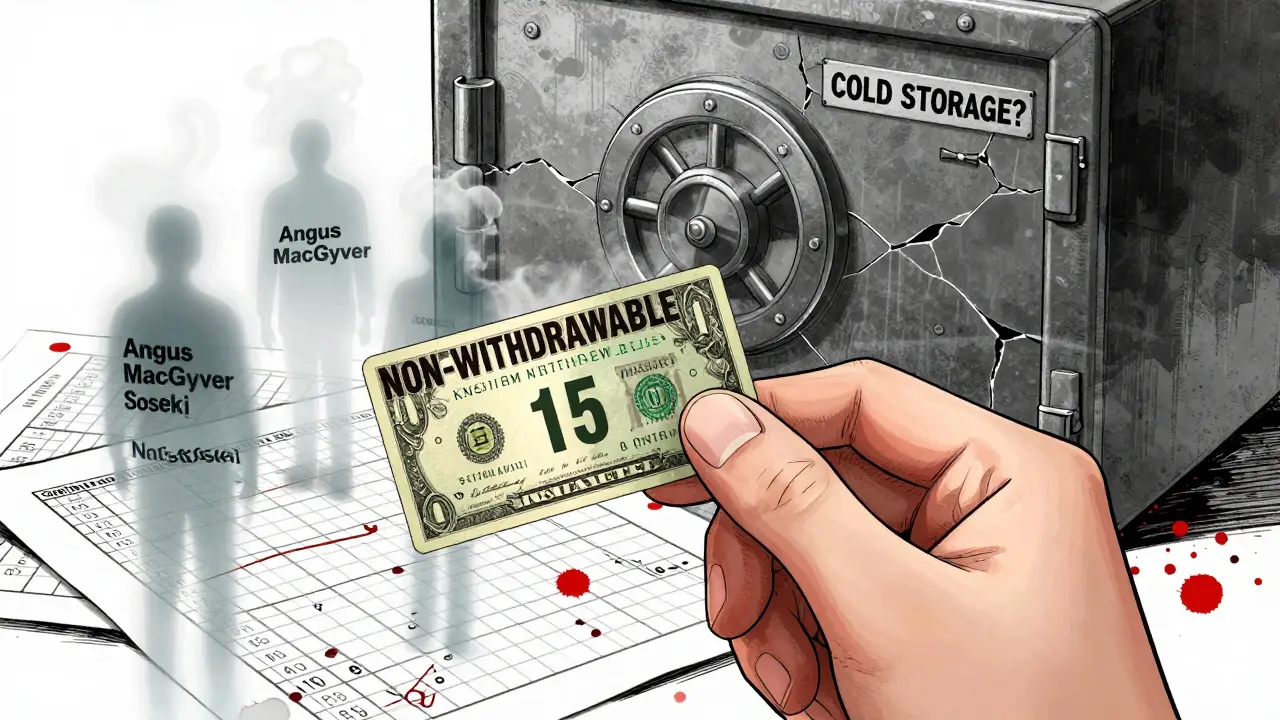
Bitcastle gives you a $15 welcome bonus just for signing up. Sounds great, right? But read the terms. The bonus is non-withdrawable until you meet a trading volume requirement - likely 10 to 20 times the bonus amount. That means if you get $15, you might need to trade $150-$300 before you can touch it. And even then, you might only get to withdraw profits, not the bonus itself.
Some users online say they successfully withdrew bonus profits. But those testimonials are vague. No dates, no trade screenshots, no wallet addresses. Just names like "Angus MacGyver" and "Natsume Soseki" - likely fake or placeholder accounts. Real users don’t post under literary pseudonyms. They post under their real names, with proof.
Withdrawal times are unlisted. There’s no mention of processing delays, KYC bottlenecks, or manual reviews. That’s unusual. Even smaller exchanges like KuCoin or Bybit publish their withdrawal timelines. Bitcastle doesn’t. That’s not confidence - it’s avoidance.
Geographic Restrictions: Who Can’t Use It?
Bitcastle bans users from over 20 countries - including the United States, Russia, China, Iran, Venezuela, and Vietnam. That’s more restrictive than most regulated exchanges. Why? Because it’s not regulated anywhere.
The company is registered in St. Vincent and the Grenadines - a known offshore jurisdiction with minimal financial oversight. No license from the SEC, FCA, ASIC, or any major authority. That’s fine if you’re a small, low-volume platform. But Bitcastle claims millions of users and offers 100x leverage. That’s not a hobby. It’s a high-risk financial service.
If you’re in the U.S., Canada, UK, EU, Australia, or Japan, you’re out of luck. If you’re elsewhere, you’re essentially trading on an unregulated platform with no legal recourse if things go wrong.
Security: No Cold Storage, No Insurance, No Transparency
There’s zero public information about Bitcastle’s security practices. No mention of cold storage. No insurance fund. No multi-sig wallets. No audit reports. No penetration testing results. Nothing.
Compare that to Coinbase, which holds 98% of assets in cold storage and carries crime insurance. Or Kraken, which publishes monthly proof-of-reserves. Bitcastle says nothing. That’s not privacy - it’s secrecy.
They do mention a "Personal Data Inspector" you can email at [email protected]. But that’s for privacy compliance, not asset security. If your coins vanish, you won’t be talking to a security team. You’ll be emailing a customer service bot.
The Atomic Wallet Partnership - A Lifeline or a Distraction?
Bitcastle partners with Atomic Wallet, a third-party multi-currency wallet that supports CASTLE - Bitcastle’s native token - and over 1,000 other coins. Atomic Wallet claims 10 million users and says you can swap coins without registering.
This sounds useful. But here’s the problem: Atomic Wallet is not a regulated exchange. It’s a non-custodial wallet. That means if you lose your private key, your coins are gone forever. And if Bitcastle shuts down tomorrow, Atomic Wallet won’t help you recover your CASTLE tokens.
Using Atomic Wallet with Bitcastle doesn’t make the exchange safer. It just gives you another place to store your coins - and another layer of complexity.

Who Is This Platform For?
Bitcastle isn’t for beginners. It’s not for casual investors. It’s not even for most crypto traders.
The only people who might benefit are:
- Experienced forex or CFD traders who want to add crypto to their MT5 workflow
- Traders in countries with no access to regulated crypto exchanges
- People comfortable with 100x leverage and the risk of losing everything overnight
Everyone else? You’re playing Russian roulette with your crypto. The zero fees look great. The bonus looks sweet. But the lack of transparency, regulation, and security details makes this a high-risk gamble.
Alternatives That Actually Deliver
If you want zero fees on spot trading, try Bybit or KuCoin - both regulated in multiple jurisdictions, with clear fee structures and public audit reports.
If you want MT5 integration with crypto, look at eToro or IC Markets. Both are regulated by ASIC or CySEC, offer transparent leverage limits (usually 30x max for retail), and have real customer support.
Bitcastle doesn’t just fall short on transparency - it ignores the basics of trust in crypto. You don’t need a flashy bonus. You need a platform that answers the hard questions.
Until Bitcastle publishes its security practices, fee schedule, and regulatory status - don’t deposit more than you’re willing to lose.
Is Bitcastle a legitimate crypto exchange?
Bitcastle operates as a crypto and multi-asset trading platform, but it’s not regulated by any major financial authority. It’s registered in St. Vincent and the Grenadines, a jurisdiction known for minimal oversight. While it’s not proven to be a scam, the lack of transparency around security, fees, and regulation makes it a high-risk choice.
Does Bitcastle really charge zero fees?
Bitcastle claims 0% fees on major cryptocurrency spot trades, but this likely applies only to select pairs. When using MetaTrader 5 for leveraged trading (CFDs, forex, gold), fees reappear as spreads, swaps, and commissions. There’s no published fee schedule, so you can’t verify the claim.
Can I withdraw my bonus from Bitcastle?
You can only withdraw profits generated from the $15 welcome bonus, not the bonus itself. To unlock withdrawals, you must meet a high trading volume requirement - often 10-20 times the bonus amount. Many users report difficulty withdrawing even after meeting these conditions, and there’s no public record of successful withdrawals with proof.
Is Bitcastle safe for storing crypto?
No. Bitcastle does not disclose its security practices. There’s no mention of cold storage, insurance, multi-signature wallets, or regular audits. If the platform is hacked or shuts down, your funds may be lost permanently. Always move crypto to a personal wallet you control.
Why is Bitcastle banned in so many countries?
Bitcastle blocks users from the U.S., EU, UK, Canada, Australia, Russia, China, and over 20 other countries because it lacks licenses to operate there. This isn’t a coincidence - it’s a signal that the platform doesn’t meet the legal and compliance standards required in those regions. If a platform can’t get licensed where it’s most profitable, it’s a red flag.
What’s the risk of using 100x leverage on Bitcastle?
100x leverage means a 1% price move against your position wipes out your entire investment. It’s not speculation - it’s gambling. Even professional traders rarely use leverage above 10x. Bitcastle doesn’t warn users enough about this risk. Many retail traders lose everything within minutes using this feature.
Should I use Atomic Wallet with Bitcastle?
Atomic Wallet is a third-party non-custodial wallet. It doesn’t make Bitcastle safer. It just gives you another place to store your CASTLE tokens. If Bitcastle disappears, Atomic Wallet won’t help you recover your funds. Only use it if you understand private key management - and even then, keep the majority of your assets offline.
Final Verdict: Avoid Unless You Know What You’re Doing
Bitcastle isn’t evil. It’s just careless. It offers features that look great on paper - zero fees, MT5 integration, a bonus - but hides the details that matter most: security, regulation, transparency.
If you’re a trader who understands leverage, accepts high risk, and lives in a country where regulated exchanges aren’t available, you might give it a small test deposit. But don’t deposit more than you can afford to lose. And never leave coins on the exchange longer than you need to.
For everyone else? Stick with platforms that answer your questions - not ones that make you wonder if they’re even trying.
Gavin Francis
January 30, 2026 AT 14:38Gary Gately
January 30, 2026 AT 21:03Gareth Fitzjohn
January 31, 2026 AT 23:17Katie Teresi
February 1, 2026 AT 23:40Moray Wallace
February 3, 2026 AT 14:49William Hanson
February 5, 2026 AT 07:00Lori Quarles
February 6, 2026 AT 09:58Steven Dilla
February 6, 2026 AT 15:45josh gander
February 7, 2026 AT 11:36Ramona Langthaler
February 7, 2026 AT 21:32Sunil Srivastva
February 9, 2026 AT 08:52