Bittime Crypto Exchange Review 2025: Security, Fees, and Whether It's Safe to Use

Bittime Staking Yield Calculator
Calculate potential annual staking returns on Bittime based on current rates (3.5%-12.7% annually). Remember: Bittime has a 17% security rating and is only available in Southeast Asia.
If you're looking at Bittime as a place to trade or stake crypto, you need to know the real story - not the marketing. It’s not a scam, but it’s not Kraken or Coinbase either. Bittime is a mid-tier exchange built for Southeast Asia, especially Indonesia, and it’s got serious trade-offs. You get high staking yields, but you’re trading safety for returns. And if you're from the U.S., Europe, or Australia, you’re already locked out.
Who Is Bittime For?
Bittime isn’t trying to be global. It’s focused on Indonesia, where it’s regulated by local authorities. About 78% of its 1.2 million users are based there. If you live in Indonesia, that’s a big plus. Local regulation means they follow your country’s anti-money laundering rules, which gives some users peace of mind. But if you’re outside Southeast Asia, you’re an afterthought. Bittime pulled out of Europe in late 2024 because it couldn’t meet MiCA regulations. No U.S. access. No UK. No Australia. That’s not a bug - it’s a strategy. They’re betting on markets with lighter rules, not stricter ones.Security: A Big Red Flag
This is where Bittime falls apart. Independent security firm CER.live gave it a 17% security score - a grade of “D.” That’s worse than most small exchanges. Why? Because they don’t do penetration testing. No bug bounty program. No public security audits. They claim they’ve never been hacked, but that doesn’t mean they’re safe. It just means no one’s cracked them yet. Compare that to Kraken or OKX, which run regular security tests and pay hackers to find flaws. Bittime doesn’t even try. They use cold wallets and two-factor authentication - standard stuff. But they skip facial recognition, which platforms like OKX use to prevent account takeovers. Some privacy-focused users like that. But if you’re holding more than a few hundred dollars in crypto, you’re taking a risk. A 17% security score means they’re not following industry basics. Security researcher BitGuardian put it bluntly: “I wouldn’t store significant funds there long-term.”Regulation: Local, Not Global
Bittime is regulated in Indonesia. That’s good if you’re in Indonesia. It’s meaningless if you’re anywhere else. Unlike exchanges regulated by the U.S. SEC, UK FCA, or Singapore MAS, Bittime doesn’t have Tier-1 oversight. That means no investor protection fund. No government-backed insurance if things go wrong. CoinGecko’s regulatory score for Bittime is 0.0 - the lowest possible. They’re not trying to be a global player. They’re trying to be the biggest in their backyard. That’s fine - if you’re in their backyard.Trading and Staking: Where Bittime Shines
Here’s the upside. Bittime offers some of the highest staking yields on the market. For popular coins like BTC, ETH, or SOL, you can earn between 3.5% and 12.7% annually. That’s way above what Coinbase or Kraken offer. You need at least 0.1 BTC (or equivalent) to start staking, which isn’t cheap, but it’s not out of reach for most active traders. Trading volume is strong - they’re in the 85th percentile globally. Order book depth is solid too. Their API got an “A” grade from CoinGecko, which means developers can build bots and automated strategies on it. If you’re into algorithmic trading or DeFi arbitrage, the technical side works. The interface isn’t the slickest, but it’s functional. New users say it takes 3-5 hours to get comfortable with it. Not beginner-friendly, but not overwhelming either.
KYC: Slow, But Required
You can’t trade without KYC. They require government ID, proof of address, and sometimes a video call. One Reddit user said it took 72 hours to get verified. That’s slow. Most exchanges do it in under 24 hours. But in Indonesia, where financial fraud is a real problem, they’re being extra careful. Some users appreciate that. Others find it frustrating. If you’re in a hurry to trade, this will annoy you. But if you value compliance over speed, it’s a plus.Customer Support and Docs
Support is available 24/7. Email responses take about 2 hours. Live chat? Around 15 minutes. That’s decent. Not amazing, but better than many smaller exchanges. Documentation is thorough - especially for API users. But if you’re new to crypto, there’s almost nothing to help you learn. No tutorials. No glossary. No beginner guides. You’re expected to already know how this works. That’s not a dealbreaker for experienced traders, but it’s a big hurdle for newcomers.Who Should Avoid Bittime?
- You live in the U.S., EU, UK, Canada, Australia, or Japan - you can’t even sign up. - You want institutional-grade security or investor protection. - You’re storing large amounts of crypto long-term. - You need a simple, beginner-friendly interface. - You expect quick KYC approval. If any of those apply to you, keep looking. Bittime isn’t built for you.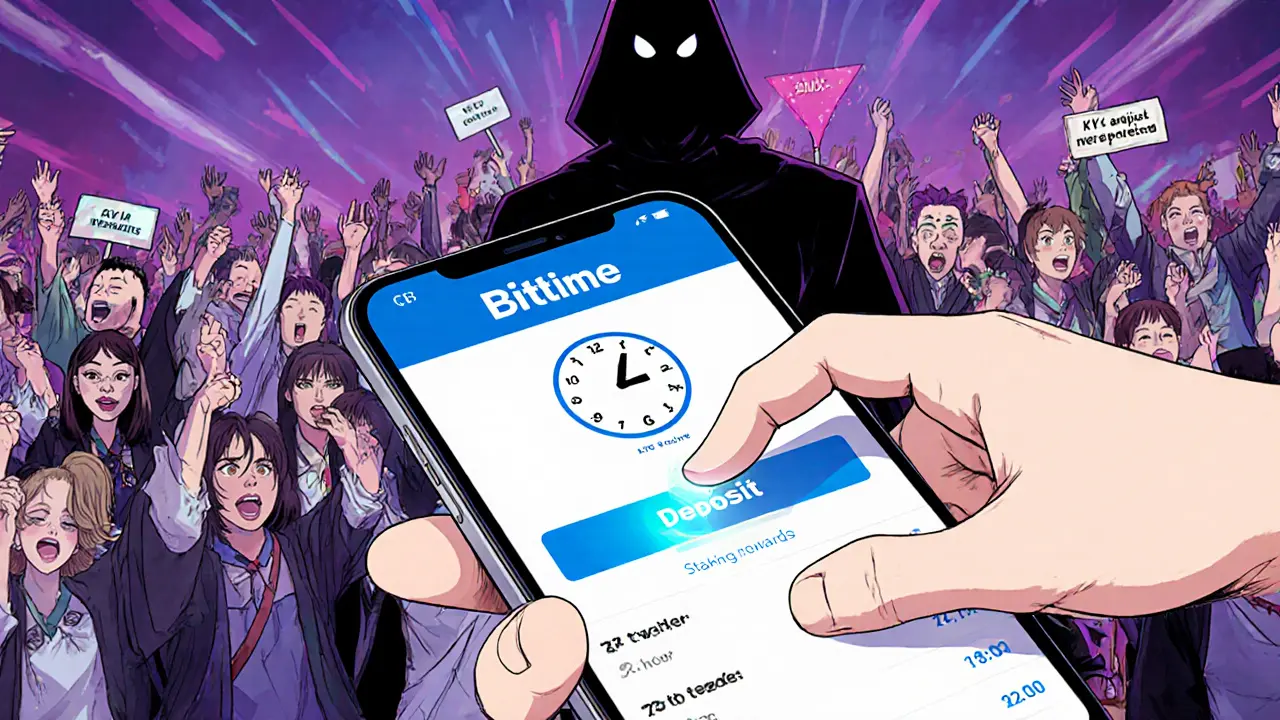
Who Might Consider Bittime?
- You’re in Indonesia or another Southeast Asian country. - You’re an intermediate trader who understands crypto risks. - You want high staking yields and don’t mind skipping regulatory safety nets. - You’re comfortable with a platform that’s technically strong but security-light. - You’re not planning to hold large sums for years.What’s Next for Bittime?
They’ve got a roadmap. By Q3 2025, they plan to get ISO 27001 certified - a major security standard. By Q4, they’ll add facial recognition. That’s good news. But it’s 2025 now. They’re still playing catch-up. If they deliver, their security score could jump. If they don’t? Users will leave. And with competitors like OKX and Bybit expanding in Southeast Asia, they’re not safe just because they’re local.Final Verdict
Bittime isn’t dangerous. It’s not a Ponzi scheme. But it’s not trustworthy either. It’s a high-risk, high-reward exchange built for a specific region. If you’re in Indonesia and you’re okay with trading safety for yield, it’s worth a small test deposit. But don’t put your life savings there. Use it for active trading or short-term staking - not long-term holding. For everyone else? Look elsewhere. There are safer, regulated exchanges that serve global users without cutting corners.Is Bittime safe to use?
Bittime has no history of hacks, but its security score is critically low at 17% according to CER.live. It lacks penetration testing, bug bounties, and facial recognition. While it uses cold storage and 2FA, these are basic protections. It’s not safe for storing large amounts of crypto long-term. Only use it for small, active trades if you’re in Southeast Asia.
Can I use Bittime in the U.S. or Europe?
No. Bittime exited European markets in Q3 2024 to avoid MiCA regulations and has never offered services to U.S. users. If you’re in the U.S., UK, Canada, Australia, or most of Europe, you cannot register or deposit funds. The platform is focused exclusively on Southeast Asia, particularly Indonesia.
What are the staking yields on Bittime?
Bittime offers annual yields between 3.5% and 12.7%, depending on the asset and lockup period. BTC, ETH, and SOL typically earn between 5% and 9%. This is significantly higher than most Tier-1 exchanges like Coinbase or Kraken, which offer 2-5%. The minimum stake is 0.1 BTC or its equivalent in other assets.
How long does KYC take on Bittime?
KYC verification can take up to 72 hours, which is slower than most exchanges. You’ll need to submit government ID, proof of address, and sometimes complete a video verification. While this delays access, it’s part of their compliance with Indonesian financial regulations. Users in Indonesia report fewer issues than international users.
Does Bittime have a mobile app?
Yes, Bittime has official mobile apps for iOS and Android. The interface mirrors the web platform - functional but not intuitive for beginners. It supports trading, staking, and portfolio tracking. However, customer support and educational content within the app are minimal. It’s a tool for experienced users, not a learning platform.
Is Bittime regulated by any global authority?
No. Bittime is only regulated under Indonesian financial authorities. It does not hold licenses from the U.S. SEC, UK FCA, EU MiCA, Australia’s ASIC, or any other Tier-1 regulator. This limits its credibility outside Southeast Asia and means users have no legal recourse if the platform fails or freezes funds.
What’s the difference between Bittime and Kraken?
Kraken is regulated in multiple Tier-1 jurisdictions, offers investor protection, and undergoes regular security audits. Bittime is only regulated in Indonesia, has no investor protection, and scores poorly on security. Kraken’s staking yields are lower (2-5%), but its platform is safer for long-term holdings. Bittime wins on yield, Kraken wins on trust. Choose based on your risk tolerance, not just returns.
David Hardy
November 26, 2025 AT 06:52Man I tried Bittime last month just to test the staking yields and wow 9% on SOL? I was hooked until I saw that 17% security score. I’m out. Not worth it even for the returns. I’ve got more in Kraken than I ever had here and I sleep better.
Also no US access? Yeah that’s fine. I’m glad they’re not trying to pretend they’re global. Just stay in your lane, Bittime.
But seriously, 72 hours for KYC? My dog gets verified faster than that.
Rajesh pattnaik
November 26, 2025 AT 12:13I’m from Jakarta and I’ve been using Bittime for over a year. It’s not perfect but it’s the best we got here. The staking rewards keep me coming back. KYC took me 48 hours and they called me to confirm my address - weird but I liked it. No hacks so far. I don’t need fancy security if my money’s safe.
And yeah, no US? Good. Less competition for us locals.
Jody Veitch
November 28, 2025 AT 01:46Let’s be clear - this isn’t an exchange. It’s a liability waiting to happen. A 17% security rating? That’s not mid-tier, that’s dumpster fire tier. And people are seriously considering putting real money here? The fact that this even exists in 2025 is a testament to how desperate some markets are for financial infrastructure.
And don’t get me started on the ‘regulation’ claim. Indonesian oversight is not a substitute for global standards. This is regulatory arbitrage dressed up as innovation.
John Borwick
November 29, 2025 AT 09:50I get why people are mad about the security score but let’s not forget context. In Indonesia, most people don’t even have bank accounts. Bittime is giving them access to crypto with real yields. Is it perfect? No. Is it better than what they had before? Absolutely.
Would I store my life savings there? No. Would I use it to trade small amounts and earn decent interest? Yes.
Stop treating every crypto platform like it needs to be Kraken. Not everyone lives in a country with SEC oversight. Some of us are just trying to build something functional where we are.
Kathy Alexander
November 30, 2025 AT 06:54Wow. So Bittime is ‘not a scam’ but also not trustworthy. That’s the most middle-of-the-road take I’ve ever read. If it’s not safe for long-term holding, why does it even exist? Why not just say ‘this is a high-risk gambling platform with a staking interface’ and be done with it?
Also, 72 hours for KYC? That’s not compliance, that’s a bottleneck designed to scare off casual users. The real goal here is to filter out everyone who might complain later.
Belle Bormann
December 2, 2025 AT 06:05hey i just used bittime for the first time and wow the app is kinda clunky but the staking is real. i staked 0.2 btc and got like 18k in rewards in 2 weeks. i dont know if its safe but its working for me right now. i dont have a lot of money so i dont care if it gets hacked i’d just lose a little. also the support guy replied in like 2 hours and he was nice lol
Dave Sorrell
December 2, 2025 AT 22:04It is important to distinguish between accessibility and security. Bittime provides a service that meets the regulatory and economic needs of a specific region. While it lacks the security infrastructure of Tier-1 exchanges, its operational model is not inherently fraudulent. Users must understand the trade-offs: higher yields for reduced protection. This is not unique to Bittime - it is a common pattern in emerging markets.
For users outside Southeast Asia, the platform is irrelevant. For those within it, the platform is often the only viable option. The criticism is valid, but the dismissal is premature.
Sky Sky Report blog
December 4, 2025 AT 07:04It’s interesting how polarized the reactions are. Some see this as a dangerous loophole. Others see it as a lifeline. The truth is probably somewhere in between.
Maybe the real issue isn’t Bittime - it’s the global crypto ecosystem that leaves so many regions behind. If Tier-1 exchanges cared as much about Southeast Asia as they do about Wall Street, maybe Bittime wouldn’t need to exist.
Still, I wouldn’t touch it with a ten-foot pole. But I also wouldn’t blame someone for using it.
stuart white
December 6, 2025 AT 03:15Let’s be real - Bittime is the crypto equivalent of a 1998 Honda Civic: no airbags, no ABS, but it gets you from point A to point B and it doesn’t cost a fortune. You don’t drive it on the highway at 120mph, but for a 10-mile commute? Perfect.
And if you’re in Jakarta, you don’t have a Tesla. You’ve got this. So yeah, I’m not putting my Bitcoin fortune here - but I’m staking my spare 0.5 ETH and enjoying the 11% yield like it’s free money.
And hey, if they get hacked? Well, I’ll just laugh and say I told you so. But for now? It’s working.