Cratos (CRTS) Airdrop Details: How It Worked, Who Won, and What Happened After
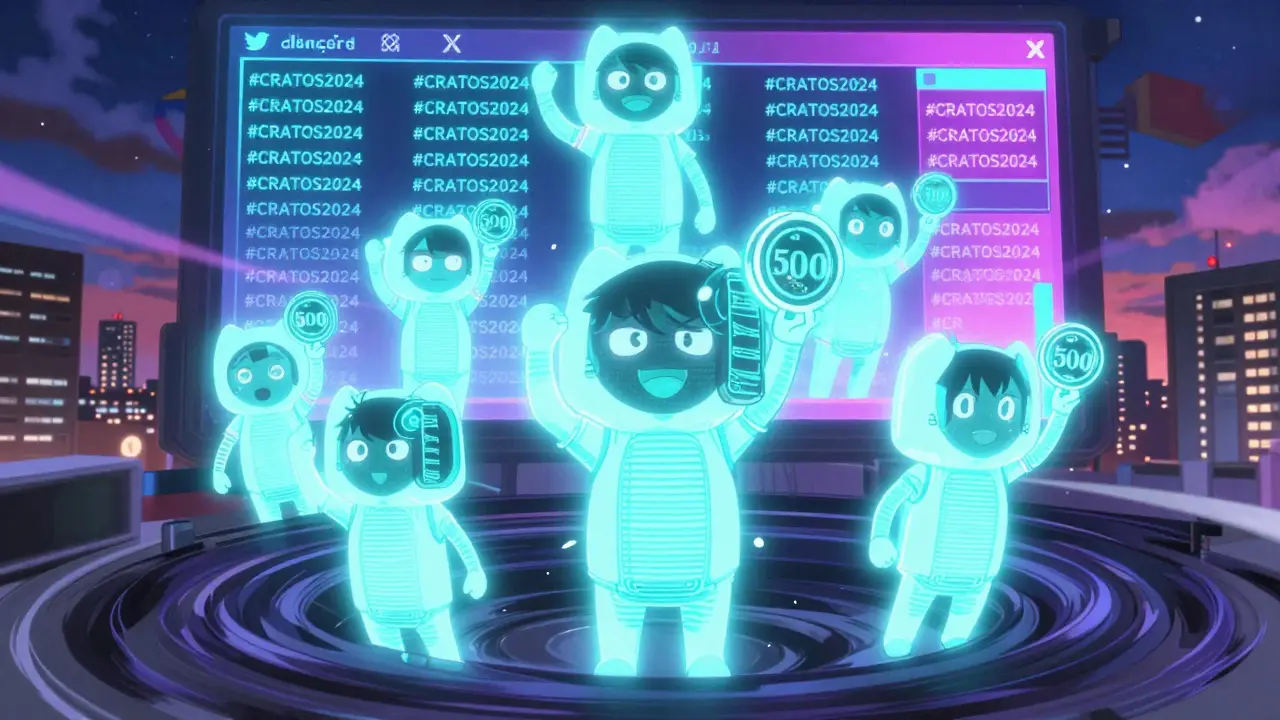
The CRTS airdrop by Cratos was not just another crypto giveaway - it was a carefully timed community push that moved markets. Over a year ago, in July 2024, Cratos distributed exactly 2.5 million CRTS tokens to 5,000 selected participants. Each winner got 500 tokens. That’s it. No complex sign-ups. No KYC. No wallet deposits. Just pure community reward.
At the time, CRTS was trading at around $0.00029888 per token. That meant each winner walked away with roughly $0.15 in value. Sounds small? Maybe. But here’s the catch: the airdrop announcement alone pushed the token’s price up by 37.33% in the days that followed. Trading volume spiked to $29.6 million daily. The market didn’t just react - it roared.
How the Cratos Airdrop Actually Worked
CRTS didn’t use a random draw. It didn’t ask you to hold tokens or stake anything. The selection was based entirely on community activity. If you were active on their Discord, shared posts with #CRATOS2024, or engaged with their Twitter/X threads, you had a shot. There was no public list of criteria, but insiders say they tracked participation over a 30-day window before the cutoff.
The deadline? July 5, 2024, at 8:00 AM UTC+9. That’s Japan Standard Time. Not a coincidence. Cratos was targeting Asian markets - where crypto adoption is high and community-driven campaigns thrive. Winners were chosen from users who showed consistent, organic engagement. Not bots. Not sock puppets. Real people.
Unlike other airdrops that require you to complete 10 tasks across 5 platforms, Cratos kept it simple. Follow. Like. Comment. Share. That’s all. And because of that, they got thousands of genuine participants - not just people hunting for free tokens.
Why 500 Tokens? The Tokenomics Behind the Decision
CRTS had a circulating supply of 62.8 billion tokens. That’s a lot. And with a market cap of $18.7 million, each token was worth less than 0.0003 USD. Why? Because low price = high accessibility.
If they’d given out 5 tokens instead of 500, most people wouldn’t have cared. But 500? That’s enough to feel like a win. Enough to post about it. Enough to convince a friend to join. Cratos understood this. They didn’t need to give away millions in value - they needed to create momentum.
The math was clean: 5,000 winners × 500 tokens = 2.5 million tokens distributed. That’s just 0.004% of the total supply. Minimal inflation. Maximum buzz.
What Happened After the Airdrop?
The price didn’t just spike - it held.
After the July 5 deadline, CRTS didn’t crash. It didn’t fade. It climbed another 18.64% over the next day. Two days later? Up 18.47%. Even after a month, it was still trading 15% higher than pre-airdrop levels. That’s rare. Most airdrops pump once and die. Cratos built something that lasted.
Why? Because the winners didn’t dump. Most held. Many joined the ecosystem. Some started running nodes. Others became moderators on Discord. The airdrop didn’t just hand out tokens - it built a core group of users who cared.
Compare that to other 2024 airdrops. Projects like Ethena or MagicEden gave away millions in value - but their tokens often dropped 70% after the initial hype. Cratos? It didn’t have the funding of Andreessen Horowitz. It didn’t have venture capital backing. It had a community. And that made all the difference.

How Cratos Compared to Other Airdrops in 2024
2024 had 36 major airdrops, according to CoinGecko. Most were either:
- Too complex (do 15 tasks, link 3 wallets, stake for 90 days)
- Too big (distributing hundreds of millions in tokens)
- Too corporate (backed by VC firms with exit plans)
CRTS did the opposite.
It didn’t need a $50 million fundraise. It didn’t need a flashy whitepaper. It just needed people to show up. And they did.
RedotPay, Andrena, and Espresso - all big-name 2025 airdrops - came later with massive funding, multi-phase claim windows, and locked tokens. Cratos was simpler. Faster. More human.
It was a reminder: sometimes, the best way to grow a blockchain project isn’t with venture capital. It’s with a Discord server, a Twitter thread, and 500 tokens.
Is the CRTS Airdrop Still Active?
No. It ended on July 5, 2024. That’s over a year ago.
There’s no way to claim more CRTS from this airdrop. The smart contract is closed. The winners have been paid. The project has moved on.
If you’re looking for current airdrops in 2026, you’ll need to focus on new projects - like RedotPay, Andrena, or Espresso. But the Cratos airdrop still matters. It’s a case study in how to do it right.

What You Can Learn From the Cratos Airdrop
Even if you missed it, the Cratos airdrop teaches you three things:
- Community beats capital. You don’t need millions in funding to build momentum. You need real people.
- Small rewards work better than big ones. 500 tokens at $0.0003 felt valuable. 5 tokens wouldn’t have. 5,000 tokens would’ve been too risky.
- Timing matters. Launching in July 2024, when crypto was warming up, gave Cratos the perfect window to ride the wave.
If you’re planning to join a future airdrop, don’t just chase the biggest names. Look for projects that treat their community like real people - not wallet addresses.
Where Is CRTS Today?
As of March 2026, CRTS is still trading - but quietly. The hype is gone. The price has settled. The token isn’t in the top 100 anymore. But it’s not dead.
The Cratos team still maintains the blockchain. The ecosystem has grown. Wallets are still being used. Nodes are still running. The airdrop wasn’t a one-time stunt. It was the first step in a longer journey.
For the 5,000 winners? Many still hold. Some sold. Others reinvested. But they all remember one thing: they didn’t pay for it. They earned it.
Sharon Tuck
March 9, 2026 AT 04:57Jennifer Pilot
March 9, 2026 AT 23:11Sherry Kirkham
March 10, 2026 AT 01:19Nick Greening
March 11, 2026 AT 07:39Issack Vaid
March 13, 2026 AT 00:02Shawn Warren
March 14, 2026 AT 03:21Jackson Dambz
March 14, 2026 AT 09:59Megan Lutz
March 15, 2026 AT 03:09Jesse VanDerPol
March 15, 2026 AT 10:54jonathan swift
March 16, 2026 AT 19:29Datta Yadav
March 17, 2026 AT 05:31Lydia Meier
March 18, 2026 AT 08:37jay baravkar
March 19, 2026 AT 23:51Ian Thomas
March 21, 2026 AT 13:40