Crypto Regulations in Canada by Province: What You Need to Know in 2026
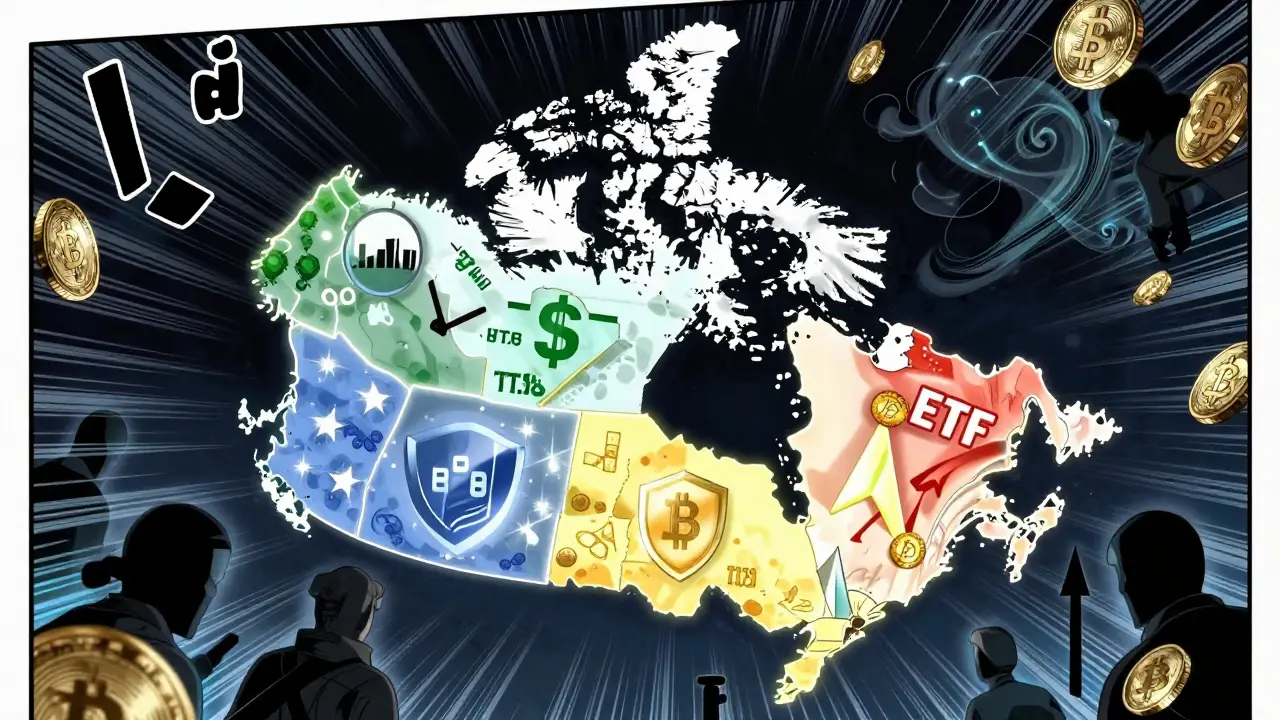
Canada doesn’t have one single rulebook for cryptocurrency - it has 13. That’s right. While the federal government sets some baseline rules, each province has its own say in how crypto businesses operate, how miners use energy, and which trading platforms can serve local customers. If you’re running a crypto business or just holding digital assets in Canada, you can’t treat the country as one big market. You need to know what’s happening in your province - and sometimes, even neighboring ones.
Canada Treats Crypto as Property, Not Cash
At the federal level, Canada classifies cryptocurrency as a commodity, not money. That means every time you sell Bitcoin for CAD, trade Ethereum for Solana, or use Dogecoin to buy a laptop, you trigger a taxable event. The Canada Revenue Agency (CRA) treats these like stock trades: 50% of your capital gain gets added to your income and taxed at your personal rate. So if you bought $1,000 worth of Bitcoin and sold it for $3,000, you’d report a $1,000 gain - and $500 of that gets taxed.
But here’s the good news: you don’t pay tax just for holding crypto. Buying crypto with Canadian dollars? No tax. Transferring crypto between your own wallets? No tax. Receiving crypto as a gift? Also no tax. Only when you dispose of it - sell, trade, or spend - does the CRA come knocking.
Who’s in Charge? Federal vs. Provincial
Two federal agencies lead the charge: FINTRAC and the Canadian Securities Administrators (CSA). FINTRAC handles anti-money laundering. Every crypto exchange, ATM operator, or wallet provider must register as a Money Services Business (MSB) and report suspicious activity. Failure to register? Fines up to $500,000 and possible criminal charges.
The CSA is trickier. It’s not a single regulator - it’s a coalition of provincial securities commissions that coordinate rules. Each province still has final say. That means a platform like Kraken might be approved in Alberta, BC, Manitoba, and Saskatchewan - but not necessarily in Quebec. And if you’re a Canadian investor using a platform not authorized in your province? You’re not protected if things go wrong.
Provincial Breakdown: Where Crypto Gets Real
British Columbia
BC took one of the toughest stances on mining. In December 2022, the government told BC Hydro to pause new mining projects for 18 months. That pause became permanent in May 2024, when amendments to the BC Utilities Commission Act gave the province direct control over electricity supply to miners. Now, BC Hydro can refuse service, limit capacity, or charge higher rates to crypto operations. The message? We won’t let mining drain power from homes or schools.
Quebec
Quebec didn’t ban mining - it priced it. In January 2023, the Régie de l’énergie approved a special rate of 16.603¢/kWh for any mining project using over 50 kilowatts of power. That’s nearly double the average residential rate. The goal? Make mining expensive enough to discourage large-scale operations, while still allowing small-scale hobbyists to run rigs. Quebec also has strict rules on how mining farms connect to the grid - they can’t be connected to residential feeders.
Ontario
Ontario doesn’t regulate mining directly, but its securities regulator - the Ontario Securities Commission (OSC) - is one of the most active in approving crypto trading platforms. As of 2025, the OSC has authorized five major platforms to operate in the province: Kraken, Crypto.com, Newton, NDAX, and Netcoins. If you’re a Canadian investor, using one of these means you’re covered by investor protection rules, including strict custody requirements and regular audits.
Alberta
Alberta’s Securities Commission (ASC) has been more open than most. It approved Kraken and Crypto.com early on, and it’s been quicker than other provinces to update rules for crypto investment funds. The ASC also allows crypto ETFs and publicly traded funds to hold up to 30% of their assets in digital currencies - a higher limit than many U.S. states. But Alberta doesn’t have any special mining rules - energy use is still handled at the federal level.
Manitoba & Saskatchewan
These two provinces follow the CSA’s lead closely. They don’t have their own crypto-specific laws, but they recognize platform authorizations from other provinces. So if Kraken is approved in BC, it can operate in Manitoba without reapplying. This makes them some of the easiest provinces for crypto businesses to enter - but it also means they rely on others to do the heavy lifting on oversight.
Trading Platforms: Not All Are Created Equal
Just because a crypto exchange says it serves Canadians doesn’t mean it’s legal everywhere. The CSA maintains a public list of authorized platforms, and you should always check it before depositing funds. As of 2025, only these platforms have full provincial authorization:
- Kraken (Payward Canada Inc.) - Authorized in Alberta, BC, Manitoba, Saskatchewan
- Crypto.com (Foris DAX CAN ULC) - Authorized across multiple provinces as of May 2025
- Newton Crypto Ltd. - Amended authorization March 2025
- NDAX Canada Inc. - Authorized April 2025
- Netcoins Inc. - Multiple authorizations, last updated October 2023
- Fidelity Digital Assets Services - Operating as an Exempt Marketplace since January 2023
If a platform isn’t on this list, it’s either not registered or operating illegally. That means no investor protection, no audit trail, and no recourse if funds disappear. Stick to the authorized ones - even if they have fewer coins or higher fees.
Mining: Energy Is the New Battleground
Canada used to be a mining hotspot because of cheap hydro power and cold winters. But that’s changing fast. BC and Quebec are leading the charge to limit mining’s energy footprint. Other provinces are watching closely.
Provinces are no longer asking, “How much power are you using?” They’re asking, “Who are you displacing?” If a mining farm uses enough electricity to power 10,000 homes, regulators now assume that’s energy taken from schools, hospitals, or families. That’s why BC and Quebec now require mining operations to prove they’re not competing with essential services.
There’s no national ban - but the trend is clear. Mining is becoming a provincial issue, not a national one. If you’re planning to set up a mining operation, start with your provincial energy regulator - not the federal government.

What’s Coming Next?
Canada isn’t planning a crypto revolution. It’s fine-tuning. In April 2025, the CSA updated National Instrument 81-102 to clarify which crypto assets Public Crypto Asset Funds can hold. Now, funds can invest in Bitcoin, Ethereum, and a few others - but not meme coins, privacy coins, or tokens from unregulated blockchains.
Expect more rules like this. The focus isn’t on banning crypto - it’s on making sure it doesn’t become a tool for fraud, money laundering, or energy waste. The government wants innovation - but only if it’s safe, transparent, and fair.
For investors, that means more protection. For businesses, it means more paperwork. For miners, it means stricter energy rules. And for everyone? It means you can’t assume what’s legal in Toronto is legal in Victoria.
What You Should Do Right Now
- Check if your crypto platform is authorized in your province - visit the CSA’s public register.
- Track your crypto trades. Use a tool that auto-calculates capital gains - don’t rely on exchange statements.
- If you’re a miner, contact your provincial energy regulator before buying equipment.
- Don’t use unregistered platforms, even if they offer better rates. The risk isn’t worth it.
- Stay updated. Provincial rules change often. Subscribe to your provincial securities commission’s newsletter.
Canada’s crypto system isn’t broken - it’s just complicated. But if you know the rules in your province, you’re already ahead of most people.
Shana Brown
March 23, 2026 AT 19:31Marie Mapilar
March 25, 2026 AT 17:24Dominic Taylor
March 27, 2026 AT 06:32Leona Fowler
March 28, 2026 AT 11:09Neil MacLeod
March 29, 2026 AT 08:39Misty Williams
March 30, 2026 AT 08:45Anand Makawana
March 30, 2026 AT 19:16Mohammed Tahseen Shaikh
March 31, 2026 AT 16:47Sarah Terry
April 2, 2026 AT 16:19namrata singh
April 3, 2026 AT 21:12Jenni Moss
April 4, 2026 AT 20:25vu phung
April 6, 2026 AT 14:13Joshua T Berglan
April 8, 2026 AT 06:33Andrew Midwood
April 8, 2026 AT 17:41