FATF Travel Rule Implementation for Crypto Worldwide: Global Status & Impact

Remember when sending money across borders felt like navigating a maze of bank forms? The FATF Travel Rule is bringing that same level of scrutiny to cryptocurrency transactions. If you are moving digital assets between exchanges or platforms, this rule likely affects you. It requires Virtual Asset Service Providers (VASPs) to share sender and receiver details for transactions above certain thresholds. This isn't just red tape; it is a global effort to stop money laundering and terrorism financing in the crypto space.
As of mid-2026, the landscape has shifted dramatically. What started as a vague guideline in 2019 is now a hard requirement in most major economies. But how does this impact your daily trading? Are you safe? Is your data secure? Let's break down what is actually happening worldwide, who is enforcing it, and what you need to do to stay compliant without getting stuck in technical limbo.
What Exactly Is the FATF Travel Rule?
The Financial Action Task Force (FATF) is the global watchdog for anti-money laundering standards. Their Recommendation 16 (R.16), known as the Travel Rule, mandates that when you send virtual assets worth more than a specific amount, the platform you use must collect and pass along your identity information to the receiving platform.
Think of it like wire transfers. When you send dollars internationally, the banks know who sent it and who received it. Before 2019, crypto was different. You could often move Bitcoin or Ethereum with minimal tracking. Now, if you send funds from Exchange A to Exchange B, both platforms must exchange data packets containing:
- Your name
- Your account number or wallet address
- Your physical address, date of birth, or national ID number
This applies to Virtual Asset Service Providers (VASPs), which includes centralized exchanges, custodial wallets, and increasingly, some decentralized finance (DeFi) interfaces. The goal is transparency. Law enforcement needs to trace illicit flows without shutting down legitimate commerce.
Global Implementation: Who Enforces It and How?
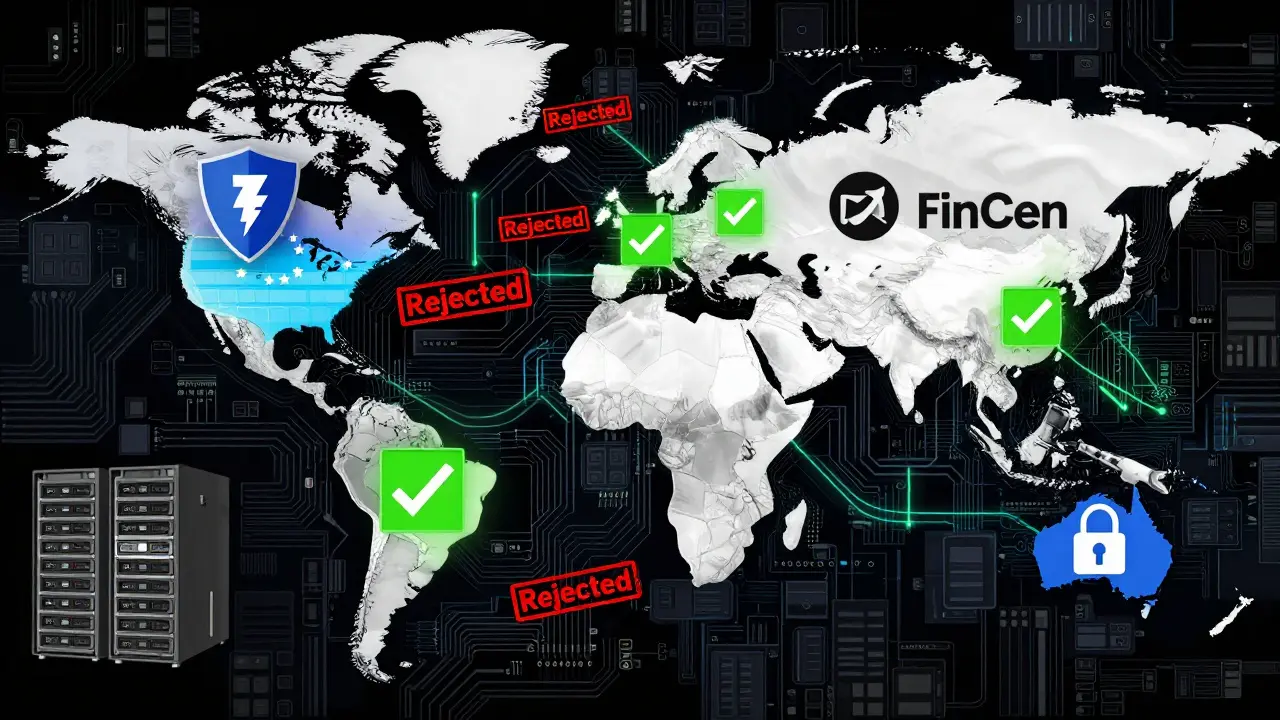
While the FATF sets the standard, individual countries enforce it. This creates a patchwork of rules that can be confusing. Here is where things stand in 2026:
| Region/Country | Threshold | Key Regulator/Framework |
|---|---|---|
| European Union | €1,000 | MiCA / Transfer of Funds Regulation (TFR) |
| United States | $3,000 | FinCEN Guidance / Executive Order 14712 |
| Japan | ¥100,000 (~$700) | JFSA / AML Guidelines |
| United Kingdom | £1,000 | FCA / Transfer of Funds Regulations |
| Australia | AUD 1,000 (~$650) | AUSTRAC |
| South Korea | Real-time monitoring | FSS / Act on Reporting Financial Transactions |
The European Union leads with the most harmonized approach. Under the Markets in Crypto-Assets (MiCA) framework, all 27 member states follow the same €1,000 threshold. This makes cross-border transfers within Europe smoother but stricter. In contrast, the US relies on FinCEN’s $3,000 threshold, but state-level regulations add complexity. If you are using a US-based exchange like Coinbase or Kraken, they are heavily integrated with these systems.
Asia shows diverse approaches. Japan and South Korea have some of the strictest enforcement. South Korea, for instance, mandates real-time monitoring for significant transactions, making it harder to bypass checks. Singapore takes a risk-based approach, focusing less on rigid thresholds and more on the nature of the customer and transaction patterns.
Impact on Users: Delays, Trust, and Privacy
You might wonder: "Does this mean my transfers will take forever?" Not necessarily. Technology has caught up. According to Gartner analyst Avivah Litan, modern compliance solutions add only about 0.8 seconds to transaction processing time, down from 4.2 seconds in 2022. For most users, the experience is seamless.
However, issues arise when platforms don't talk to each other properly. Interoperability is the biggest headache. If you send crypto from a small, non-compliant exchange to a major one like Binance or Kraken, the receiving platform may reject the transaction because they didn't receive the required data packet. This happened to many users in late 2025, leading to frozen funds and support tickets.
On the flip side, trust is increasing. A Q2 2025 survey by Blockchain Market Insights found that 37% more users prefer platforms that display compliance badges, such as Travala's RMA™ Badge. People feel safer knowing their funds aren't going into a black hole. Platforms like Kraken see positive reviews citing "feeling safer with transactions" as a key benefit.
But privacy advocates raise valid concerns. Dr. Richard Turrin argues that overly broad implementation undermines blockchain's privacy benefits. While large transactions are tracked, even smaller ones below the threshold sometimes face unnecessary data collection due to aggressive risk models. If you value anonymity, the era of truly private public-chain transfers is effectively over for regulated entities.

Technical Challenges: How Platforms Comply
For VASPs, implementing the Travel Rule is expensive and complex. A 2025 Deloitte study estimated that medium-sized exchanges spend around $487,000 on initial setup, plus $183,000 annually for maintenance. They need robust infrastructure to:
- Collect accurate customer data during KYC (Know Your Customer) processes.
- Format this data into standardized messages.
- Securely transmit this data to counterparties.
- Store records for audit trails.
The industry has developed protocols to handle this. The Travel Rule Protocol (TRP) is the leading standard, adopted by 63% of compliant VASPs as of late 2025. Other players include INBlox (22%) and proprietary solutions (15%). These protocols act as translators, ensuring that when Platform A sends data to Platform B, it arrives in a readable format.
Decentralized Finance (DeFi) faces unique hurdles. Traditional Travel Rule logic assumes a central operator. But who is responsible for a smart contract? The FATF's June 2025 Targeted Update clarified that "decentralized applications receiving and sending value may be classified as VASPs under certain conditions." This means front-end developers and interface providers might now bear compliance responsibilities, pushing many DeFi projects to integrate identity layers or partner with compliant gateways.
Future Outlook: What Comes Next?
The regulatory net is tightening. By 2027, the FATF aims for 100% implementation among significant markets. We are already seeing specialized reports emerging on stablecoins and offshore VASPs. The next major update in June 2026 will likely expand the list of monitored jurisdictions.
Technology will also evolve. Zero-knowledge proofs (ZKPs) are gaining traction. These cryptographic techniques allow platforms to prove a user is compliant without revealing their full identity data to every counterparty. Gartner predicts ZKP integration could reduce compliance costs by 63% while enhancing privacy. This could be the best of both worlds: security for regulators, privacy for users.
For now, the message is clear: ignore the Travel Rule at your peril. Use reputable, compliant platforms. Keep your KYC documents updated. And expect that as you move larger sums, your identity travels with your crypto.
Does the Travel Rule apply to peer-to-peer (P2P) transactions?
Generally, no. The Travel Rule applies to Virtual Asset Service Providers (VASPs). If you send crypto directly from your personal non-custodial wallet to another person's personal wallet, no intermediary is involved to collect and share data. However, if either party uses an exchange or custodial service to facilitate the transfer, those services must comply. Be cautious with P2P platforms that act as intermediaries, as they may be classified as VASPs depending on local laws.
What happens if I exceed the threshold but my exchange doesn't ask for extra info?
Your exchange should already have your KYC data on file. For existing customers, the Travel Rule data is pulled from their records automatically. If you are a new user or haven't completed full KYC, the exchange will likely block the transaction until you provide the necessary identification. Never assume silence means approval; check your account status before sending large amounts.
Is my personal data safe under the Travel Rule?
Reputable VASPs use encrypted channels to transmit Travel Rule data. However, any system handling personal data carries risk. Choose platforms with strong security track records and clear privacy policies. Look for compliance certifications and avoid obscure exchanges that may not invest in proper data protection infrastructure. Remember, once data is shared, control over its secondary use diminishes.
How does MiCA affect crypto users in Europe?
MiCA creates a unified regulatory framework across the EU. For users, this means consistent rules regardless of which country you are in. The €1,000 threshold is strictly enforced. Cross-border transfers within the EU are smoother due to standardized data formats, but you will notice stricter identity checks compared to pre-MiCA days. Non-EU platforms serving EU customers must also comply or risk being blocked.
Will the Travel Rule kill privacy coins like Monero?
It significantly restricts their usability on regulated platforms. Most major exchanges have delisted privacy coins or suspended deposits/withdrawals for them because they cannot verify the source of funds easily. While you can still hold and trade privacy coins via OTC desks or non-compliant platforms, accessing the broader financial ecosystem becomes much harder. The trend favors transparent assets like Bitcoin and Ethereum.

Crystal Davis
May 31, 2026 AT 14:28You really think the average retail trader gives a damn about 'global effort to stop money laundering'? Please. This is just another layer of bureaucratic friction designed to slow down capital flow and give centralized exchanges more leverage over your keys. The data you're handing over isn't just sitting in a vault; it's being sold, leaked, or subpoenaed within seconds. I've seen enough exchange breaches to know that 'secure transmission' is a marketing buzzword, not a technical guarantee. You are trading privacy for an illusion of safety that doesn't even exist.
Barclay Chantel
June 2, 2026 AT 06:37It is absolutely pathetic how quickly people forget the fundamental purpose of decentralized currency. We built this technology to escape the very surveillance state these regulations seek to impose. Now we have elites in Geneva dictating that every single transaction must be logged, tracked, and reported like some medieval tax collector. It is not 'transparency'; it is totalitarianism wrapped in the language of financial compliance. If you need a government stamp to move your own property, you do not own it. You are merely a custodian for the state.
Miss Masquer
June 4, 2026 AT 04:16I have been following the implementation of MiCA closely across the European markets, and while the harmonization is theoretically appealing for cross-border trade, the practical application has revealed significant discrepancies in how different member states interpret the 'risk-based approach.' For instance, smaller VASPs in Eastern Europe are struggling with the interoperability requirements compared to their larger counterparts in Germany or France, which creates an uneven playing field that ultimately disadvantages the consumer who seeks lower fees but finds themselves blocked by non-compliant counterparties.
Edith Mair
June 4, 2026 AT 22:02So let me get this straight. You are telling me that if I send Bitcoin from my personal wallet to another person's personal wallet, I am safe? But if I use any service that facilitates that transfer, suddenly I am a criminal suspect until proven otherwise? This distinction is arbitrary and dangerous. It forces users into centralized platforms under the guise of legality, effectively killing the peer-to-peer ethos of crypto. Why should the method of transfer dictate my legal standing?
Sam Dashti
June 5, 2026 AT 21:41Man, the irony is thick enough to cut with a knife here. We went from 'code is law' to 'compliance is king' faster than you can say 'rug pull.' I remember when sending ETH felt like magic, now it feels like filing taxes via blockchain. 🤡 But hey, at least the tech guys are busy building zero-knowledge proofs so we can pretend we still have privacy while the regulators nod along. It’s a beautiful dance of deception, really. Who needs actual freedom when you have cryptographic obfuscation approved by the FATF?
Joe Clements
June 6, 2026 AT 22:12I totally understand why everyone is frustrated, but looking at the bright side, having these standards actually makes me feel a lot safer using major exchanges. Knowing that there is a paper trail means if something goes wrong, there is actually someone to hold accountable. It might be annoying to fill out forms, but I’d rather deal with bureaucracy than lose my life savings to a scam ring that vanished into thin air. Trust is hard to build, but easy to break, so maybe this is the growing pain we needed.
Rosie Morris
June 7, 2026 AT 21:49i mean its kinda scary how much info they want right?? like my physical address?? for a digital asset?? i always thought crypto was supposed to be anonymous lol. but then again i got burned last year when an exchange froze my funds cause they didnt talk to each other properly so maybe its worth it? idk just feels like big brother is watching every penny i spend on coffee tokens 😬
lorna erni
June 9, 2026 AT 12:42Stop whining about privacy and start understanding security! You think criminals care about your 'anonymity'? They exploit the lack of regulation to launder billions. This rule stops them. If you have nothing to hide, you have nothing to fear. The fact that you are complaining about sharing your name with a bank-level institution shows how little you understand the real-world implications of unregulated finance. Get used to it or go back to cash under your mattress!
Debbie Lewis
June 10, 2026 AT 16:51Just observing from the sidelines. The tech seems to work fine for most people, but the small exchanges are definitely suffering. I noticed my local platform started rejecting transfers from overseas because their TRP integration is outdated. It’s not a conspiracy, just bad business practices meeting new rules. Boring, but true.
Eric Grosso
June 12, 2026 AT 09:37so does this mean if i use a non-custodial wallet im good? or do they gonna come after devs next? reading between the lines it sounds like they are trying to squeeze defi too which is wild. also the cost for exchanges to comply is insane like half a million bucks?? no wonder fees are going up lol
saradee dee
June 12, 2026 AT 10:05Oh my goodness, this is such a dramatic shift in our financial landscape! It feels like we are moving from the Wild West to a strict library where everyone must show ID to borrow a book. While I appreciate the order, I worry about the loss of spontaneity in transactions. However, knowing that my friends in Europe can now trade with less fear of frozen accounts is quite comforting. Let us hope the technology evolves fast enough to keep our data safe!
Craig Swanson
June 13, 2026 AT 16:34Listen up, folks. If you are running a DeFi front-end, you better wake up and smell the coffee. The FATF update in June 2025 made it crystal clear: you are likely a VASP now. Stop hiding behind 'decentralized' excuses. Integrate identity layers or partner with compliant gateways, or you will get shut down. It is not a suggestion; it is survival. Help your community by educating them on KYC requirements before they get locked out of their own funds.
Bill Gunn
June 15, 2026 AT 08:53Hey team! 👋 Just wanted to chime in on the ZKP part. Zero-Knowledge Proofs are genuinely exciting tech 🚀. Imagine proving you are over 18 without showing your birthdate, or proving you aren't sanctioned without revealing your full IP history. It’s the holy grail for privacy advocates. Companies like Aztec Network are already experimenting with this. Don’t lose hope; the tech is catching up to the regs! 💻✨ #CryptoFuture #PrivacyMatters
Dana Rapoport
June 15, 2026 AT 14:01The philosophical implication here is profound. We are redefining what ownership means in a digital age. Is it the ability to possess, or the ability to transact without permission? As we integrate these systems, we must ask ourselves if we are building a tool for liberation or a cage for control. The silence of the majority often speaks louder than the complaints of the few. Proceed with caution.