Future of Tokenomics Design: How Blockchain Economies Are Evolving in 2026
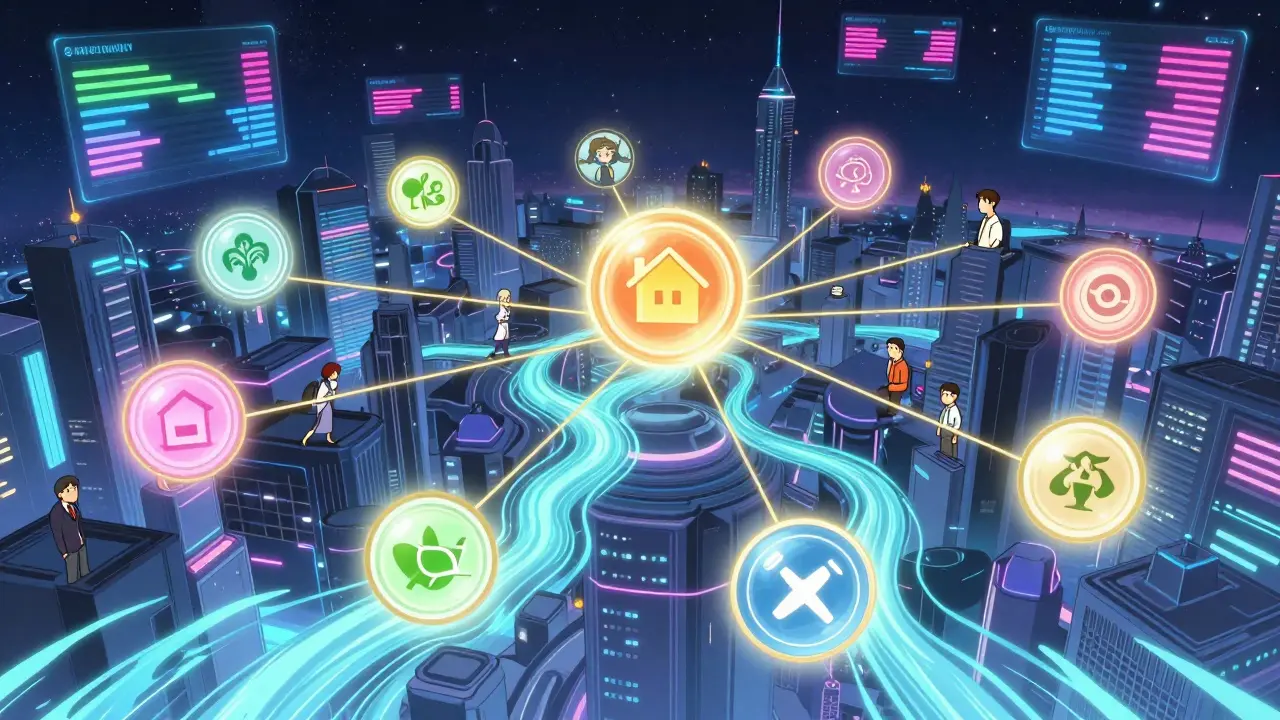
Tokenomics used to be simple: mint a token, set a supply, hype it up, and hope the price goes up. That era is over. By 2026, tokenomics design has become the backbone of sustainable blockchain projects-not just a marketing gimmick. The most successful projects now build economic systems that generate real value, not just speculation. They’re not just about selling tokens; they’re about creating ecosystems where users, developers, and investors all have aligned incentives to grow the network over time.
From Speculation to Sustainable Utility
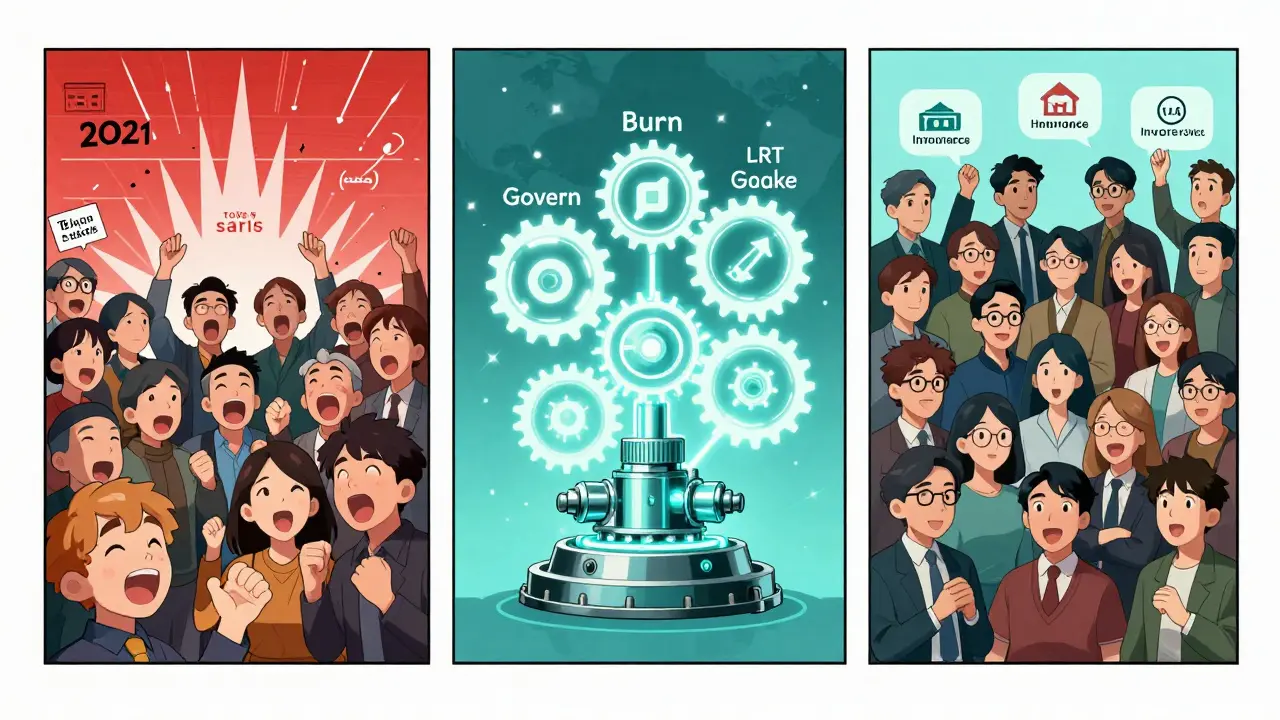
In 2021, a lot of tokens had no clear purpose. They existed because someone thought they could raise money fast. Today, that’s not enough. Investors and regulators alike are asking: what does this token actually do? The answer now must be concrete. Tokens are being designed to serve as access keys, voting rights, revenue shares, or even digital ownership certificates for real-world assets like real estate, art, or carbon credits.Take the $1.5 trillion projected market for tokenized real-world assets by 2030. That’s not a fantasy-it’s already happening. A property in Wellington, for example, can now be split into 10,000 digital tokens. Each token represents a fraction of ownership. Rent flows automatically to token holders. Taxes are paid via smart contract. No middlemen. No paperwork. This isn’t just crypto; it’s finance rebuilt from the ground up. And the token isn’t just a speculative asset-it’s a legal and functional claim.
Regulation Isn’t the Enemy-It’s the Foundation
Remember when people said regulation would kill crypto? It’s doing the opposite. The EU’s MiCA regulation and stricter SEC oversight have forced projects to clean up their act. Now, the best token designs include compliance built in from day one. That means KYC for certain token functions, transparent audit trails, and clear definitions of what rights the token grants.Projects that ignore this are dying. Those that embrace it are gaining trust. A token that can prove it follows legal standards isn’t just safer-it’s more valuable. Institutional investors won’t touch a project that looks like a gamble. But they’ll pour money into one that looks like a regulated financial product with blockchain efficiency. The future belongs to projects that treat compliance as a feature, not a bug.
Multi-Mechanism Tokenomics: More Than Just Staking
The old model was: stake your tokens, earn rewards, wait for the price to rise. Too simple. Today’s top tokenomics use multiple interacting systems to keep the economy balanced.- Transaction fees are partially burned to reduce supply.
- Staking rewards are adjusted dynamically based on network usage.
- Soft rebasing mechanisms gently expand or contract supply to maintain price stability.
- DAO governance tokens give holders voting power on protocol upgrades.
These aren’t random features. They’re carefully tuned parts of a single system. Think of it like a car engine: if you only have a gas pedal, you’ll crash. But if you have brakes, gears, and a fuel injection system-all working together-you can drive smoothly for miles. Projects like Uniswap and Aave have already shown how this works. Their tokens aren’t just for trading; they’re for governing, securing, and earning from the network itself.

DAOs and DeFi: The New Financial Engine
Decentralized Autonomous Organizations (DAOs) are no longer just voting forums. They’re becoming financial hubs. Why? Because they’re now deeply integrated with DeFi protocols.Here’s how it works: a DAO token isn’t just used to vote on proposals. You can also stake it in a lending protocol like Aave to earn interest. Or deposit it into a liquidity pool on Curve to earn trading fees. Some DAOs even issue their own stablecoins, backed by their native tokens. This creates a loop: the more people use the DAO, the more valuable its token becomes-and the more people want to hold it.
This convergence is turning DAOs into self-sustaining economies. A DAO that manages a decentralized insurance fund? Its token becomes the currency for claims payouts. A DAO that funds open-source developers? Its token pays for work done. These aren’t theoretical ideas-they’re live on-chain right now.
Liquid Restaking Tokens: The Next Leap
One of the most exciting developments in 2025 was the rise of Liquid Restaking Tokens (LRTs). If you’ve ever staked ETH to earn rewards, you know you couldn’t use that staked ETH anywhere else. LRTs change that.With LRTs, you stake your ETH once, and get a liquid token in return-say, rETH. But now, you can use rETH in DeFi protocols: lend it, trade it, use it as collateral. Meanwhile, the underlying ETH still secures the Ethereum network. You’re earning staking rewards AND using your assets elsewhere. It’s like having your cake and eating it too.
By mid-2025, LRTs had over $8 billion in total value locked. That number is still growing. This isn’t just about efficiency-it’s about rethinking how capital moves across blockchains. Future tokenomics will increasingly rely on these layered, interoperable systems where one asset can serve multiple roles.
The Four Pillars of Long-Term Tokenomics
After studying dozens of failed and successful projects, four patterns keep appearing in the ones that last:- Continuous value generation - The token must constantly create utility. Not just once. Not just for launch. Every quarter, new features, partnerships, or use cases should emerge.
- Risk mitigation - Smart contracts must be audited, token distribution must be transparent, and governance must prevent centralization. Projects with more than 15% of tokens held by one wallet rarely survive long-term.
- Balanced supply and demand - If supply grows faster than demand, the price crashes. If demand spikes without supply mechanisms, the token becomes unaffordable. The best designs have clear rules for both.
- Strong demand drivers - Tokens need real reasons to be used. Are they required to access a service? To vote on funding? To earn rewards? If the only reason people hold it is “it might go up,” it’s a house of cards.
Projects that nail all four don’t just survive-they thrive. They don’t need to be the flashiest. They just need to be the most reliable.
Governance: Decentralized But Not Chaotic
One of the biggest tensions in tokenomics is between decentralization and efficiency. Too much decentralization? Proposals take six months to pass. Too little? It’s just another corporation with a blockchain logo.The winning models strike a balance. They use weighted voting: the more token you hold (and the longer you’ve held it), the more voting power you have. They also use tiered governance: minor changes go to a fast-track committee, major ones go to the full community. Some even use quadratic voting to prevent whale dominance.
It’s not about eliminating control. It’s about distributing it wisely. The goal isn’t to have 10,000 people vote on every line of code. It’s to have the right people-those with skin in the game-making decisions that benefit the whole network.
What’s Next? The Tools Are Here
The future of tokenomics isn’t about inventing something new. It’s about combining what already works:- Real-world asset tokenization for tangible value
- AI-driven trading and analytics for smarter market behavior
- Layer-2 chains like Base and zkSync for low-cost, high-speed transactions
- Liquid restaking for capital efficiency
- DAO-DeFi integration for self-sustaining economies
These aren’t distant dreams. They’re live, operational, and scaling right now. The projects that win in 2026 won’t be the ones with the biggest marketing budgets. They’ll be the ones with the most thoughtful, well-tested, and transparent economic models.
Tokenomics isn’t just about money anymore. It’s about trust, structure, and long-term alignment. The next wave of blockchain adoption won’t come from hype. It’ll come from systems that work-reliably, fairly, and sustainably.
What makes a tokenomics design sustainable?
A sustainable tokenomics design generates continuous value, balances supply and demand, mitigates risks like centralization and smart contract flaws, and creates strong, real-world utility for the token. It’s not about short-term price pumps-it’s about building a system where users have ongoing reasons to participate, hold, and contribute.
How do DAOs and DeFi work together in modern tokenomics?
DAOs provide governance and community control, while DeFi provides financial tools like lending, staking, and liquidity pools. When combined, DAO tokens can be staked in DeFi protocols to earn yield, which increases demand for the token. This creates a feedback loop: more usage leads to higher token value, which attracts more users and funding for the DAO.
Why are Liquid Restaking Tokens (LRTs) important?
LRTs solve a major problem in staking: locked capital. Before LRTs, staking your ETH meant you couldn’t use it elsewhere. With LRTs, you get a liquid token that represents your staked asset and can be used in DeFi-lent, traded, or used as collateral-while still earning staking rewards. This dramatically increases capital efficiency and unlocks new economic possibilities.
Is tokenizing real-world assets the future of tokenomics?
Yes. Tokenizing assets like real estate, commodities, or intellectual property brings trillions of dollars of existing value onto blockchain networks. These aren’t speculative tokens-they’re legal claims backed by real assets. This bridges traditional finance with Web3, creating more stable, regulated, and scalable token economies.
Can tokenomics be too complex?
Absolutely. Overcomplicating tokenomics with too many mechanisms can confuse users and create unintended consequences. The best designs are simple in concept but powerful in execution. Focus on one or two core utilities, make them transparent, and build from there. Complexity should serve clarity-not hide it.
Anna Lee
March 22, 2026 AT 02:59Okay but like… tokenomics in 2026 isn’t even the same beast as 2021. I remember when people thought just adding a staking reward would make a token go viral. 😅 Now it’s all about real utility-like tokens that actually pay rent from property sales or vote on funding dev teams. It’s wild how much has changed. I’m so glad we’re moving past the hype cycle.
Also, LRTs? Game changer. Finally, my staked ETH can do more than just sit there. 🚀
Kevin Da silva
March 23, 2026 AT 03:22Regulation isn’t killing crypto. It’s filtering out the scams.
Simple as that.
Marie Mapilar
March 24, 2026 AT 10:12Honestly, I’ve been watching this space for 5 years and the shift from ‘get rich quick’ to ‘build sustainable systems’ is the most promising development I’ve seen. The four pillars you outlined? Spot on.
Continuous value generation is everything-projects that treat tokenomics like a quarterly product roadmap, not a one-time launch, are the ones that survive. And risk mitigation? So many projects ignored this and collapsed. Audits aren’t optional. Token distribution transparency isn’t ‘nice to have’-it’s survival.
Also, DAO-DeFi integration is where the magic happens. When your governance token can earn yield AND vote on upgrades? That’s not finance. That’s a living economy. I’m excited to see how this evolves in 2027.
One thing I’d add: liquidity mining incentives need to be time-weighted. Right now, too many projects still reward short-term flippers. Long-term holders should get more than just a bigger slice-they should get more influence. Quadratic voting + time-vested voting power = the future.
Shelley Dunbrook
March 26, 2026 AT 06:59It’s ironic that the most ‘decentralized’ projects now have more compliance officers than a Fortune 500 bank.
But… they’re right. The market doesn’t want chaos. It wants predictability. So now we get KYC-enabled staking, audited smart contracts, and legal opinions on token utility. Who knew blockchain’s salvation would be a lawyer?
manoj kumar
March 27, 2026 AT 19:26all this talk about 'sustainable tokenomics' and yet 90% of these projects still have dev wallets with 20% of supply. you think the 'aligned incentives' are real? lol. this is just rebranded pump-and-dump with a DAO sticker on it.
if you really believe in decentralization, then why are the same 5 teams launching every new 'revolutionary' token? the system is rigged. and no amount of quadratic voting fixes that.
Joshua T Berglan
March 28, 2026 AT 18:35Man, I love how you framed DAOs as financial hubs-this is the future. I’ve been staking my $UNI in Aave for over a year now, and honestly? It’s been life-changing. I’m earning yield AND voting on upgrades. It feels like I’m part of something bigger.
Also, LRTs? YES. I used to think staking meant locking up my assets. Now I’m using rETH as collateral on GMX. It’s like magic. 🤯
To everyone doubting this: try it. Don’t just read about it. Jump in. The tools are here. The tech works. Let’s build.
Shana Brown
March 29, 2026 AT 11:53Can I just say how much I love that we’re finally moving away from ‘token = investment’ to ‘token = participation’? 🥹
When I first got into crypto, I thought I was buying shares. Now I feel like I’m part of a global community building new systems. That shift? Priceless.
And the real-world asset stuff? My cousin just bought 0.02% of a vineyard in Napa via token. She gets a cut of the wine sales every month. That’s not crypto. That’s just… better finance. 💚
Jenni Moss
March 30, 2026 AT 02:37You’re all so right. I’ve been skeptical for years, but this? This is the real deal. No more empty promises. Just real utility, real rules, real value.
Keep going. We’re building something beautiful. 💪💖