Germany's 12‑Month Crypto Tax Exemption for Bitcoin Holders - What You Need to Know
Germany Crypto Tax Exemption Calculator
Enter your purchase and sale details to determine if your cryptocurrency sale qualifies for Germany's 12-month tax exemption.
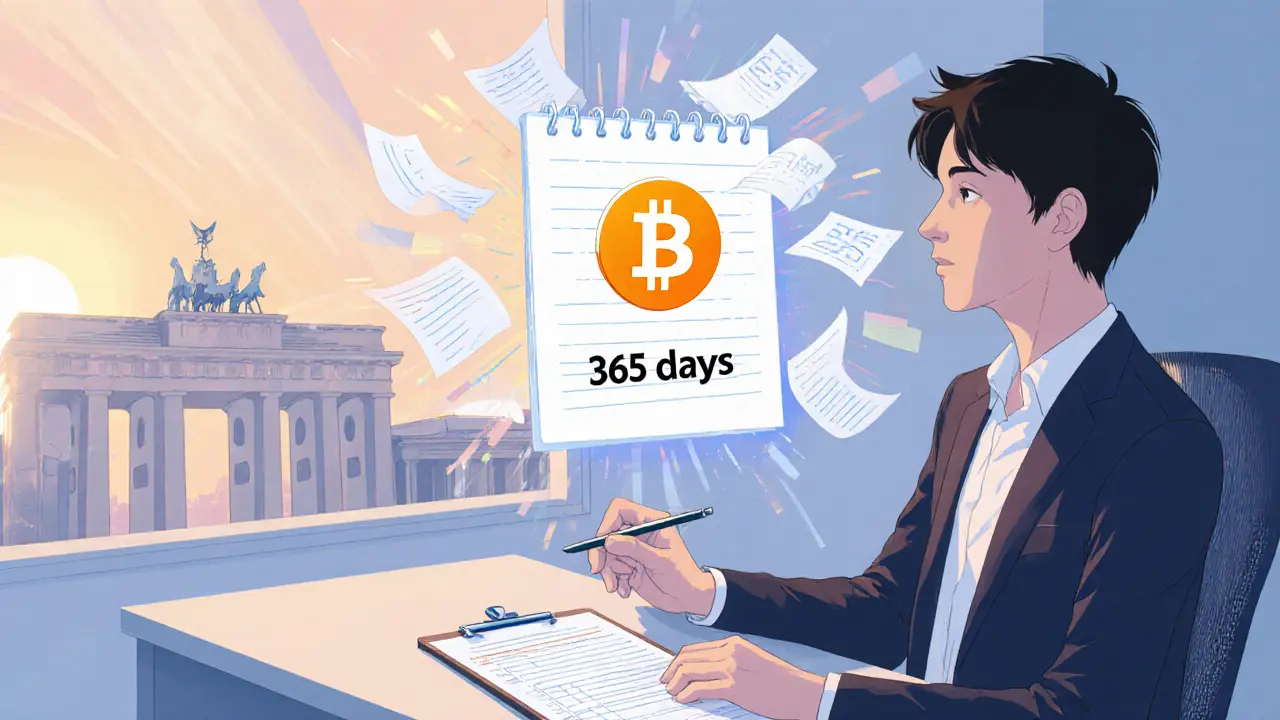
When it comes to crypto taxes, Germany's 12‑month crypto tax exemption is a rule that removes tax on gains from Bitcoin, Ethereum and other digital assets if you hold them for at least 365 days and sell them afterwards. This article walks you through the nuts‑and‑bolts of the exemption, the paperwork you need, and common pitfalls that can turn a tax‑free profit into a costly surprise.
Key Takeaways
- The exemption applies after a full 12‑month (365‑day) holding period - every minute counts.
- Gains under €1,000 in a calendar year are tax‑free, even if held short‑term.
- Short‑term gains (under 12 months) are taxed at personal income rates up to 47.475%.
- Mining, staking and DeFi rewards are taxed immediately unless held 12 months.
- Record‑keeping, FIFO accounting and the ELSTER portal are mandatory for compliance.
How the 12‑Month Rule Works
Under Section 23 EStG of the German Income Tax Act, cryptocurrencies are classified as “private money.” If you acquire Bitcoin on 1 January 2024 and sell it on 2 January 2025, the entire profit is tax‑exempt. The law counts calendar days, not trading days, and any fraction of a day is rounded up - a point stressed by tax expert Dr. Lena Schmidt.
By contrast, a sale on 31 December 2024 triggers the short‑term regime. The gain is added to your other income and taxed at your marginal rate (14‑45%). On top of that, the solidarity surcharge (5.5%) may apply, pushing the effective maximum to 47.475%.
When the Exemption Does NOT Apply
Even with the 12‑month rule, several situations remain taxable:
- Trading gains under €1,000 are still reported, but you do not pay tax unless the total exceeds the threshold.
- Mining, staking, and yield‑farm rewards are considered income at receipt and taxed immediately.
- DeFi liquidity‑pool deposits generate taxable events the moment you provide the asset.
- Losses cannot be offset against gains - Germany offers no tax‑loss harvesting.
These nuances make the regime ideal for “buy‑and‑hold” investors but painful for day traders.
Step‑by‑Step: Filing Your Crypto Taxes in Germany
- Gather every transaction record. Export CSV files from every exchange (Kraken, Binance, Coinbase, etc.) and note the exact timestamp.
- Calculate the holding period for each lot. The Blockpit software that creates BZSt‑compliant reports can automate this.
- Apply the FIFO (First‑In‑First‑Out) rule. The oldest acquisition is considered sold first; mixing new and old coins in the same wallet can unintentionally trigger short‑term tax.
- Sum all gains that exceed €1,000. If the total is below the threshold, you can skip the tax return for crypto.
- Log into the ELSTER portal Germany’s official online tax filing system and enter the figures under “Private sales of assets.”
- Attach the Blockpit report (or Koinly, BitcoinSteuer, etc.) as supporting documentation.
- Submit by 30 September 2025 (the deadline was extended from 31 July). Late filing incurs penalties.
Most first‑time filers spend 15‑20 hours preparing the data. Hiring a tax advisor costs around €285 on average, but the savings can easily outweigh the fee if you’re near the €1,000 threshold.
Comparing Germany to Other EU Jurisdictions
| Country | Holding period for exemption | Tax rate on short‑term gains | Annual tax‑free allowance | Notes |
|---|---|---|---|---|
| Germany | 365 days | Personal income tax up to 47.475 % | €1,000 | Private‑money classification; no loss offset |
| France | None - flat rate applies | 30 % flat | €0 | All crypto gains taxed immediately |
| United Kingdom | None - CGT allowance | 10 % (basic) or 20 % (higher) | £6,000 (2025) | Capital‑gains regime, allowance applies to total gains |
| Portugal | 28 days | 0 % (long‑term); short‑term taxed under personal income | €0 | Recent regulatory changes tightened short‑term rules |
Germany’s 12‑month window makes it the most attractive option for long‑term investors in the EU, second only to Portugal’s ultra‑short exemption.
Common Pitfalls and How to Avoid Them
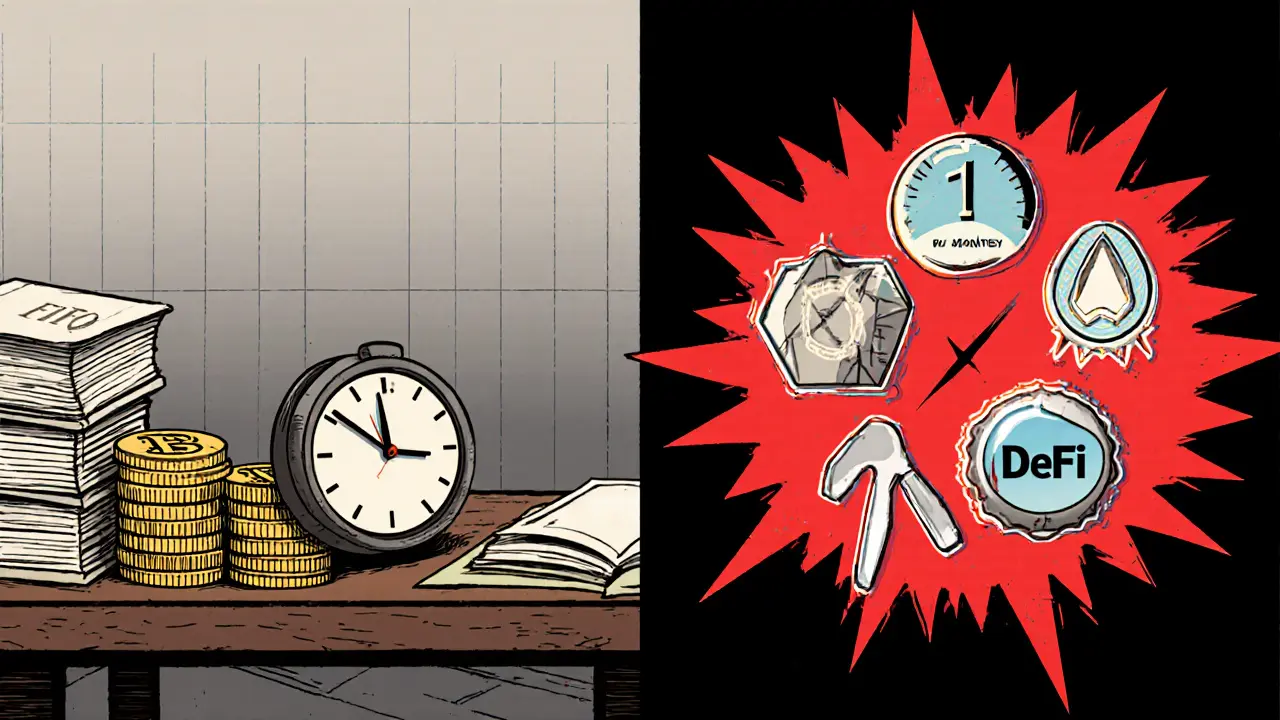
- Mis‑counting the day. The rule counts every minute. Selling even a few hours before the 365‑day mark reverts the gain to short‑term tax.
- Mixing wallets. If you keep new purchases in the same address as old ones, FIFO will treat the old coins as sold first, potentially creating taxable events.
- Ignoring DeFi rewards. Liquidity‑pool deposits trigger a taxable event at the moment of entry - many users forget to report this.
- Skipping timestamps. Screenshots of transaction times are a lifesaver if the tax office asks for proof.
- Relying on generic software. Some tax tools still assume a “capital‑gains” model and ignore Germany’s private‑money classification, leading to wrong calculations.
Most of these errors can be prevented by separating long‑term holdings into a dedicated wallet and using a German‑compatible tax app like Blockpit or Koinly.
Future Outlook - Will the Exemption Survive?
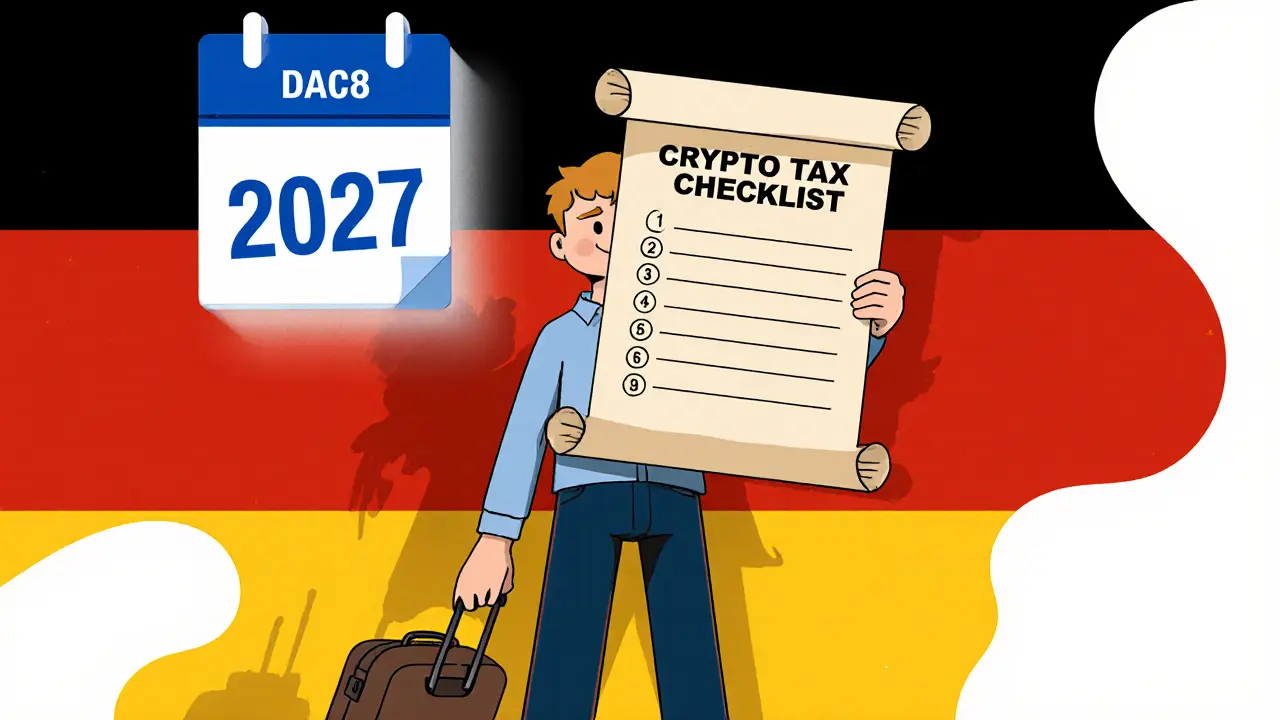
The European Commission is drafting the DAC8 directive, which aims to harmonise crypto taxation across the EU by 2027. The proposal suggests a uniform 15 % capital‑gains tax after a 365‑day holding period, effectively erasing Germany’s unique exemption. Deloitte estimates a 60 % chance that the draft will be adopted, though a grandfather clause may protect existing holdings.
Until then, the rule remains a powerful incentive for crypto immigrants. In 2024, over 18,500 foreigners cited Germany’s tax friendliness as a relocation reason. If you’re planning to move or invest long‑term, locking in assets now could lock in tax savings for years to come.
Quick Checklist Before You Sell
- Confirm the acquisition date and time for each lot.
- Count 365 full days - a single hour short means the gain is taxable.
- Verify total short‑term gains stay below €1,000.
- Export data to a German‑compatible tax tool (Blockpit, Koinly, BitcoinSteuer).
- Generate the BZSt‑ready report and upload it via ELSTER.
- Keep screenshots of timestamps for at least 10 years (the tax office can request them).
Follow this list and you’ll avoid the most common tax shocks.
Do I need to report crypto trades under €1,000?
Yes. You must still list the transactions in ELSTER, but you won’t owe tax unless total short‑term gains exceed €1,000 for the year.
How does FIFO affect my Bitcoin holdings?
FIFO means the oldest Bitcoin you bought is considered sold first. If you have both old and new coins in the same wallet, a sale may unintentionally use a recent lot, turning a long‑term gain into a short‑term one.
Can I offset crypto losses against gains?
No. German law does not allow loss‑harvesting for private‑money assets. All gains above the €1,000 threshold are taxed in full.
What records should I keep for DeFi activity?
Save the transaction hash, timestamp, value of the asset deposited or withdrawn, and the protocol name. A screenshot of the pool entry/exit screen works as proof.
When will DAC8 potentially change German crypto tax?
The final DAC8 rules are expected to take effect in 2027. Until then, Germany’s 12‑month exemption stays in force.
Stephen Rees
October 22, 2025 AT 02:38The 12‑month rule feels less like a tax break and more like a hidden leash the state places on crypto freedom. Every minute you wait is logged by an ever‑watchful bureaucracy, turning patience into a bargaining chip. It's as if regulators hope the delay will dampen enthusiasm and keep the market under their thumb. Meanwhile, the exemption threshold of €1,000 silently filters out smaller traders, maintaining the illusion of fairness while protecting larger interests.
Scott McCalman
October 22, 2025 AT 04:51If you sell before the 365‑day mark, the tax man will gobble your gains! 😱
johnny garcia
October 22, 2025 AT 07:05In accordance with the statutory provisions, the exemption merely postpones fiscal liability pending the fulfillment of a full year’s possession. Consequently, meticulous record‑keeping becomes indispensable, lest an inadvertent short‑term sale precipitate an unexpected surcharge. Practitioners should therefore segregate long‑term holdings into a dedicated address to forestall FIFO‑induced taxable events. Moreover, the integration of German‑compliant tax software ensures that the ELSTER submission adheres to the requisite format. 📊
Andrew Smith
October 22, 2025 AT 09:18Hey folks, keep those long‑term coins in a separate wallet and the tax hassle drops dramatically. It’s a simple trick that saves you from accidental FIFO pitfalls. Stick to the checklist and you’ll breeze through ELSTER without a sweat.
Ryan Comers
October 22, 2025 AT 11:31The DAC8 draft is just another EU shakedown to strip away Germany’s unique advantage. They want a flat 15 % tax and it’ll hurt the crypto‑friendly vibe we’ve built. Hold tight, the exemption won’t fade tomorrow, and we’ll outlive the bureaucracy. 🚀
Prerna Sahrawat
October 22, 2025 AT 13:45One must first acknowledge the profound philosophical implications inherent in the very notion of a temporal tax exemption. The legislator, in drafting §23 EStG, appears to have woven a tapestry where chronology intertwines with fiscal destiny. By imposing a precise 365‑day cadence, the law subtly whispers that patience is not merely a virtue but a taxable commodity. Such a provision, when examined through the lens of epistemology, raises the question of whether temporality can ever be truly quantified without sacrificing the essence of individual liberty. Moreover, the €1,000 threshold operates as an invisible gatekeeper, distinguishing the modest trader from the affluent speculator, thereby reinforcing a socioeconomic hierarchy. The reliance on FIFO accounting further entrenches a deterministic view of asset flow, reducing the nuanced reality of decentralized finance to a linear, mechanistic process. One cannot overlook the paradox wherein mining and staking rewards are taxed immediately, seemingly contradicting the very spirit of the exemption that rewards prolonged ownership. In effect, the law constructs a bifurcated universe: one where dormant holdings are sanctified, and active participation is condemned to immediate fiscal scrutiny. The practical ramifications are equally profound, compelling investors to engineer separate wallets, adopt specialized software, and dedicate countless hours to data reconciliation. This bureaucratic choreography, while ostensibly protective, may inadvertently stifle innovation within the burgeoning crypto ecosystem. It is incumbent upon the prudent holder to meticulously document timestamps, lest a marginal miscalculation transform a tax‑free gain into a punitive levy. Furthermore, the looming specter of DAC8 looms as a potential catalyst for homogenizing tax policy across the Union, threatening to dissolve Germany’s distinctive advantage. Yet, until such legislative harmonization materializes, the current framework remains a beacon for crypto‑immigrants seeking fiscal refuge. In summation, the 12‑month exemption is an intricate construct, simultaneously empowering the patient investor and entangling them in a lattice of regulatory obligations that demand both vigilance and strategic foresight.
Joy Garcia
October 22, 2025 AT 15:58The moral calculus of this tax rule is as colorful as a sunrise over Berlin – it rewards patience while punishing the restless. Yet, the fact that DeFi rewards are snatched away instantly feels like a betrayal of the very ethos that crypto champions. If the state claims to protect citizens, it should at least give them a fair chance to reap the fruits of their labor. Otherwise, we’re just feeding a system that thrives on selective generosity.
Erik Shear
October 22, 2025 AT 18:11Keep it simple. Use a dedicated wallet. Track dates. Submit on ELSTER.
Tom Glynn
October 22, 2025 AT 20:25Think of the exemption as a marathon, not a sprint. Pace yourself, hold those coins for a year, and the tax burden disappears like morning fog. If you stumble, the software tools will guide you back on track. 🌟
Johanna Hegewald
October 22, 2025 AT 22:38Here’s the quick way: write down when you bought each coin, count 365 days, and make sure your short‑term profit stays under €1,000. Then upload the CSV to Blockpit or Koinly, get the report, and push it through ELSTER. It’s that easy.
Benjamin Debrick
October 23, 2025 AT 00:51One must, arguably, recognize the intricate interplay between legislative intent and individual fiscal strategy; however, the prevailing narrative, unfortunately, overlooks the nuanced reality of transactional chronology; consequently, many investors, perhaps unwittingly, expose themselves to inadvertent tax liabilities, which, in turn, underscores the paramount importance of precise timestamp documentation; moreover, the optionality of utilizing German‑compliant tax software, whilst ostensibly beneficial, may inadvertently engender a false sense of security, leading to complacency; thus, a diligent, methodical approach remains indispensable.
del allen
October 23, 2025 AT 03:05i feel u on this one, the tax stuff can be sooo confusing. just make sure you got all the dates right and keep those screenshots, they save u later. hope it goes smooth! :)
Jon Miller
October 23, 2025 AT 05:18Yo, if you’re not into the whole 12‑month dance, just remember you can still sell under €1,000 and avoid tax. Keep it chill.
Lindsey Bird
October 23, 2025 AT 07:31Ugh, another tax rule to read. Like, why can’t we just trade and not worry about a spreadsheet? 🙄