Halving Impact on Bitcoin Price: History, Mechanics, and 2026 Reality

It is August 2026. You have likely heard the term Bitcoin halving thrown around since you first bought your first fraction of a coin. It sounds like magic-a scheduled event that supposedly guarantees your portfolio will explode in value. But does it actually work that way? Or is it just hype?
The short answer is yes, but not overnight. The Bitcoin halving is a programmed event that reduces the reward miners receive for securing the network by 50%, effectively cutting the supply of new bitcoins entering the market. This mechanism is the heartbeat of Bitcoin’s monetary policy. As of today, we are living in the post-2024 halving era, where the block reward sits at 3.125 BTC. The next cut isn’t until April 2028. So, what does this mean for your wallet right now?
How the Halving Mechanism Actually Works
To understand why prices move, you need to understand the math behind the curtain. Bitcoin was designed by Satoshi Nakamoto with a hard cap of 21 million coins. Unlike fiat currencies, which central banks can print endlessly during crises, Bitcoin’s supply growth is predictable and shrinking.
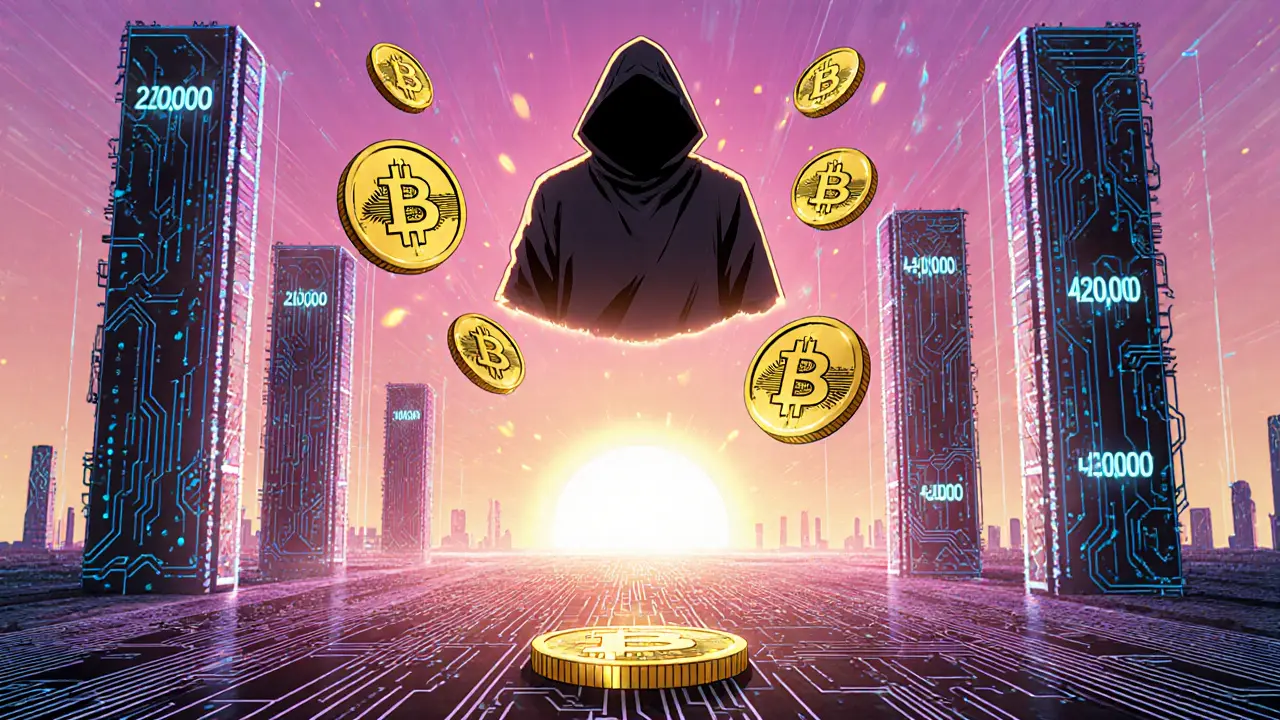
Every time the blockchain reaches a specific number of blocks (every 210,000 blocks, or roughly four years), the software automatically cuts the miner reward in half. Why miners? Because they secure the network using computational power. Their income comes from two sources:
- Block Subsidy: The newly created bitcoins awarded for solving the block puzzle.
- Transaction Fees: Small payments users attach to their transactions to prioritize them.
Historically, the subsidy has been the dominant source of revenue. When that subsidy gets slashed, miners face an immediate income shock. If the price of Bitcoin doesn’t rise to compensate, unprofitable miners turn off their machines. This leads to a temporary drop in the network’s hash rate (computational power). However, history shows this is a self-correcting cycle. As weaker miners exit, the remaining efficient ones capture more rewards, and the reduced supply of new coins hitting exchanges often creates upward pressure on price if demand remains steady.
A Look Back: The Four Halvings That Shaped Crypto
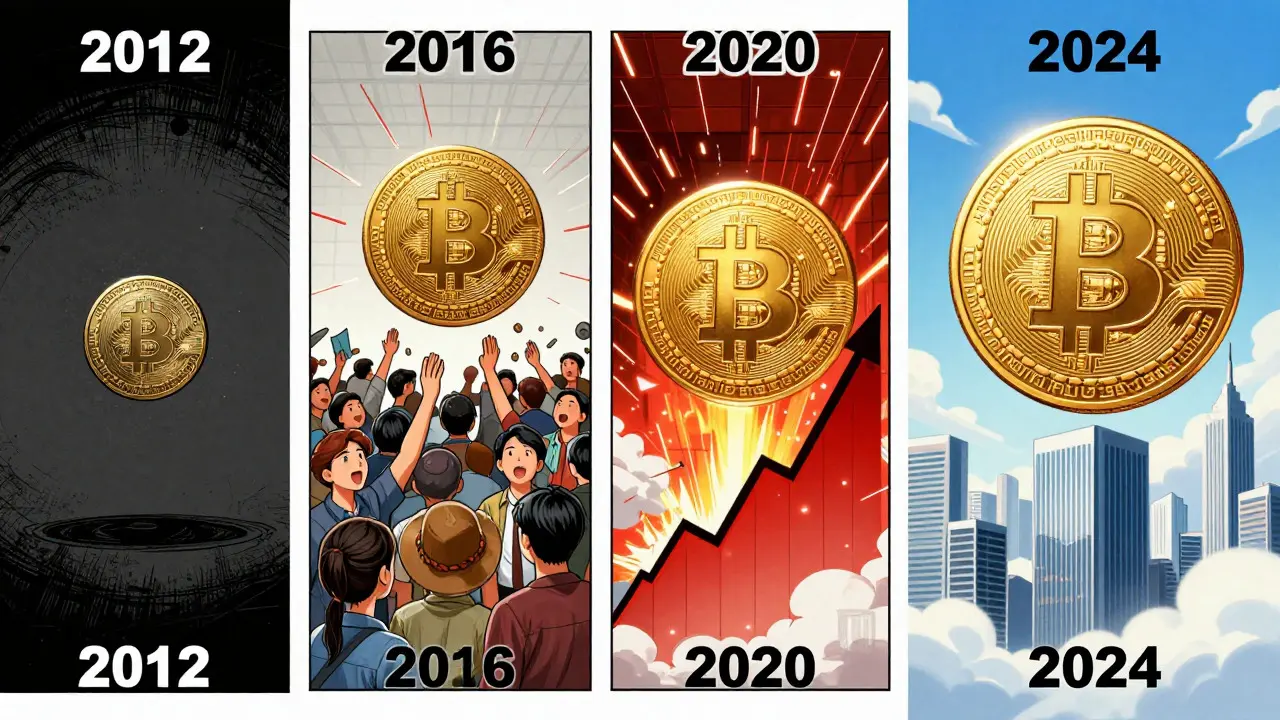
You can’t predict the future without looking at the past. We have seen four halvings so far. Each one happened in a different economic climate, yet each followed a similar long-term pattern of appreciation, albeit with varying degrees of volatility.
| Date | Block Reward Change | Price at Halving | Peak Price Post-Halving | Context |
|---|---|---|---|---|
| Nov 28, 2012 | 50 BTC → 25 BTC | ~$12 | ~$1,100 (Nov 2013) | Niche tech experiment; low liquidity |
| July 9, 2016 | 25 BTC → 12.5 BTC | ~$640 | ~$20,000 (Dec 2017) | Rising retail interest; early institutional awareness |
| May 11, 2020 | 12.5 BTC → 6.25 BTC | ~$9,000 | ~$69,000 (Nov 2021) | Pandemic inflation; massive global money printing |
| April 20, 2024 | 6.25 BTC → 3.125 BTC | ~$63,000 | $73,750 (March 2024)* | Institutional adoption; ETF approvals; mature market |
Notice the trend? The percentage gains have diminished with each cycle, but the absolute dollar values have skyrocketed. In 2012, Bitcoin went from $12 to $1,100. In 2024, it moved from $63,000 to over $73,000. This suggests diminishing returns as the asset matures, a concept known as logarithmic growth.
The 2024 Halving: A Different Beast
The most recent halving in April 2024 broke some old rules. Historically, Bitcoin would dip slightly after the halving, then grind up slowly before exploding 12-18 months later. In 2024, something else happened: front-running.
Because the market is now dominated by large institutions and Spot Bitcoin ETFs (Exchange-Traded Funds), smart money bought heavily in early 2024, anticipating the supply shock. This pushed Bitcoin to an all-time high of $73,750 in March, just weeks before the event. On the day of the halving itself, the price was around $63,000.
Why did it drop after peaking? Simple profit-taking. Many traders who bought in January and February sold into the strength leading up to the event. Additionally, mining fees spiked dramatically during the halving block-exceeding $2.6 million in fees alone-as people rushed to get transactions confirmed in the historic block. This showed that while the subsidy dropped, transaction fees are becoming a more significant part of miner revenue, stabilizing the network even as subsidies shrink.
What Happens to Miners?
If you think the halving only affects traders, think again. Miners are the backbone of the network. When their revenue is cut in half overnight, the weak links break.
In the weeks following every halving, we typically see a consolidation in the mining industry. Smaller, less efficient operations that rely on older hardware or expensive electricity shut down. Larger companies with access to cheap hydroelectric power or advanced ASIC miners (like those made by Bitmain) survive and expand. This leads to higher industry concentration.
However, there is a silver lining for the network. As inefficient miners leave, the total energy consumption of the network becomes more optimized per transaction. Furthermore, if the price of Bitcoin rises-which it historically does-it restores profitability for the remaining miners within 12 to 18 months. This creates a natural feedback loop: scarcity drives price up, price up drives miner profitability back to normal, and security is maintained.
The "Digital Gold" Thesis and Supply Shock
The core argument for holding Bitcoin through halvings is the supply shock. Imagine if gold miners suddenly produced half as much gold every four years, but everyone still wanted jewelry and bars at the same rate. What would happen to the price of gold? It would go up.
Bitcoin’s annual issuance rate has dropped from nearly 100% in its early days to less than 1% today. After the 2024 halving, only about 3.125 BTC are created every ten minutes. That’s roughly 450 BTC per day, or 164,250 BTC per year. Compare this to the trillions of dollars in fiat currency printed by central banks during the 2020 pandemic. This contrast fueled the narrative of Bitcoin as "digital gold"-a hedge against inflation and currency debasement.
In 2020, when the Federal Reserve injected unprecedented liquidity into the economy, Bitcoin surged from ~$9,000 to ~$69,000. The halving provided the supply-side catalyst, while global macroeconomic conditions provided the demand-side fuel. Today, in 2026, many investors view Bitcoin not just as a speculative tech bet, but as a macroeconomic asset class similar to treasury bonds or gold.

Looking Ahead: 2026 and Beyond
So, where do we stand in August 2026? We are roughly two years into the post-2024 halving cycle. Historical patterns suggest that the peak of a bull market typically occurs 12-18 months after a halving. For the 2024 event, that window would be between mid-2025 and late 2025.
If historical cycles hold true, the market may currently be in a cooling-off phase or early accumulation stage for the next cycle. Analysts had projected prices potentially reaching $100,000 to $160,000 in the 12-18 months following the 2024 halving, contingent on factors like:
- Continued institutional adoption via ETFs.
- Clearer regulatory frameworks in major economies.
- Stabilization of global inflation rates.
The next halving is slated for April 2028. Until then, the focus shifts from supply shocks to utility, adoption, and macroeconomic trends. The "easy money" phase of simply buying before a halving and waiting might be over. Future gains will likely depend on broader financial integration and real-world usage.
Risks and Pitfalls to Avoid
Don’t let the historical charts fool you into thinking this is a guaranteed lottery ticket. Past performance is not indicative of future results. Here are three risks to keep in mind:
- Market Maturation: As Bitcoin’s market cap grows, it takes exponentially more capital to move the price. The 1,800% gain from 2012 is unlikely to repeat because the base is now in the trillions.
- Regulatory Shifts: Governments can change laws overnight. Bans, heavy taxation, or restrictions on ETFs could dampen demand regardless of supply mechanics.
- Technological Disruption: While unlikely, a breakthrough in quantum computing or a critical bug in the Bitcoin code could threaten the network’s security or trustworthiness.
Always diversify. Never invest more than you can afford to lose. The halving is a powerful economic event, but it operates within a complex global financial system.
Frequently Asked Questions
When is the next Bitcoin halving?
The next Bitcoin halving is expected to occur in April 2028. This event will reduce the block reward from 3.125 BTC to 1.5625 BTC. The exact date can vary slightly depending on mining difficulty adjustments, but it generally falls every four years.
Does Bitcoin price always go up after a halving?
Historically, yes, but not immediately. In all four previous halvings, Bitcoin experienced periods of volatility or decline in the weeks immediately following the event. The significant price appreciation typically unfolds over the 12 to 18 months afterward as the supply shock takes effect and demand catches up.
Why did Bitcoin hit an all-time high before the 2024 halving?
This was due to "front-running" by institutional investors and traders. With the approval of Spot Bitcoin ETFs and increased market maturity, large players anticipated the supply reduction and bought aggressively in early 2024, pushing the price to $73,750 in March, just before the April halving.
How does the halving affect Bitcoin miners?
Miners see their primary revenue source (block subsidies) cut in half instantly. This forces less efficient miners to shut down, leading to industry consolidation. However, if the Bitcoin price rises due to scarcity, the remaining profitable miners can maintain their earnings. Transaction fees also play a larger role in miner revenue post-halving.
Is Bitcoin truly deflationary?
Yes, in terms of issuance. The rate at which new bitcoins are created decreases by 50% every four years. Eventually, the last bitcoin will be mined around the year 2140. Unlike fiat currencies, which can be inflated indefinitely by central banks, Bitcoin’s maximum supply is capped at 21 million.
Should I buy Bitcoin right before a halving?
Timing the market is difficult. While historical data shows long-term gains, short-term volatility is common. In 2024, buying right before the halving meant buying near an all-time high. It is generally better to adopt a Dollar-Cost Averaging (DCA) strategy rather than trying to time the exact bottom or top.
What happens if no one mines Bitcoin anymore?
If miners stop participating, the network becomes vulnerable to attacks. However, as the block subsidy approaches zero (post-2140), miners will rely entirely on transaction fees. For the network to remain secure, these fees must be high enough to incentivize miners. Currently, transaction fees are a small fraction of miner revenue, but they are expected to grow as Bitcoin becomes a more widely used settlement layer.

Pernelia Wahkan
August 11, 2026 AT 12:06It is fascinating to observe how the narrative shifts from pure speculation to institutional mechanics. The data presented regarding the diminishing percentage gains is particularly illuminating, as it suggests a maturation of the asset class that many early adopters failed to anticipate. One must consider that the logarithmic growth pattern implies that while the absolute dollar value increases, the relative velocity of price appreciation naturally decelerates. This is not a failure of the technology but rather a mathematical inevitability of scaling within a global financial system. The comparison to gold is apt, yet Bitcoin possesses a distinct advantage in terms of divisibility and transferability which gold lacks entirely. We are witnessing the transition from a digital curiosity to a macroeconomic staple. The role of transaction fees becoming more significant for miners is a critical detail often overlooked by casual observers. It indicates that the network's security model is evolving to rely less on inflationary subsidies and more on actual usage. This shift is vital for long-term sustainability. Without this evolution, the network would eventually become vulnerable once the block subsidy approaches zero. The historical context provided helps ground expectations in reality rather than hype.
Ed Mitchell
August 11, 2026 AT 18:59The entire premise of this article is built upon a foundation of fragile trust in centralized entities. You speak of institutions and ETFs as if they are benevolent guardians of your wealth, yet they are merely the new gatekeepers designed to extract rent from the masses. The 'front-running' mentioned here is not a market anomaly; it is a calculated maneuver by the same banking cartels that have manipulated fiat currencies for decades. They buy low through opaque channels and sell high to the retail herd who read articles like this one. The halving is a psychological trick, a programmed scarcity designed to keep you holding while they consolidate power. Do not be fooled by the charts. The hash rate drop is not a self-correcting cycle; it is a sign of centralization where only those with state-subsidized energy can afford to mine. Your wallet is not safe because of code; it is safe because the regulators allow it to be. When they decide the game is over, the code will mean nothing. Wake up before the next crash wipes out your savings.
Michael Mostyn
August 13, 2026 AT 15:57One might ponder the philosophical implications of a currency whose supply is predetermined by an algorithm rather than human consensus. In doing so, we strip away the moral agency traditionally associated with monetary policy. Is this liberation or abdication? The halving event serves as a ritualistic reaffirmation of these rules, a digital sacrament that reinforces the belief in scarcity. However, scarcity alone does not confer value; perception does. The fact that the market reacts to these events with such fervor suggests a collective psychological dependence on the narrative of inevitable growth. We are no longer trading an asset; we are trading a story about the future. The question remains whether this story can sustain itself when the economic environment shifts dramatically. History teaches us that all narratives eventually face their reckoning. Whether Bitcoin survives this reckoning depends not on its code, but on the continued faith of its adherents. It is a mirror reflecting our desire for order in a chaotic world.
Erica Johnson
August 15, 2026 AT 02:34Actually, the table in the post has a slight error regarding the peak prices if you look at adjusted values for inflation, but otherwise, it's a decent summary. :)
Ken G
August 15, 2026 AT 18:59you people really think this is freedom its just another way for the elites to control money without congress seeing it the rich get richer and the poor get taxed into oblivion while buying dogecoin and bitcoin its sad really
Lorraine Surringer
August 16, 2026 AT 07:38I feel like everyone is missing the point here. It's not about the money, it's about the energy. The environmental impact is being ignored again. How can we call this sustainable when the carbon footprint is so huge? It breaks my heart to see nature sacrificed for digital coins that live on servers. We need to care more about the planet than our portfolios. Please stop defending this industry until they prove they are green. It's exhausting watching the denial. :(
Alex Di Mango
August 17, 2026 AT 14:37Let's try to keep the discussion constructive, everyone. While the concerns about centralization and environment are valid, dismissing the technological progress entirely seems counterproductive. The shift towards renewable energy in mining is real, even if slow. Perhaps we can focus on how regulation might help balance these interests rather than assuming the worst. There is room for both skepticism and optimism. Let's encourage solutions instead of just pointing out flaws. We are all learning together. It is important to remember that change takes time. Let's support each other in understanding this complex landscape. A balanced view helps us make better decisions. Thanks for sharing your thoughts. Peace.
Amor Jordan
August 19, 2026 AT 11:33It is truly heartbreaking to see how much anxiety this topic generates. People are pouring their life savings into something so volatile, driven by fear of missing out rather than genuine understanding. I worry about the emotional toll this takes on families. The pressure to perform financially in this modern economy is immense. We need more compassion and less judgment. Let's hold space for those who are struggling. The market doesn't care about your feelings, but we should. Take a deep breath. You are enough regardless of your portfolio. Let's prioritize mental health over marginal gains. Love and light to all. 🌸
Nick Darring
August 20, 2026 AT 03:35You know what, I've been reading all these comments and honestly, most of you are missing the bigger picture completely because you're too busy looking at the four-year cycles and ignoring the fact that the real game is played in the derivatives market where the big players manipulate the spot price to trigger liquidations on the other side of the board. It's not about the halving, it's about the open interest in futures contracts which are currently at record highs, meaning the smart money is positioning for a massive short squeeze or a devastating crash depending on which way the Fed decides to twist the liquidity spigot next week, and frankly, worrying about whether the block reward is 3.125 or 1.5625 is like worrying about the color of the curtains on the Titanic while the iceberg is already scraping the hull, so maybe take a step back and look at the broader macro indicators like the DXY index and the yield curve inversion which are screaming caution to anyone who actually understands basic economics rather than just repeating memes from Twitter influencers who got lucky once in 2017 and haven't learned anything since then except how to sell courses on how to trade options.