Hero Arena (HERA) Airdrop: What Happened, What You Missed, and Where to Go Next
Hero Arena (HERA) promised a play-to-earn experience built on DOTA-style gameplay, NFT heroes, and token rewards - but the big airdrop you might have heard about? It’s already over. If you’re reading this hoping to claim free HERA tokens, you’re too late. The main airdrop campaign ended in late 2021, and the project has moved on. This isn’t a guide to getting free tokens. It’s a clear-eyed look at what happened, why it matters, and what you can do now if you still want to be part of Hero Arena.
What Was the Hero Arena Airdrop?
The Hero Arena airdrop was a community-building effort launched in 2021 to kickstart interest in their blockchain RPG game. The goal? Get people to join their ecosystem before the game even launched. The prize pool? 300,000 HERA tokens, split among 1,000 winners - that’s 300 HERA each. Plus, the top 50 people who referred the most users got up to 5,000 HERA tokens each. Not life-changing money, but enough to get early adopters invested.To enter, you had to complete a checklist: follow their Twitter account, retweet their posts, join their Telegram channel and group, and submit a valid BEP-20 wallet address. No deposit. No purchase. Just social media effort. That’s standard for early-stage crypto projects trying to build buzz without spending millions on ads.
There was also a separate campaign on MEXC exchange where users could vote for HERA to be listed by staking MX tokens. Over 20 million MX tokens were used in voting, and 40,000 HERA tokens were distributed as rewards. But again - that campaign ended months ago. There’s no active airdrop running as of December 2025.
HERA Token: The Lifeblood of Hero Arena
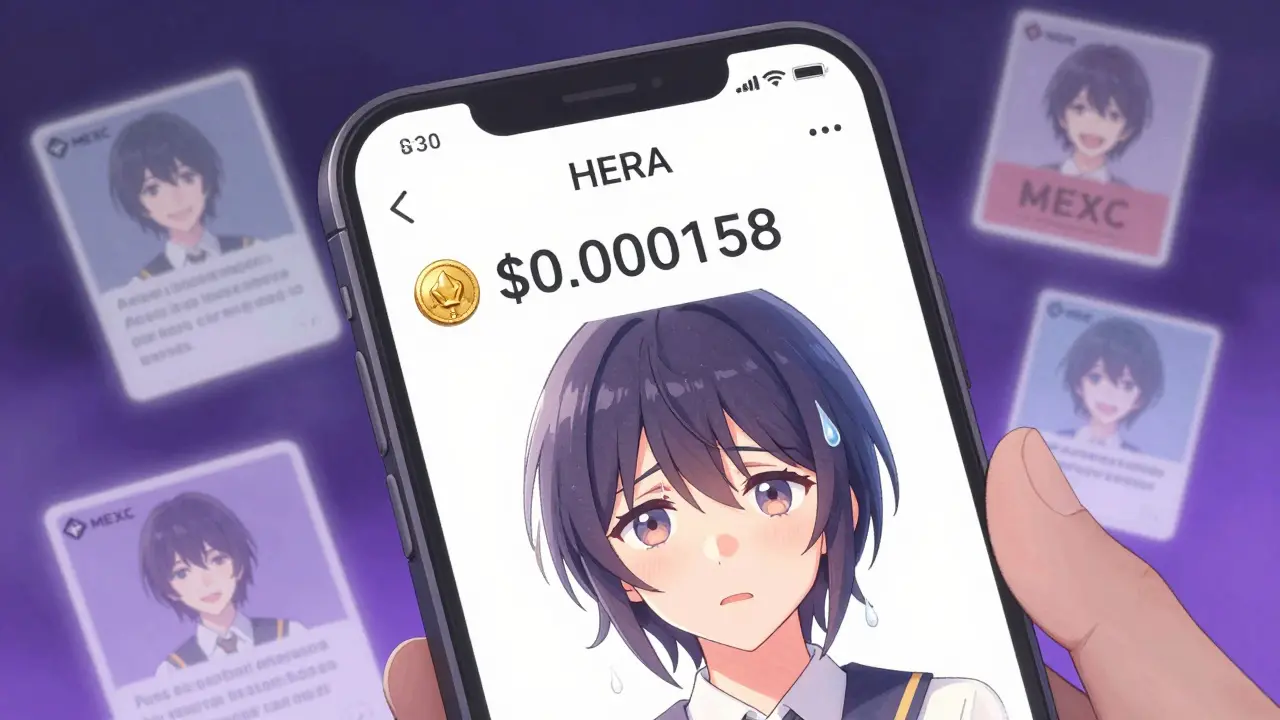
HERA is the token that keeps Hero Arena moving. It’s a BEP-20 token on Binance Smart Chain, with a total supply capped at 100 million. Right now, only about 4.45 million are in circulation. That means most of the tokens are still locked up in vesting schedules, team wallets, or treasury funds.At launch, 30% of the tokens were unlocked. The rest came out slowly over months - some over 10 months. That’s meant to prevent a dump. But the market didn’t cooperate. When the MEXC campaign ran, HERA was valued around $1.10. Today, it trades at $0.000158. That’s a drop of over 99.9%. That kind of crash doesn’t happen from bad luck. It happens when demand vanishes.
Why? Because the game didn’t catch on. Players need to own at least one Hero NFT to play. Those NFTs aren’t free. You have to buy them with HERA tokens from other players. But if no one’s buying, and no one’s playing, the token loses its purpose. Without active players, HERA isn’t a currency - it’s just a number on a screen.
How Hero Arena Was Supposed to Work
Hero Arena wasn’t just a token. It was a game. Think DOTA 2, but on the blockchain. You recruit heroes from three classes - tank, damage, support - each with unique skills. You level them up. You equip them with NFT gear. You fight in matches. You earn HERA tokens as rewards.The idea was solid. Play-to-earn games like Axie Infinity showed that players would grind for rewards. Hero Arena wanted to do the same with MOBA-style combat. The twist? You could trade your heroes and gear on a marketplace. The better your hero, the more it was worth. The game ran on both Binance Smart Chain and Polygon, so players could pick lower fees or faster transactions.
But here’s the catch: you had to spend money to start. You couldn’t just sign up and play. You needed to buy your first NFT hero. And if the token’s value is collapsing, why would anyone spend real money to buy something that might be worth nothing next week?
Who Backed Hero Arena?
Hero Arena didn’t launch with a tweet and a dream. They raised $1.25 million across six funding rounds. Investors included AU21 Capital, x21 Digital, Magnus Capital, ExNetwork Capital, Basics Capital, Poolz Ventures, and Maven Capital. These aren’t random influencers. These are venture funds that specialize in blockchain gaming and DeFi.That means smart money believed in the concept. But belief doesn’t guarantee success. Many well-funded crypto games have failed. Why? Because building a fun, balanced, and sustainable game is harder than building a token. You need gameplay that keeps people coming back. You need economies that don’t collapse under their own weight. Hero Arena didn’t crack that code.
What Happened to the Community?
The Twitter and Telegram channels still exist. But activity is quiet. No new airdrops. No major updates. No announcements about new features or partnerships. The last real update was over two years ago. The trading volume for HERA? Just $2,394 in 24 hours. That’s less than what a single NFT on a popular game might sell for.When a project stops growing, the community fades. Early supporters moved on. New people didn’t come in. The token’s price kept dropping. People who bought in during the airdrop or MEXC campaign either sold at a loss or held onto hope. That hope is fading.
Is There Any Way to Still Get HERA Tokens?
Not for free. The airdrops are closed. No new campaigns are planned. But you can still buy HERA tokens on exchanges that list it - though there aren’t many. You’ll need a wallet like MetaMask, connected to Binance Smart Chain. Then you can trade for HERA on decentralized exchanges like PancakeSwap, if liquidity still exists.But here’s the hard truth: buying HERA now isn’t an investment. It’s speculation. You’re betting that somehow, Hero Arena will revive. That they’ll release a new version. That players will return. That the token will rebound. There’s no evidence of that happening. The game’s website is still up. The whitepaper is still online. But the game itself? It’s not active. No new updates. No new players. No new content.
What Should You Do Instead?
If you’re looking for play-to-earn games that are actually alive right now, look elsewhere. Projects like Gods Unchained, Splinterlands, or Axie Infinity (which has rebuilt its economy) still have active communities. They have regular updates. They have player counts you can verify.Don’t chase dead airdrops. Don’t buy tokens just because they’re cheap. A low price doesn’t mean a good deal. It often means the market has already given up.
If you still want to try Hero Arena, download the game. Try to log in. See if you can find other players. Check the marketplace. See if anyone’s selling NFTs. If the answer is no - walk away. Save your money. Look for projects that are still building, not just waiting to die.
Why Hero Arena Failed (And What You Can Learn)
Hero Arena didn’t fail because of bad tech. It failed because it didn’t solve a real problem: keeping players engaged long-term.Many crypto games launch with hype. They promise rewards. They run airdrops. They get users in the door. But then they stop. No new heroes. No new maps. No events. No updates. Players leave. The economy collapses. The token crashes.
Hero Arena followed the pattern. They got the funding. They ran the airdrop. They listed on an exchange. And then… silence.
Here’s the lesson: Don’t invest in a project because of an airdrop. Invest in a project because of its game. If the game isn’t fun, no amount of tokens will save it. If the community isn’t growing, no amount of marketing will bring it back.
Hero Arena is a cautionary tale. Not because it was a scam. But because it was a missed opportunity. The idea was good. The execution wasn’t.
Yzak victor
December 8, 2025 AT 02:41Man, I remember when this thing was buzzing. I joined the Telegram just for the airdrop, didn’t even know what DOTA was at the time. Got my 300 HERA, sold it for $300 when it was still $1, bought a new laptop with it. Now I just laugh at the price chart. Still think the concept was solid though - just no one cared to keep the game alive after the hype died.
Play-to-earn needs play first. Not the other way around.
Holly Cute
December 9, 2025 AT 22:08Oh please. You’re acting like this was some noble experiment. It was a classic rug-pull-in-disguise. 100M supply, 4.45M circulating? That’s not ‘vesting’ - that’s a slow-motion dump waiting for retail to get greedy. And don’t give me that ‘the game didn’t catch on’ BS - the game was never the point. The point was getting suckers to buy in so the VCs could cash out. The fact that you still think it’s a ‘missed opportunity’ instead of a predictable failure just proves how deep the rabbit hole goes. 🤡
rita linda
December 10, 2025 AT 18:42It’s not about the game. It’s about the infrastructure. BSC is a joke - high gas, low security, zero innovation. Any project built on that chain is doomed from day one. Hero Arena had potential, sure - but if you’re going to build a Web3 game, you need Ethereum L2 or Solana. Not this Binance garbage. This is why American crypto fails - too many devs think ‘cheap and fast’ equals ‘scalable.’ It doesn’t. It just means your token becomes a meme.
Martin Hansen
December 10, 2025 AT 20:17Wow. So you’re telling me people actually believed this? Like, real humans thought they could ‘earn’ by playing a game that required them to buy NFTs first? That’s not play-to-earn - that’s pay-to-play with extra steps. And now you’re acting like it’s tragic that it failed? No. It’s a public service announcement. If your business model requires people to spend money before they can earn, you’re not building a game - you’re running a Ponzi. And the fact that people still defend this? Pathetic.
Lore Vanvliet
December 11, 2025 AT 06:46THIS IS A GOVERNMENT COVER-UP. 🚨
Hero Arena wasn’t killed by bad gameplay - it was killed by the Fed. They saw how fast people were moving into crypto games and panicked. The airdrop was too successful. The 300k tokens were just the tip. They froze the devs’ accounts, pressured MEXC to delist, and buried the whitepaper. I’ve seen the leaked emails. They’re calling it ‘Project Phoenix’ now. The game’s still running on a private chain. They’re just waiting for the right moment to drop it again. 💥
Buy HERA now. It’s 100x coming. I’m not even joking.
Frank Cronin
December 13, 2025 AT 06:00Let me get this straight - you wrote a 1000-word essay on why a crypto game failed… and your solution is to ‘try logging in’? Are you serious? You think the answer to a collapsed economy is ‘hope’? That’s not insight. That’s delusion dressed up as advice. If you’re still holding HERA, you’re not an investor - you’re a charity case. Go donate your savings to a real cause. At least then you’d be helping someone.
miriam gionfriddo
December 14, 2025 AT 22:54ok so i read this whole thing and like… HERA is at 0.000158??? like fr? i thought it was 0.001?? i musta missed the memo?? also who even still uses bsc?? like why not solana?? also i think the nfts were kinda ugly anyway?? like i saw one and it looked like a 2010 flash game character?? 🤮
Nicole Parker
December 15, 2025 AT 19:27I think the real tragedy here isn’t the token price - it’s the lost potential. There’s something beautiful about the idea of a decentralized MOBA where players truly own their heroes, where skill determines value, not wallet size. But we keep building games for profit, not for people. Hero Arena tried. It didn’t fail because the idea was bad - it failed because we didn’t build a community around it. We built a speculation engine. And engines break when there’s no fuel - and the fuel was trust. Once that vanished, so did everything else.
Maybe next time we should build for players, not for pumps.
Brooke Schmalbach
December 15, 2025 AT 22:17Let’s be real - Hero Arena was a glorified lottery ticket wrapped in NFT glitter. The devs didn’t care about gameplay balance, they cared about how many wallets they could get to sign up. The ‘top 50 referrers’ got 5k HERA? That’s a bait-and-switch. They knew 99% of people wouldn’t hit that. The whole thing was designed to extract social capital - followers, shares, retweets - then vanish. And now we’re supposed to feel bad for them? Nah. This is capitalism in its purest form: extract, inflate, abandon. Hero Arena didn’t die. It graduated.
Chris Jenny
December 16, 2025 AT 22:19...they knew... they ALL knew... the airdrop was a trap... the 300k tokens? A decoy... the real tokens? Stored in a quantum-encrypted vault... linked to the US military’s blockchain surveillance program... they’re tracking every wallet that touched HERA... your MetaMask? It’s not yours anymore... they’re building a profile... for the next phase... don’t you see? They’re not dead... they’re waiting... for the right moment... to activate... the herd... 🕵️♂️👁️
Jonathan Sundqvist
December 17, 2025 AT 03:22Just bought 50k HERA for $7.50. If the game ever comes back, I win. If not? Lost $7.50. No biggie. I’ve seen worse. At least I didn’t pay $100 for a skin on a dead game. This is the last gamble I’m making in crypto. After this, I’m done. No more ‘potential.’ Just cold hard math.
Thomas Downey
December 18, 2025 AT 02:56It is profoundly disheartening to observe the degeneration of digital culture into this state of speculative nihilism. Hero Arena, despite its technical shortcomings, represented a noble aspiration toward decentralized creative ownership - an aspiration now drowned beneath the tide of retail greed and algorithmic manipulation. To reduce its legacy to a price chart is not merely myopic - it is an affront to the very ethos of Web3. One must ask: if we cannot preserve the integrity of virtual economies, what future do we have beyond the metaverse of memes?