How Crypto Exchanges Detect VPNs: The Multi-Layered Trap Explained

You click "Connect" on your preferred cryptocurrency exchange, only to be greeted by a cold, hard error message: "Suspicious Activity Detected" or "Access Restricted." You aren't doing anything illegal; you're just trying to access a trading platform that's blocked in your country. But the gatekeepers-major centralized exchanges like Binance is a leading global cryptocurrency exchange that employs sophisticated multi-layered systems to detect and block Virtual Private Network usage to comply with regional regulations.-are watching. And they are getting smarter.
This isn't about simple IP blocking anymore. In 2026, the war between privacy seekers and regulatory compliance has evolved into a high-stakes technological arms race. Exchanges now use multi-layered detection methods that go far beyond checking if your IP address belongs to a known server farm. If you rely on standard tools, you are likely already flagged before you even log in.
The Anatomy of Detection: Beyond IP Blacklists
To understand why your connection gets dropped, you have to look under the hood of these detection systems. It starts with the basics, but it quickly escalates. The first line of defense is IP Address Analysis is the process of comparing user connection origins against massive, constantly updated databases of known VPN and proxy server IP ranges maintained by cybersecurity firms and exchange security teams. Major providers like NordVPN and ExpressVPN operate thousands of servers. While this sounds like plenty of room to hide, these IPs are public knowledge. Security teams maintain real-time feeds of these addresses. When you connect through a popular server in Amsterdam or Tokyo, the exchange sees a cluster of users logging in from the exact same location within seconds. That’s a red flag.
But what happens when you switch to a less common server? That’s where Deep Packet Inspection (DPI) is an advanced network surveillance technology that analyzes the header and payload of data packets to identify unique traffic signatures associated with specific VPN protocols, even when encryption is active. comes into play. Even encrypted traffic leaves fingerprints. DPI tools examine the size, timing, and structure of data packets. A standard OpenVPN or WireGuard connection has a distinct rhythm. If your traffic pattern matches the signature of a known tunneling protocol, the system flags it. This is why many users find that simply changing their IP isn't enough; the *way* their data moves is also monitored.
Then there is the silent killer of anonymity: DNS leaks. Your Domain Name System resolver translates website names into IP addresses. If your browser requests a local ad network or a regional service using your ISP’s default DNS instead of the VPN’s secure DNS, your true location pops up. Exchanges monitor for these inconsistencies. If your IP says you are in Switzerland, but your DNS queries are going to a provider in China, the mismatch triggers an immediate review.
Behavioral Biometrics: The Human Element
Technical checks are only half the battle. The other half is you. Exchanges have integrated behavioral analytics that feel almost dystopian. They don't just look at your network; they look at your habits. Time zone analysis is a surprisingly effective tool. If your account profile suggests you are based in New York, but you are actively trading at 3 AM Eastern Standard Time while your connection originates from Southeast Asia, the algorithm raises an eyebrow. Consistency matters.
Browser fingerprinting adds another layer. This technology scans your device for unique identifiers: screen resolution, installed fonts, battery level, and even hardware acceleration settings. If your digital footprint contradicts your claimed geographic location, you get flagged. For instance, if your language settings are set to Mandarin, but you are connecting from a US-based IP without a valid US KYC verification, the risk score spikes.
Perhaps most invasive is the emerging use of interaction biometrics. Advanced systems analyze mouse movements, typing cadence, and touch patterns. These metrics help distinguish between a human user and automated bots, but they also help verify identity consistency. If your login behavior changes drastically compared to your historical baseline, the system may require additional verification or restrict access entirely.
| Solution Type | Detection Risk | Primary Weakness | Best Use Case |
|---|---|---|---|
| Centralized Premium VPNs (e.g., NordVPN, ExpressVPN) | High | Known IP ranges; predictable traffic patterns | General web browsing; not recommended for restricted crypto access |
| Free VPN Services is unpaid virtual private network applications that often sell user data and utilize highly congested, easily identifiable server infrastructures. | Critical | Universal IP blacklisting; severe privacy risks | Avoid entirely for financial activities |
| Double VPN / Onion Over VPN is a configuration where internet traffic is routed through two separate VPN servers or combined with the Tor network to add layers of encryption and obfuscation. | Medium-High | Slower speeds; complex setup; still vulnerable to advanced DPI | Users requiring moderate obfuscation who can tolerate latency |
| Decentralized Mixnets (e.g., NymVPN) | Low | User experience complexity; slower adoption | High-risk environments requiring strong anonymity against sophisticated tracking |

Why Centralized VPNs Are Failing
If you are using a mainstream VPN service, you are likely fighting a losing battle. Services like NordVPN and ExpressVPN are excellent for general privacy, but they are terrible for bypassing crypto exchange restrictions. Why? Because they are centralized. They own their servers. They have a fixed number of IP addresses. Security researchers note that these proprietary infrastructures create concentrated points of failure. When an exchange decides to block a region, they simply add the entire IP range of the major VPN providers to their blacklist. It’s efficient and effective.
User reports from communities like r/cryptocurrency confirm this trend. Many users report being identified within minutes of attempting to log in via a premium VPN. The success rate varies, but it is declining. Free VPNs are even worse. Their IPs are among the first to be flagged because they are widely abused by spammers and botnets. Using a free VPN for crypto trading is akin to walking into a bank wearing a sign that says "I am suspicious."">
Even advanced configurations like Split Tunneling-where only specific apps route through the VPN-are becoming easier to detect. Exchanges monitor for discrepancies between background traffic and foreground activity. If your banking app goes through a direct connection while your browser uses a tunnel, the inconsistency triggers alerts.
The Decentralized Alternative: NymVPN and Mixnets
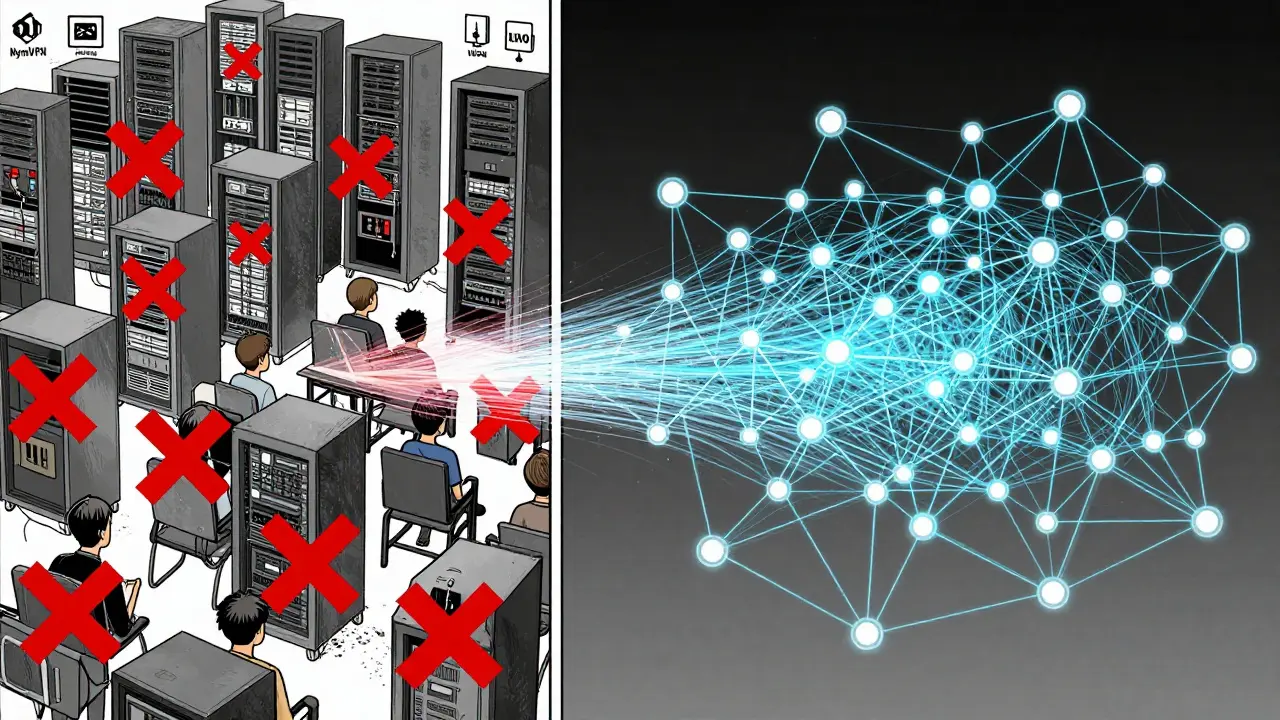
So, what works? The answer lies in decentralization. NymVPN is a decentralized privacy network built on the Noise Generating Mixnet architecture, which routes user traffic through multiple community-run nodes to obscure origin and destination metadata. Unlike traditional VPNs, Nym does not rely on a central company owning servers. Instead, it uses a mixnet. Your traffic is mixed with traffic from thousands of other users at each hop. There is no single point of entry or exit that can be easily mapped to a specific user.
This architecture presents a significant challenge for Deep Packet Inspection. Because the traffic is constantly mixed and re-encrypted by independent nodes, the characteristic signatures of a standard VPN tunnel disappear. To an observer, the traffic looks like random noise. This makes it incredibly difficult for exchanges to distinguish between a legitimate user and a VPN user, or even to determine where the user is located.
Privacy advocates argue that this is the future of online anonymity. As centralized services become more transparent to regulators, decentralized networks offer a robust alternative. However, there is a trade-off. Mixnets can be slower due to the multiple hops required. They also require a higher level of technical understanding to configure correctly. But for users facing strict geo-restrictions, the performance hit is often worth the reliability.
The Regulatory Arms Race
It is important to understand the motivation behind these aggressive measures. Cryptocurrency exchanges are under immense pressure. Governments in regions like China, Russia, and Turkey have imposed strict bans or heavy restrictions on crypto trading. Exchanges like Binance and Coinbase face legal liability if they facilitate transactions from prohibited jurisdictions. They are not trying to spy on you for fun; they are trying to stay in business.
This creates a delicate balance. If detection is too loose, the exchange gets fined or shut down. If it is too aggressive, they lose legitimate customers who just want some privacy. This tension drives innovation. We are seeing the integration of Know Your Customer (KYC) and Anti-Money Laundering (AML) systems with network monitoring. Your wallet address, your IP, your device, and your behavior are all cross-referenced.
Blockchain analysis adds another dimension. Exchanges can correlate on-chain activity with off-chain identity. If a wallet linked to your account shows transaction patterns typical of a restricted region, your network-level disguise becomes irrelevant. The ledger doesn't lie.
Practical Steps for Users
If you need to access a restricted exchange, here is how to approach it realistically:
- Ditch the mainstream VPNs: Stop relying on NordVPN or ExpressVPN for this specific task. Their IPs are compromised.
- Consider Decentralized Networks: Look into solutions like NymVPN. While the setup is more complex, the anonymity is superior.
- Check for DNS Leaks: Before you log in, test your connection. Ensure your DNS queries are not leaking your true location. Tools like DNS Leak Test can help.
- Maintain Behavioral Consistency: If you claim to be in a certain time zone, act like it. Don't trade at odd hours relative to your claimed location.
- Use Dedicated Devices: Avoid mixing your personal browsing history with your trading activity. Use a clean browser profile or a dedicated device to minimize fingerprinting conflicts.
Remember, the goal is not to hide illegally, but to protect your privacy in a landscape that increasingly demands transparency. Understanding these mechanisms helps you make informed decisions about your digital safety.
Can I use NordVPN to access Binance from a restricted country?
It is highly unlikely. Binance and other major exchanges maintain extensive blacklists of NordVPN's IP ranges. While you might occasionally slip through on a less-monitored server, the risk of account restriction or permanent ban is very high. The centralized nature of NordVPN makes its traffic patterns easy to identify via Deep Packet Inspection.
What is Deep Packet Inspection (DPI) and how does it detect VPNs?
DPI is a technology that examines the contents of data packets passing through a network. Even if the data is encrypted, DPI can analyze packet sizes, timing, and headers to identify the unique "fingerprint" of VPN protocols like OpenVPN or WireGuard. This allows exchanges to detect VPN usage even if the IP address itself is not immediately recognized as malicious.
Is NymVPN better than traditional VPNs for crypto trading?
For bypassing sophisticated exchange detection, yes. NymVPN uses a decentralized mixnet architecture that mixes your traffic with others, obscuring your origin and destination. This makes it much harder for exchanges to apply standard IP blacklists or DPI techniques. However, it may offer slower speeds and requires more technical setup than commercial VPNs.
Why do free VPNs always get detected?
Free VPNs are heavily used by spammers, hackers, and other malicious actors. As a result, their IP addresses are universally blacklisted by security systems worldwide. Additionally, free services often lack the infrastructure to rotate IPs frequently or implement advanced obfuscation, making them instantly recognizable to exchange security teams.
Can exchanges track me if I use a VPN but my wallet is linked to my identity?
Yes. Blockchain analysis firms can trace transactions between wallets. If your wallet is linked to your identity through a previous KYC process or public association, exchanges can correlate your on-chain activity with your network behavior. Even if your IP is hidden, your transaction history can reveal your geographic patterns and trigger restrictions.