How Cuba Adopted Crypto Despite U.S. Sanctions: A Guide to the Legal Framework

For decades, sending money from Miami to Havana felt like trying to push water through a stone wall. Western Union shut down its 400+ locations in 2020. Credit cards didn't work. PayPal was inaccessible. Then, something unexpected happened. Instead of banning cryptocurrency to control capital flight, the Cuban government legalized it. In August 2021, Cuba became only the second country in the world to officially recognize Bitcoin and other digital assets as legal payment methods.
This wasn't a move driven by tech enthusiasm alone. It was survival. With over 60 years of U.S. economic sanctions blocking traditional financial channels, Cubans needed a way to connect with the global economy. Today, an estimated 100,000 to 200,000 people on the island use crypto for remittances, online shopping, and business. But how does this work under such strict scrutiny? Let’s look at the reality of Cuban crypto adoption, the rules that govern it, and why it matters for anyone interested in decentralized finance in sanctioned regions.
The Regulatory Shift: From Ban to License
You might assume a state-controlled economy would crush private digital currencies. The opposite occurred. The Cuban Central Bank (BCC) published Resolution 215 in the Official Gazette, granting itself the power to regulate digital currencies. This resolution cited "reasons of socio-economic interest" as the primary motivation. In plain English, the government realized that if they didn’t regulate crypto, they’d lose control over it entirely.
By May 2022, the BCC issued a decree law establishing specific procedures for Virtual Asset Service Providers (VASPs). This isn't a free-for-all. Only the BCC can approve licenses for individuals or companies wanting to operate in this space. They evaluate three things: legality, opportunity, and socioeconomic interest. They also check the applicant's probity and experience.
Here is what this means for you if you are looking at the market:
- Licensing Authority: The Cuban Central Bank (BCC) holds exclusive power to issue VASP licenses.
- Compliance Requirement: All license holders must follow strict rules for preventing money laundering, terrorism financing, and weapons proliferation.
- Oversight Body: Applications require approval from the General Directorate of Investigation of Financial Operations within the BCC.
The BCC even decides which cryptocurrencies can be listed on Cuban exchanges. This centralized approach ensures the government maintains visibility into transactions while allowing citizens access to digital assets.
Why Crypto Works Where Banks Fail
To understand why adoption grew so fast, you have to look at the alternatives. Or rather, the lack thereof. Since 1962, U.S. sanctions have isolated Cuba from the global banking system. Most international banks avoid Cuban clients due to compliance risks. Many Cuban companies are indirectly controlled by state-owned entities like GAESA or Gaviota, which are sanctioned by the Office of Foreign Assets Control (OFAC). This creates a gray area where banks fear accidental violations.
When Western Union left in 2020, families were cut off. Remittances had been a lifeline, accounting for a significant portion of household income. Crypto filled that void immediately. Bitcoin, Ethereum, and Avalanche became the new pipes for money transfer.
| Feature | Traditional Banking/Wire | Cryptocurrency |
|---|---|---|
| Access to Global Markets | Blocked by Sanctions | Open via Blockchain |
| Transaction Speed | Days to Weeks | Minutes to Hours |
| Cost | High Fees + Exchange Losses | Network Gas Fees Only |
| Availability | Limited Physical Locations | Mobile-First Access |
| Regulatory Status | Risky for International Banks | Legal under BCC Resolution 215 |
The shift wasn't just about convenience; it was about necessity. For a freelance developer in Havana selling services abroad, crypto is the only reliable way to get paid without facing frozen accounts or exorbitant conversion losses.

Mining Goes Green: Energy and Infrastructure
If you think mining is illegal in Cuba, think again. As of 2025, cryptocurrency mining is explicitly legal. However, it comes with strings attached. The government established guidelines focusing on energy consumption caps and cybersecurity standards. Why? Because electricity is scarce in Cuba. Blackouts are common. The last thing the grid needs is unregulated miners draining power from hospitals or homes.
The solution? Renewable energy. Mining farms established in 2023 focused on regions with abundant solar and wind resources. This aligns with global sustainable mining trends but is driven by local scarcity. The government partnered with international tech companies to build infrastructure and train the local workforce. This isn't just about extracting Bitcoin; it's about building technical capacity.
These partnerships help modernize the grid while creating jobs. Miners must prove their operations don't strain public resources. This pragmatic approach turns a potential drain into a structured industry.
The Real Challenges: Internet and Enforcement
Legal status doesn't mean easy usage. Cuba faces real-world hurdles that affect daily crypto life. First, internet access. While mobile data has improved, speeds remain slow compared to global averages. Volatility in connectivity makes checking wallets or executing trades frustrating.
Second, there is the issue of enforcement. The BCC requires reporting of suspicious activities. Anti-money laundering (AML) rules are strict. If you run a service provider, you need robust compliance systems. For individual users, this means KYC (Know Your Customer) processes are mandatory when interacting with licensed exchanges. You can't just buy Bitcoin anonymously at a street corner without leaving a trace in the regulated ecosystem.
Additionally, U.S. sanctions still loom large. While crypto bypasses some banking blocks, American software and hardware restrictions can limit access to certain wallets or exchanges. Users often rely on peer-to-peer (P2P) networks or offshore platforms that accept fiat deposits via alternative methods.
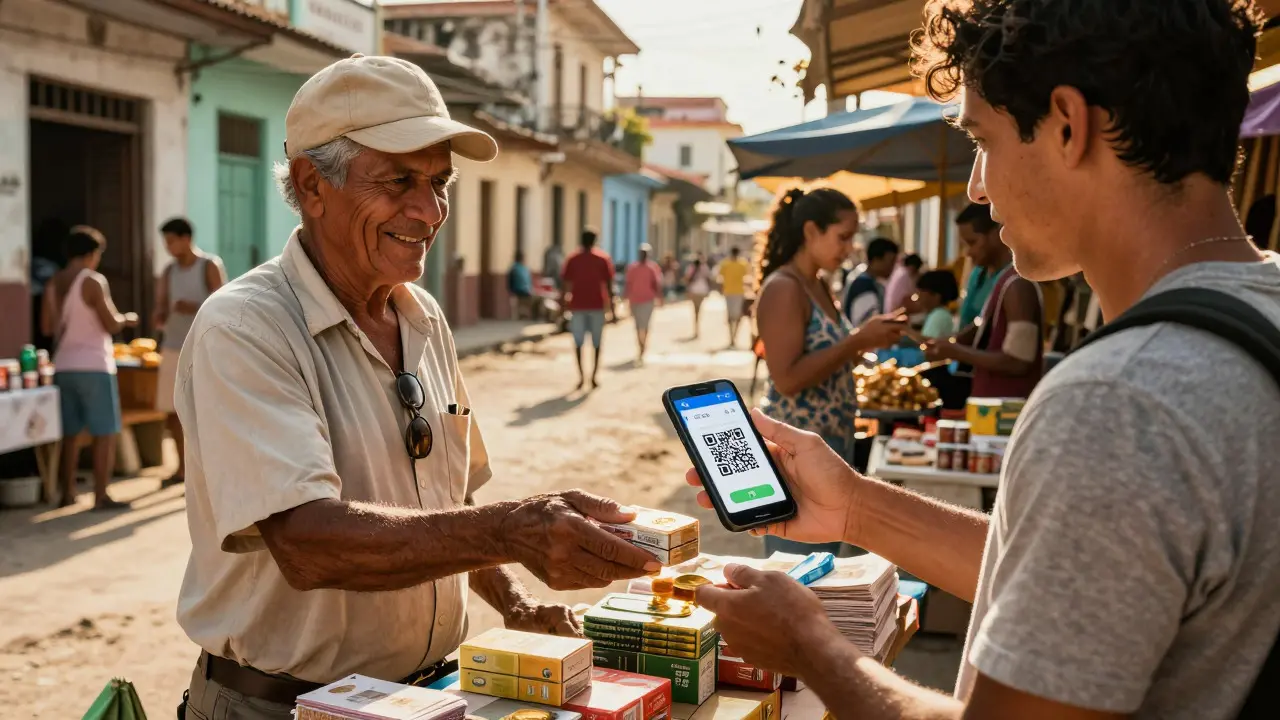
Who Uses Crypto in Cuba?
Adoption isn't uniform. The 100,000 to 200,000 active users represent roughly 1-2% of the population. Who are they? Mostly young professionals, freelancers, and small business owners (known as *cuentapropistas*). These groups benefit most from direct access to foreign currency.
Freelancers use crypto to receive payments for coding, design, or translation work. Small businesses use it to import goods or pay for advertising on platforms that don't accept Cuban bank cards. Families use it to receive remittances from relatives in the U.S., Spain, or Canada. The speed and lower cost make it superior to traditional hawala-style informal transfers that previously dominated.
However, older generations or those without smartphones lag behind. Digital literacy remains a barrier. Education programs led by the government and NGOs are slowly bridging this gap, teaching basic wallet security and transaction verification.
What This Means for the Future
Cuba’s model offers a template for other sanctioned nations. By regulating rather than banning, the government captures tax revenue, monitors flows, and provides citizens with a lifeline. It balances control with necessity. As of 2025, the framework is one of the most comprehensive globally for a developing nation.
Future developments will likely focus on expanding legitimate use cases. We may see more integration with tourism sectors, allowing hotels to accept Bitcoin directly. Partnerships with international tech firms will continue to enhance mining efficiency and security. The key question remains: Can this system withstand further geopolitical pressure? So far, the answer is yes. Crypto has proven resilient where traditional finance failed.
Is Bitcoin legal in Cuba?
Yes. Since August 2021, Bitcoin and other cryptocurrencies are legal payment methods in Cuba. The Cuban Central Bank regulates them under Resolution 215, requiring licenses for service providers.
Can I mine crypto in Cuba?
Yes, mining is legal as of 2025. However, miners must comply with energy consumption caps and cybersecurity standards. Operations often use renewable energy sources like solar and wind to reduce grid strain.
How do Cubans send money using crypto?
They use licensed Virtual Asset Service Providers (VASPs) or peer-to-peer platforms. Funds are sent via blockchain networks like Bitcoin or Ethereum, then converted to cash locally through authorized exchanges or P2P trades.
Does the Cuban government track crypto transactions?
Yes. Licensed providers must follow anti-money laundering (AML) rules and report suspicious activities. The General Directorate of Investigation of Financial Operations oversees compliance.
Why did Cuba legalize crypto despite being a communist state?
It was a response to economic isolation caused by U.S. sanctions. With traditional banking blocked, crypto provided a necessary channel for remittances and trade, forcing the government to regulate it to maintain oversight.