How Ethereum Proof of Stake Works: A Simple Guide to PoS
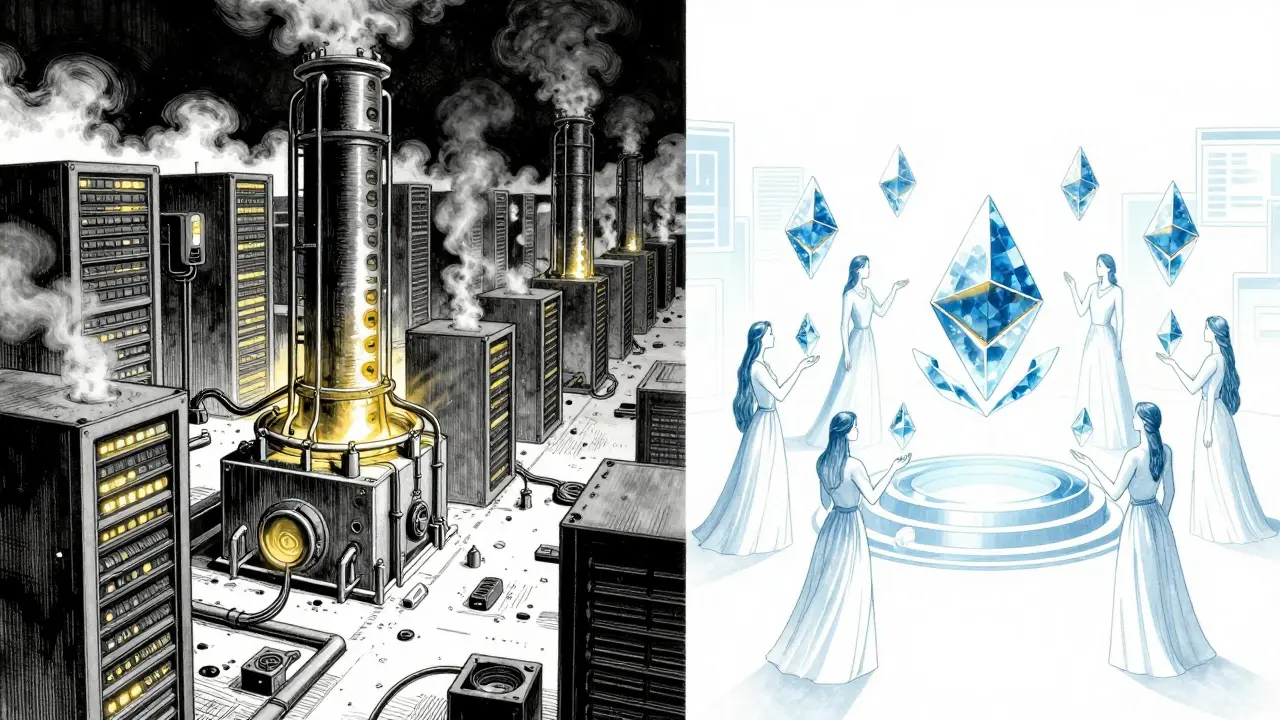
Imagine a world where keeping a global financial ledger secure doesn't require warehouses full of humming computers burning through electricity. That's exactly what happened when Ethereum ditched its old energy-hungry system for something called Ethereum Proof of Stake is a consensus mechanism that secures the blockchain by requiring participants to stake cryptocurrency as collateral rather than solving complex mathematical puzzles. If you're wondering how this actually works without a central bank calling the shots, you're in the right place. We'll break down how it replaces the "mining" era with a system of economic incentives, penalties, and digital voting.
The Core Idea: Skin in the Game
In the old days of Proof of Work (what Bitcoin still uses), miners competed to solve a puzzle. The first one to solve it won the right to add a block and got a reward. It was a race of raw computing power. Proof of Stake (PoS) flips this script. Instead of using electricity to prove you're trustworthy, you use your own money. This is called "staking."
To become a validator-the people who actually run the network-you need to lock up ETH (Ethereum's native currency) into a deposit contract. Specifically, you need 32 ETH. Think of this as a security deposit. If you play by the rules, you earn rewards. If you try to cheat the system, the network takes some or all of your deposit. This "skin in the game" ensures that the people running the network have a massive financial incentive to keep it honest.
The Lifecycle of a Validator
Becoming a part of the consensus process isn't instantaneous. There's a specific workflow you have to follow to go from a regular user to an active validator.
- The Deposit: You send 32 ETH to the deposit contract. Along with the funds, you provide a signed message containing your public key and a withdrawal address. This is where your money will eventually go when you decide to stop staking.
- The Activation Queue: You don't start working immediately. Ethereum uses a queue to prevent too many people from joining at once, which keeps the network stable. Your status moves from "Pending" to "Active" once it's your turn.
- The Duty: Once active, your 32 ETH becomes your "effective balance." You are now eligible to be chosen to propose blocks and vote on others' work.
- The Exit: When you're done, you request a withdrawal. Just like joining, there's an exit queue to ensure the network doesn't lose too many validators too quickly.
Since 32 ETH is a lot of money for most people, many use staking pools. These allow you to pool your smaller amounts of ETH with others to meet the requirement while splitting the rewards proportionally.
Slots, Epochs, and the 12-Second Heartbeat
Ethereum doesn't just randomly toss blocks into the chain; it follows a strict schedule. Time is divided into slots and epochs.
A slot is exactly 12 seconds long. In every single slot, the network randomly picks one validator to be the "block proposer." This person bundles up a batch of transactions and proposes them as the next block. While Bitcoin blocks can take 10 minutes, Ethereum's 12-second heartbeat makes the network feel much snappier.
Then come the epochs. An epoch consists of 32 slots, totaling about 6.4 minutes. The first block of every epoch acts as a checkpoint. This is crucial for "finality," which is the point where a transaction is considered permanent and cannot be reversed.

How Consensus is Reached: Voting and Finality
Proposing a block is only half the battle. To make sure the proposer didn't sneak in any fake transactions, a committee of other validators is randomly assigned to review the block. They cast "attestations"-essentially votes-confirming the block is valid.
To achieve absolute certainty, Ethereum uses a protocol called Casper FFG (Friendly Finality Gadget). It manages how checkpoints are finalized. When at least two-thirds of all staked ETH agrees on a checkpoint, that part of the chain is "finalized." In real-world terms, it takes about 12.8 minutes (two epochs) for a transaction to reach full finality. Unlike the probabilistic security of Proof of Work, where you just hope the chain doesn't fork, Casper FFG provides mathematical certainty.
| Feature | Proof of Work (Old) | Proof of Stake (Current) |
|---|---|---|
| Resource Used | Computing Power (Hardware) | Staked Capital (ETH) |
| Energy Use | Extremely High | Extremely Low |
| Block Time | Variable (~13 seconds) | Fixed (12 seconds) |
| Security Method | Computational Difficulty | Economic Penalties (Slashing) |
| Finality | Probabilistic | Deterministic (via Casper FFG) |
The Penalty System: What is Slashing?
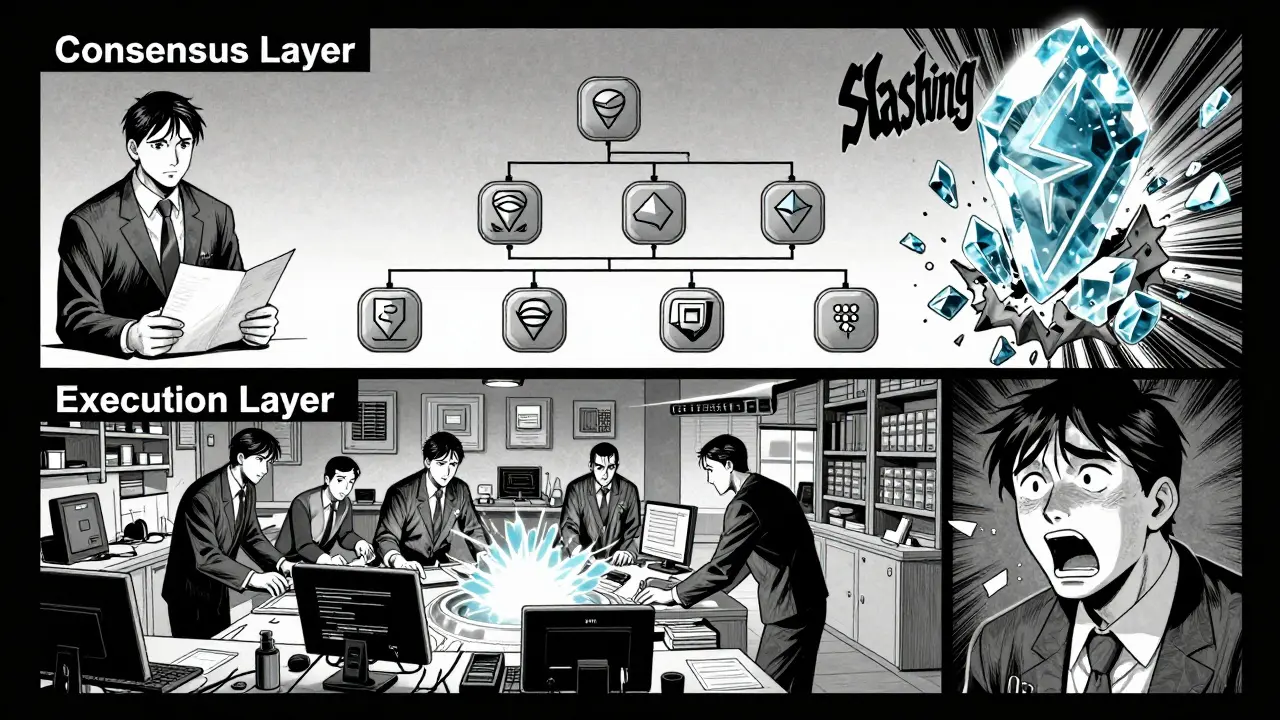
To keep the system honest, Ethereum employs a disciplinary tool called slashing. If a validator tries to attack the network, they don't just lose their reward-they lose their actual deposit.
Slashing is typically triggered by two main sins:
- Equivocation: This happens if a validator proposes two different blocks for the same time slot. It's a clear sign of an attempt to create a fork or double-spend.
- Contradictory Attestations: This occurs when a validator votes for two different versions of the chain history at the same time.
In a massive, coordinated attack where many validators misbehave at once, the network can slash up to 100% of their stake. This makes the cost of attacking Ethereum astronomically high, as the attacker would have to destroy billions of dollars of their own ETH to succeed.
The Two-Layer Architecture
One of the coolest parts of Ethereum's design is that it splits the work between two different layers. It's like having a manager and a worker.
The consensus layer (often called the Beacon Chain) is the manager. It handles the "who's who" of validators, manages the slots and epochs, and coordinates the voting. It doesn't actually care what's inside a transaction; it only cares that the validators agreed on it.
The execution layer is the worker. This is where the actual smart contracts live and where transactions (like sending tokens or swapping on Uniswap) are processed. When a validator receives a block, they use their execution client to re-run the transactions and make sure the math adds up before they send their vote back to the consensus layer.
Handling Conflicts: LMD-GHOST
Even with a strict schedule, the internet is messy. Sometimes network lag causes validators to see different versions of the chain. To solve this, Ethereum uses an algorithm called LMD-GHOST (Latest Message Driven - Greedy Heaviest Observed Subtree).
Instead of just following the longest chain, LMD-GHOST looks for the chain that has the most "weight"-meaning the most attestations from validators. It basically asks, "Which version of history do the most people agree with?" This ensures the network stays unified even if some nodes are temporarily out of sync.
Can I stake ETH if I don't have 32 ETH?
Yes. While running your own full validator node requires 32 ETH, you can use staking pools or liquid staking services. These allow you to deposit any amount of ETH, and the service provider handles the technical requirements and the 32 ETH minimum on your behalf, sharing the rewards with you.
Is my ETH locked forever when I stake it?
No, but it isn't instantly liquid. You can initiate a withdrawal at any time. However, there is an exit queue to prevent a massive wave of validators from leaving at once, which would weaken the network's security. Depending on the queue length, it may take a few days or weeks to get your funds back.
What happens if my computer goes offline while validating?
You won't be "slashed" (which is for malicious acts), but you will suffer from "inactivity leak." This means you lose a small amount of ETH for every slot you miss because you aren't contributing to the network's security. It's a productivity penalty, not a punishment for cheating.
How does PoS actually make Ethereum greener?
Proof of Work requires miners to run powerful hardware 24/7 to solve puzzles. Proof of Stake replaces that race with a lottery based on how much ETH you hold. A validator can run on a modest computer or even a small server, reducing the network's total energy consumption by over 99.9%.
What is MEV and does it affect staking?
Maximal Extractable Value (MEV) is the profit a block proposer can make by strategically ordering or including certain transactions in their block. This adds an extra layer of reward for validators beyond the standard protocol rewards, but it also introduces complexity and potential fairness issues in how transactions are processed.
Next Steps for Aspiring Validators
If you're looking to get involved, your path depends on your technical comfort level:
- The Non-Tech Route: Look into reputable liquid staking protocols. This is the fastest way to earn rewards without managing servers.
- The Mid-Tech Route: Use a staking-as-a-service provider where you keep your keys but they manage the infrastructure.
- The Pro Route: Set up your own hardware. You'll need an execution client (like Geth), a consensus client (like Prysm), and a validator client. Make sure you have a stable internet connection and a reliable power backup, or you'll face those inactivity leaks we mentioned earlier.
Carroll Foster
April 11, 2026 AT 01:52Imagine thinking this is a "simple guide" when it barely scratches the surface of the Byzantine Fault Tolerance implications here. It's all fun and games until you actually dive into the state transition function and realize most people just blindly trust the Beacon Chain without understanding the actual cryptographic primitives at play. Totally adorable that we're pretending the MEV-Boost leak isn't a massive centralization vector in this supposedly decentralized utopia.
daniella davis
April 12, 2026 AT 05:24Omg please... as if anyone here actually knows what a "checkpoint" even is lol. I've been in the space since the early days and this explanation is just so... basic. Like, it's practically childs play. Honestly, if you don't get the nuance of LMD-GHOST on the first read, maybe just stick to buying dog coins and leave the real tech to the adults who actually launder their gains properly.
Terrance Hausmann
April 12, 2026 AT 23:06It's great to see the transition from PoW to PoS explained so clearly for newcomers.
While some might argue that the technical complexities are overwhelming, it's important to remember that every expert was once a beginner, and providing these accessible entry points is exactly how we grow the community into a more inclusive and sustainable ecosystem for everyone involved regardless of their starting point.
Swati Sharma
April 13, 2026 AT 06:23The synergy between the execution layer and the consensus layer is a brilliant architectural choice to optimize throughput. Using liquid staking protocols definitely lowers the barrier to entry for retail participants who can't afford the 32 ETH threshold, effectively democratizing the validation process while maintaining the network's security parameters through pooled collateral.
Tracie and Matthew Hartley
April 14, 2026 AT 02:32idk why everyone is acting like PoS is so great. its basically just a rich get richer scheme. the whalez just stack more eth and get more votes. its not even real decentralization, just a different way to gatekeep the network lol.
Jonathan Chamma
April 14, 2026 AT 13:31That's a fair point, but it's more like a garden that needs tending. If we focus too much on the weeds, we miss the beautiful flowers of innovation. Let's just be glad we aren't boiling the ocean with those old mining rigs anymore.
Will Dixon
April 14, 2026 AT 22:36i just use a pool cause i dont have 32 eth. its way easier for regular folks.
Scott Fenton
April 16, 2026 AT 01:53It is imperative to emphasize that individuals utilizing staking-as-a-service providers must perform due diligence regarding the custody of their private keys. Entrusting the security of one's assets to a third party introduces a counterparty risk that may outweigh the convenience of the service.
Lauren Abrams
April 16, 2026 AT 15:08The part about the 12-second heartbeat is interesting. It makes the whole system feel more like a living clock than a random competition.
Stanly Hayes
April 17, 2026 AT 11:41Who cares about the heartbeat? The real issue is that the US is still lagging behind in crypto adoption compared to other regions. We need to stop playing around with "simple guides" and start dominating the infrastructure before someone else does it first!
logan bates
April 19, 2026 AT 05:08Exactly. American tech should lead the way or not bother at all.
aletheia wittman
April 19, 2026 AT 13:33LMAO the drama in these comments is better than the actual article. Imagine being this pressed over some digital coins. Its literally just math and money, stop acting like its a religion!!
Rebecca Violette
April 19, 2026 AT 15:50My wallet just got slashed and im literally shaking right now. I did nothing wrong and now my money is gone because of some stupid glitch. Why does this always happen to me? Everything is just so unfair and this whole system is a nightmare that just sucks the life out of everyone who tries to participate in good faith.
Chidinma Sandra okafor
April 20, 2026 AT 21:40Oh look, another person crying about their lost money in the comments. How shocking. Truly, the pinnacle of financial revolution is watching people lose their life savings to a "technical error" while the devs pretend everything is fine. Pure brilliance.