How Russia Uses Cryptocurrency to Bypass Western Sanctions in 2026

Western sanctions have squeezed Russia’s traditional banking channels dry. But instead of collapsing, the Russian financial system has pivoted into the shadows of blockchain technology. By mid-2026, a sophisticated network of custom tokens, shell companies, and replacement exchanges is keeping billions of dollars flowing for military procurement and political operations. This isn’t just about buying Bitcoin; it’s a structured, state-aligned infrastructure designed specifically to blind international regulators.
The core problem for Moscow was simple: how do you move rubles out of the country when correspondent banks refuse to touch them? The answer they found involves complex multi-layered systems that convert sanctioned currency into digital assets, shuffle them through opaque jurisdictions like Kyrgyzstan, and cash them out globally. Understanding this mechanism is crucial for anyone tracking global financial security or navigating compliance in the crypto space.
The Rise of the A7A5 Token
At the heart of this evasion strategy lies a specific digital asset: A7A5, a ruble-backed cryptocurrency issued by a Kyrgyzstani firm. Launched in early 2025, this token wasn’t created for speculative trading. It was built as a bridge between the isolated Russian economy and the global crypto market.
A7A5 operates on both TRON and Ethereum blockchains. This dual-chain presence is strategic. It ensures redundancy; if one network faces increased scrutiny or technical issues, transactions can shift to the other. In its first four months alone, A7A5 processed $9.3 billion in transactions. That volume dwarfs most legitimate stablecoin launches and highlights the sheer scale of capital moving through this channel.
The token functions by allowing users to deposit rubles into a dedicated exchange, receive A7A5 tokens, and then trade those tokens for other cryptocurrencies or fiat currencies abroad. This process effectively strips the transaction of its Russian origin story before it hits the broader market. Compliance firms like Elliptic have had to update their screening tools to detect A7A5 activity, proving that these custom assets are becoming a standard tool for sanctions evasion.
From Garantex to Grinex: The Exchange Pivot
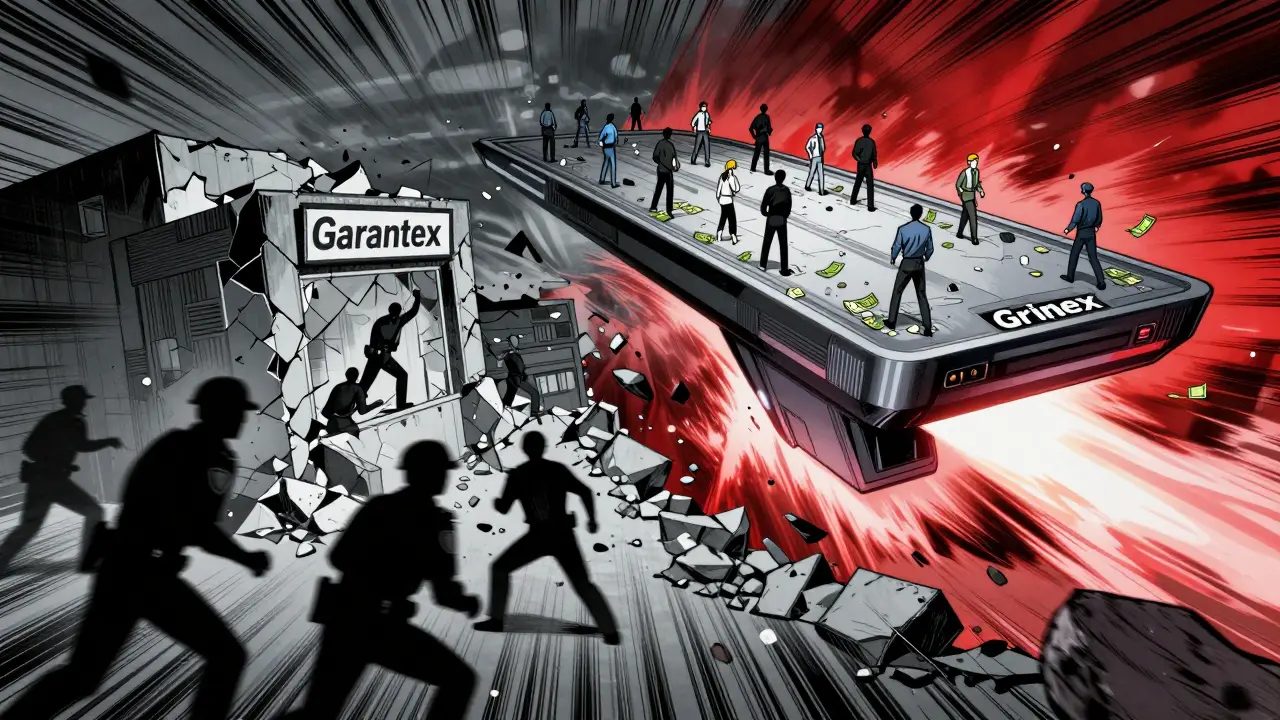
Russia’s reliance on centralized exchanges for these flows has been dramatic. For years, Garantex served as the primary gateway for converting illicit funds into crypto. However, the U.S. Secret Service moved against Garantex on March 6, 2025, seizing its domain and disrupting its operations. Most observers expected this to cripple the flow of funds.
They were wrong. Almost immediately, Garantex officers launched Grinex. The transition was seamless. Grinex’s promotional materials explicitly stated it was formed in response to the sanctions and asset freezes affecting Garantex. Customer deposits were transferred directly to the new platform, maintaining continuity for users who needed to move money quickly.
This rapid pivot demonstrates a high level of operational resilience. Grinex didn’t just copy Garantex; it integrated deeper into the evasion ecosystem, facilitating billions in transactions before being designated by the U.S. Treasury’s Office of Foreign Assets Control (OFAC). The pattern is clear: when one exchange falls, another rises with identical infrastructure and personnel, making enforcement a game of whack-a-mole.
| Platform | Status (2026) | Key Role in Evasion | Sanctioning Body |
|---|---|---|---|
| Garantex | Seized/Inactive | Primary gateway until March 2025 | U.S. Treasury (OFAC) |
| Grinex | Active/Sanctioned | Direct successor to Garantex | U.S. Treasury (OFAC) |
| A7A5 | Active | Ruble-backed token for liquidity bridging | UK Government |
| Meer | Active/Sanctioned | Secondary exchange partner | UK Government |
The Kyrgyzstan Connection
You cannot understand Russia’s crypto evasion without looking at Kyrgyzstan. This Central Asian nation has become a critical hub for laundering Russian money. The architecture relies heavily on local financial institutions acting as gateways between the Russian ruble zone and the global crypto market.
A key player here is Capital Bank, based in Bishkek. Under director Kantemir Chalbayev, Capital Bank serves as a financial conduit for purchasing military goods. It connects traditional banking systems with cryptocurrency networks, enabling the conversion of digital assets back into fiat currency for procurement purposes.
This integration is dangerous because it legitimizes illicit flows. By using a licensed bank, the funds gain a veneer of legality before entering the crypto sphere. Investigations by Transparency International Russia have shown how shell individuals and companies sell their documents en masse to bypass Know Your Customer (KYC) checks at these institutions. The result is a pipeline where dirty money enters a regulated bank, converts to crypto, and exits into unregulated wallets.
Political Warfare and Ilan Shor
Cryptocurrency isn’t just funding tanks; it’s funding political destabilization. Leaked data from September 2025 revealed the extent to which Russian allies use crypto for covert operations. Ilan Shor, a Moldovan politician sanctioned by the U.S., sits at the center of this web.
Shor, convicted in 2017 for stealing $1 billion from Moldovan banks, has been aiding Russia’s efforts to undermine democratic elections in Moldova. Analysis by Elliptic shows that wallets controlled by A7 and associated businesses received $8 billion in stablecoin transactions over 18 months. These funds weren’t just parked; they were used to purchase infrastructure for apps that manage and pay networks of political activists.
This creates a direct link between crypto sanctions evasion and hybrid warfare. The same mechanisms that allow Russia to buy weapons also allow it to fund disinformation campaigns and influence foreign elections. The opacity of blockchain makes it difficult to trace these payments back to their source, providing perfect cover for such activities.

International Regulatory Crackdown
The window for easy evasion is closing. Throughout 2025 and into 2026, international bodies have coordinated unprecedented strikes against these networks. The European Union adopted its 19th package of sanctions, marking the first time it directly targeted "dirty Russian crypto schemes." This ban prohibits transactions on platforms known to bypass restrictions.
In October 2025, the UK government announced actions targeting Grinex, Meer, and the A7A5 token infrastructure. These moves were part of a broader strategy to reinforce diplomatic pressure on Russia. The U.S. Treasury has continued to designate entities under OFAC, freezing assets and cutting off access to the dollar system.
However, enforcement remains challenging. The Financial Action Task Force (FATF) highlighted in August 2025 that terrorist organizations and state actors alike are exploiting virtual assets. President Elisa de Anda Madrazo noted that groups like ISIL-K are increasingly using crypto for organizational transfers. This broader context means that anti-money laundering efforts must address not just Russia, but a global trend of malicious crypto usage.
Future Trends and Industry Impact
Despite the crackdowns, analysis from Oxford Analytica suggests Russia will continue expanding its crypto footprint. The short-term benefits of circumventing sanctions outweigh the risks for now. As regulatory pressure mounts, we expect further innovation in evasion techniques.
Look for more custom tokens similar to A7A5, each designed to exploit gaps in specific regulatory frameworks. Expect deeper integration with decentralized finance (DeFi) protocols, which offer less oversight than centralized exchanges. The cat-and-mouse game between evaders and regulators will drive significant changes in the crypto industry’s compliance infrastructure.
For the legitimate crypto community, this means stricter KYC requirements and more advanced chain analysis tools. Companies like Elliptic are already adding support for screening specific evasion tokens. If you operate in this space, staying ahead of these evolving threats is no longer optional-it’s essential for survival.
What is the A7A5 token?
A7A5 is a ruble-backed cryptocurrency issued by a Kyrgyzstani firm. It was created specifically to help Russians bypass Western sanctions by converting rubles into a digital asset that can be traded on TRON and Ethereum blockchains. Since its launch, it has processed billions of dollars in transactions.
Why did Garantex shut down and what replaced it?
Garantex was seized by the U.S. Secret Service in March 2025 due to its role in facilitating sanctions evasion. It was immediately replaced by Grinex, an exchange launched by the same team. Grinex continues to provide similar services and has itself been sanctioned by the U.S. Treasury.
How does Kyrgyzstan fit into Russia's crypto evasion scheme?
Kyrgyzstan acts as a financial hub where Russian rubles are converted into cryptocurrency. Institutions like Capital Bank serve as gateways, connecting traditional banking with crypto networks. Shell companies and lax KYC checks in the region facilitate the movement of illicit funds.
Is using cryptocurrency to bypass sanctions legal?
No. Using cryptocurrency to evade internationally recognized sanctions is illegal in most Western jurisdictions. The U.S. Treasury, UK government, and EU have all imposed strict penalties on individuals and entities involved in these schemes, including asset freezes and criminal charges.
What role does Ilan Shor play in this network?
Ilan Shor is a sanctioned Moldovan politician who uses crypto funds to support Russian political interests. Leaked data shows his associated wallets received billions in stablecoins, which were used to fund political activism and destabilize democratic processes in Moldova.
Jerry CUNNINGHAM SR
May 17, 2026 AT 04:23The structural resilience of these evasion networks is quite fascinating from a systemic risk perspective. It highlights how quickly financial infrastructure can adapt when traditional channels are closed, creating a parallel economy that operates largely outside regulatory oversight. The shift from Garantex to Grinex demonstrates a level of operational continuity that suggests deep institutional knowledge rather than just opportunistic behavior. We must consider the broader implications for global financial stability as these mechanisms become more entrenched.
Shelby Cantu
May 17, 2026 AT 22:41So scary.
Bradley Geldenhuys
May 18, 2026 AT 06:09look at this mess its totaly wild how they keep switching names like garantex to grinex lol. its not hard to trace if u actually look at the wallet addresses but regulators are too slow or maybe just dumb. the kyrgyzstan angle is classic move using weak links in the chain to wash money clean before it hits the real markets. honestly feels like a video game where they respawn instantly after dying. we need better tech to catch these guys fast
Kiran CS
May 19, 2026 AT 10:37One might observe that the so-called 'innovations' described herein are merely the desperate flailings of a sanctioned regime attempting to maintain relevance through illicit means. The reliance on such opaque instruments as A7A5 reveals a profound lack of sophistication in their economic strategy, relying instead on brute force volume to overwhelm compliance filters. It is truly amusing to witness the West struggling to contain what is essentially a digital version of old-school smuggling rings. The pretension of calling this 'financial engineering' is laughable.
Bijan Das
May 20, 2026 AT 01:36yeah another article about russia doing shady stuff who cares really. i mean sure its interesting but its not like its gonna change anything for us regular folks. they will just find another way around it probably some new token next week. boring stuff honestly
Ashley Rodriguez
May 20, 2026 AT 09:12i think its really important to understand how these systems work because it affects everyone eventually you know its not just about sanctions its about trust in the whole system and when people see banks being used for bad things it makes them feel unsafe and i worry that this will lead to more distrust in traditional finance which could be bad for the economy overall so we should pay attention to these developments even if they seem far away right now
Bridget Coogle
May 20, 2026 AT 19:27its good to see people talking about this openly because awareness helps fight it we need to stay informed and support stronger regulations without giving up hope that transparency can win out in the end
Zara Zaman
May 21, 2026 AT 21:19This is exactly why we cannot allow foreign interference in our financial systems. The use of crypto to fund political destabilization is an act of war against democratic institutions. We must take immediate action to shut down these pipelines and hold those responsible accountable regardless of where they hide their assets. National security depends on closing these loopholes now.