IP Address Tracking and Geolocation Verification for Crypto Users: How Your Privacy Is at Risk

When you send Bitcoin, you might think you’re anonymous. Your wallet address? Just a string of letters and numbers. No name, no ID, no bank account linked. But what if someone could pinpoint where you are - down to the city - just by watching your internet traffic? That’s not science fiction. It’s happening right now.
How Your IP Address Leaks Your Crypto Activity
Every time you broadcast a Bitcoin transaction, your device connects to other nodes on the network. These nodes are computers running Bitcoin software that relay transactions to keep the blockchain updated. When your transaction goes out, it doesn’t vanish into thin air. It travels through the network, and each node logs the IP address of the device that sent it. This isn’t a glitch. It’s how Bitcoin was designed to work. Researchers at the University of Edinburgh and other institutions proved this back in 2018. They set up over 100 monitoring nodes across the globe. These weren’t hacking tools. They were regular Bitcoin clients, quietly listening for new transactions. Using a statistical method called a naive Bayes classifier, they matched transaction timestamps and network propagation patterns to the IP addresses that first sent them. In many cases, they could identify which IP address controlled a specific Bitcoin wallet with over 70% accuracy. The scary part? This setup doesn’t require special hardware or deep technical skills. A single server, a few lines of code, and a public Bitcoin node can do this. And there’s no way to tell if you’re being watched. Your wallet doesn’t show a warning. Your app doesn’t notify you. You just keep sending coins - unaware that your location is being recorded.Geolocation Isn’t Just About Your City
IP addresses aren’t just random numbers. They’re tied to internet service providers (ISPs), data centers, and geographic regions. When law enforcement or blockchain analysis firms like Chainalysis or Elliptic get a hold of an IP address linked to a Bitcoin transaction, they can cross-reference it with public databases to find out:- Which country the user is in
- Which city or even neighborhood
- Which ISP they use (e.g., Comcast, Deutsche Telekom, Telstra)
- Whether the IP belongs to a residential connection or a data center
Privacy Coins Aren’t the Escape Hatch You Think
Many users turn to privacy-focused coins like Monero or Zcash thinking they’re safe. But the reality is more complicated. Zcash was built with optional privacy. It has two types of addresses: transparent (t-addresses) and shielded (z-addresses). The shielded ones use zk-SNARKs - advanced cryptography that hides sender, receiver, and amount. Sounds perfect, right? Not quite. A 2023 study found that less than 15% of Zcash transactions used fully shielded addresses. Why? Because most wallets default to t-addresses. Users don’t know how to switch. Or they send funds to an exchange that doesn’t support shielded addresses. Or they accidentally send from a shielded wallet to a public one - and boom, the trail is live. Monero is stronger. It hides every transaction by default. But even Monero isn’t bulletproof. In 2024, multiple exchanges delisted Monero due to regulatory pressure. And while the blockchain itself hides details, your IP address during a transaction? Still visible. If you’re not using Tor or a VPN, Monero won’t save you from geolocation tracking.
What People Do to Hide - And Why It Often Fails
The crypto community has developed a few workarounds. Most common?- VPNs: Hide your real IP. Sounds smart. But many VPN providers log your activity, and some have been subpoenaed by authorities. A 2022 case in the U.S. showed that a crypto trader was identified because his VPN provider kept logs for 90 days.
- Tor: Routes your traffic through multiple encrypted layers. More secure than a VPN. But Tor is slow. Many crypto wallets don’t support it. And if you connect to a public Bitcoin node over Tor, you still risk being flagged as a privacy user - which makes you a target.
- Mixing services: These services pool your coins with others to break the chain. But they’re risky. Many have been shut down by regulators. Others are scams. And if you’re moving large amounts, mixers often fail - the timing and volume of inputs and outputs still leave patterns.
Who’s Doing the Tracking - And Why
This isn’t just about hackers. It’s about governments, exchanges, and compliance firms.- Law enforcement: Agencies like the FBI, Europol, and the UK’s NCA use blockchain analytics tools to track ransomware payments, drug sales, and tax fraud. In 2023, the IRS seized over $2 billion in crypto assets tied to unreported income - all traced through IP and exchange records.
- Exchanges: Coinbase, Binance, Kraken - they all log your IP when you log in. If you transfer crypto from your wallet to their platform, they now know your wallet address is linked to your identity. That data can be shared with authorities.
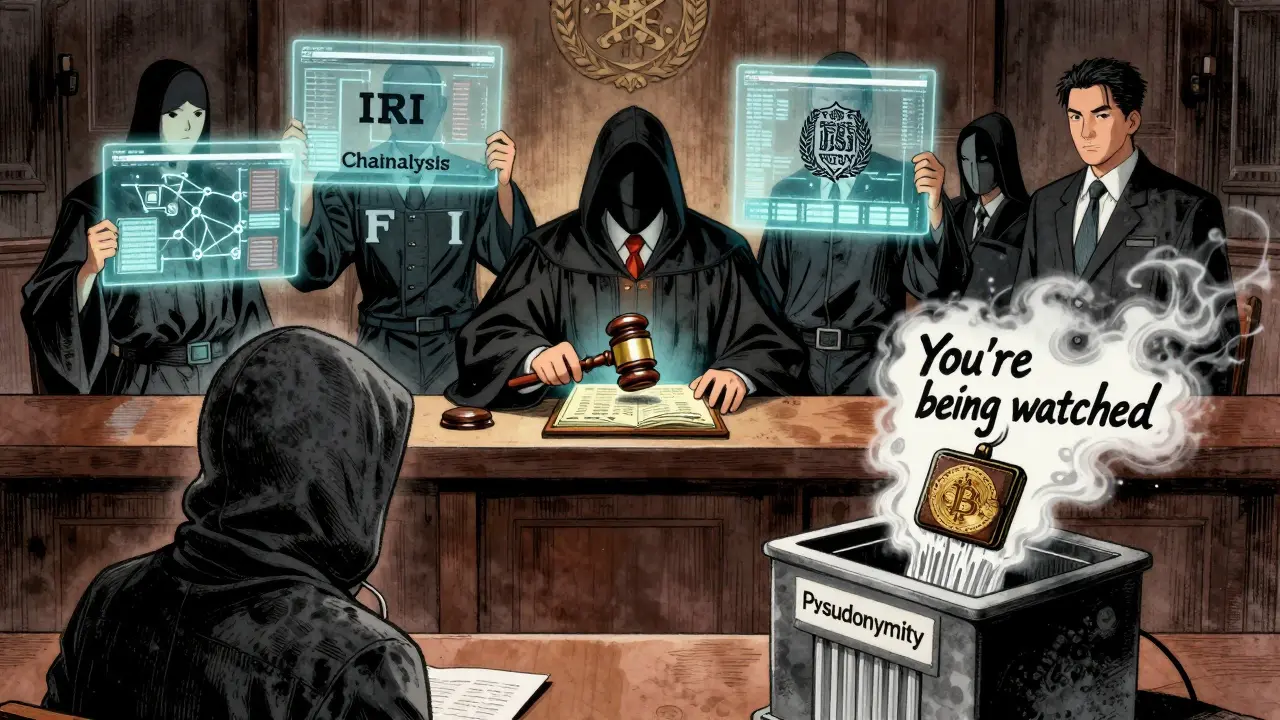
- Blockchain analytics firms: Companies like Chainalysis and Elliptic sell tools to governments and banks. Their software doesn’t just track transactions - it maps networks. If Wallet A sent money to Wallet B, and Wallet B later sent money to a known darknet market, they can trace the entire flow - even if Wallet A was never directly connected to an exchange.
What You Can Actually Do to Protect Yourself
You can’t eliminate risk. But you can reduce it.- Use Tor - If your wallet supports it (like Wasabi or Samourai), route all traffic through Tor. It’s not perfect, but it’s the best free option.
- Never reuse addresses. Each time you receive crypto, generate a new one. This makes correlation harder.
- Avoid linking wallets to exchanges. If you need to cash out, use peer-to-peer platforms like Bisq or LocalBitcoins - but even then, be cautious about your IP.
- Use privacy coins correctly. If you use Monero or Zcash, make sure you’re using shielded addresses and know how to check your transaction type. Don’t assume the app does it for you.
- Don’t publish your Bitcoin addresses. Posting them on social media, forums, or GitHub? That’s like leaving your house key under the mat.
What the Future Holds
The arms race is accelerating. On one side, trackers are using AI to detect patterns in transaction timing, fee structures, and network behavior. On the other, developers are building new protocols - like Lightning Network improvements, confidential transactions, and decentralized mixers. But here’s the hard truth: as long as crypto networks rely on peer-to-peer broadcasting, your IP address will be exposed. The real question isn’t whether tracking works - it’s whether you’re willing to accept the trade-off. If you want true privacy, you need to treat your crypto activity like a secret. Not just your wallet. Your connection. Your location. Your habits. Because someone, somewhere, is already watching.Can law enforcement track Bitcoin transactions without a warrant?
Yes. In many countries, law enforcement can obtain IP logs from ISPs or blockchain analytics firms without a warrant if they’re investigating financial crimes. Bitcoin transactions are public, and IP addresses linked to those transactions are treated as non-private data under current legal frameworks in the U.S., EU, and other jurisdictions.
Does using a VPN completely hide my crypto activity?
No. A VPN hides your IP from websites and public nodes, but your VPN provider can still see your activity. If they keep logs - and many do - authorities can request them. Also, if you connect to a Bitcoin node through your VPN, your traffic can still be monitored by blockchain analysis firms that track node connections. A VPN helps, but it’s not a full shield.
Why can’t I just use a new wallet for every transaction to stay anonymous?
Creating a new wallet helps, but only if you never link it to your real identity. If you buy Bitcoin on an exchange using your name, then send it to a new wallet, that new wallet is still tied to you through the exchange’s records. The wallet itself may be anonymous, but the money trail leading to it isn’t.
Are privacy coins like Monero truly untraceable?
Monero hides transaction amounts, senders, and receivers on the blockchain - that’s true. But your IP address during a transaction is still visible unless you use Tor or a VPN. So while the blockchain can’t trace the money, your location can. Monero is strong, but it’s not magic.
Can I be tracked if I only use crypto for small, personal purchases?
Yes. Even small transactions leave a trail. If you buy coffee with Bitcoin and later use that same wallet to receive funds from an unknown source, investigators can link those activities. The size of the transaction doesn’t matter - the connection between addresses does.
Gaurav Mathur
February 11, 2026 AT 17:33Jeremy Lim
February 12, 2026 AT 02:00John Doyle
February 13, 2026 AT 05:25kelvin joseph-kanyin
February 13, 2026 AT 14:45Grace Mugambi
February 15, 2026 AT 12:09Crystal McCoun
February 17, 2026 AT 11:17Beth Trittschuh
February 19, 2026 AT 09:20Benjamin Andrew
February 19, 2026 AT 21:04