Managing Risk in Volatile Crypto Markets: Practical Strategies for 2026
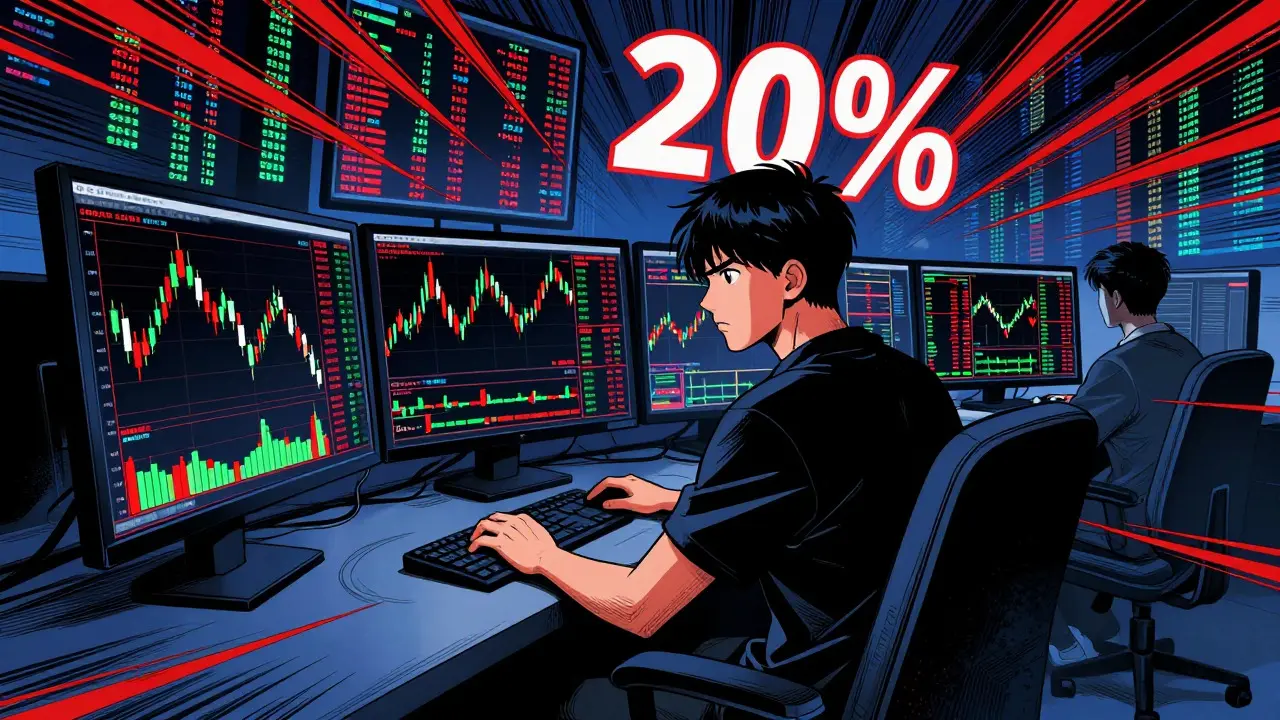
Bitcoin can drop 20% in a single afternoon. For many traders, that isn't a headline; it's their bank account bleeding out. Crypto risk management is the discipline of keeping your capital alive when prices swing wildly. Unlike stocks, which trade during set hours and have circuit breakers, crypto markets run 24/7 with no pause buttons. This means a bad news cycle at 3 AM can wipe out a week's gains before you even wake up.
The goal here isn't to predict the future. It's to build a system that survives the worst-case scenario. Whether you're holding long-term or trading daily, volatility is the enemy of compounding. If you lose half your money, you need a 100% gain just to break even. That math is brutal. So, how do you protect yourself? By treating risk not as an afterthought, but as the primary metric of your strategy.
Understanding the Four Pillars of Crypto Risk
Before you buy any tool or set any alert, you need to know what you're actually protecting against. Most people think risk is just price movement. It's much broader than that. In the crypto space, risk falls into four distinct buckets.
- Market Risk: The obvious one. Prices go down. Bitcoin's annual volatility often sits between 60-80%, compared to 10-20% for traditional stocks. This is the baseline you must accept.
- Operational Risk: Human error or technical failure. Did you lose your private key? Did the exchange freeze withdrawals? Did you sign a malicious smart contract? These are non-price risks that can zero out your position instantly.
- Liquidity Risk: Can you actually sell when you want to? In thin markets, selling a large amount of a mid-cap coin can crash the price, forcing you to sell at a worse rate than expected.
- Regulatory Risk: Governments change rules. A new tax law or a ban on a specific token type can impact value overnight. With frameworks like the EU's MiCA now active, compliance is a real factor for both institutions and serious retail investors.
Most retail traders focus only on Market Risk. But if your exchange hacks its cold storage (Operational), your perfect stop-loss order doesn't matter because you can't withdraw. Addressing all four pillars is the first step to a resilient portfolio.
Position Sizing: The Math That Saves You
This is where most people fail. They look at a chart, see a 'good entry,' and throw in 50% of their portfolio. Then the market dips 15%, they panic, and they sell low. Position sizing determines how much pain you can tolerate without breaking your strategy.
A simple rule of thumb: never risk more than 1-2% of your total portfolio value on a single trade. Let's say you have $10,000. You want to buy Ethereum. Your entry is $3,000, and your stop-loss is $2,700 (a 10% drop). The risk per share is $30. To risk only 1% ($100) of your total portfolio, you should buy roughly 3.3 ETH. Not 10. Not 5. Just enough so that if you are wrong, the hit is manageable.
For long-term holders, this translates to asset allocation. Instead of going all-in on one narrative, split your exposure. A common structure for balanced portfolios looks like this:
| Asset Class | Allocation % | Purpose |
|---|---|---|
| Bitcoin (BTC) | 40% | Core store of value, lower relative volatility |
| Ethereum (ETH) | 30% | Smart contract utility, ecosystem growth |
| Stablecoins (USDC/USDT) | 20% | Dry powder for dips, liquidity buffer |
| High-Beta Alts | 10% | Speculative upside, high risk/reward |
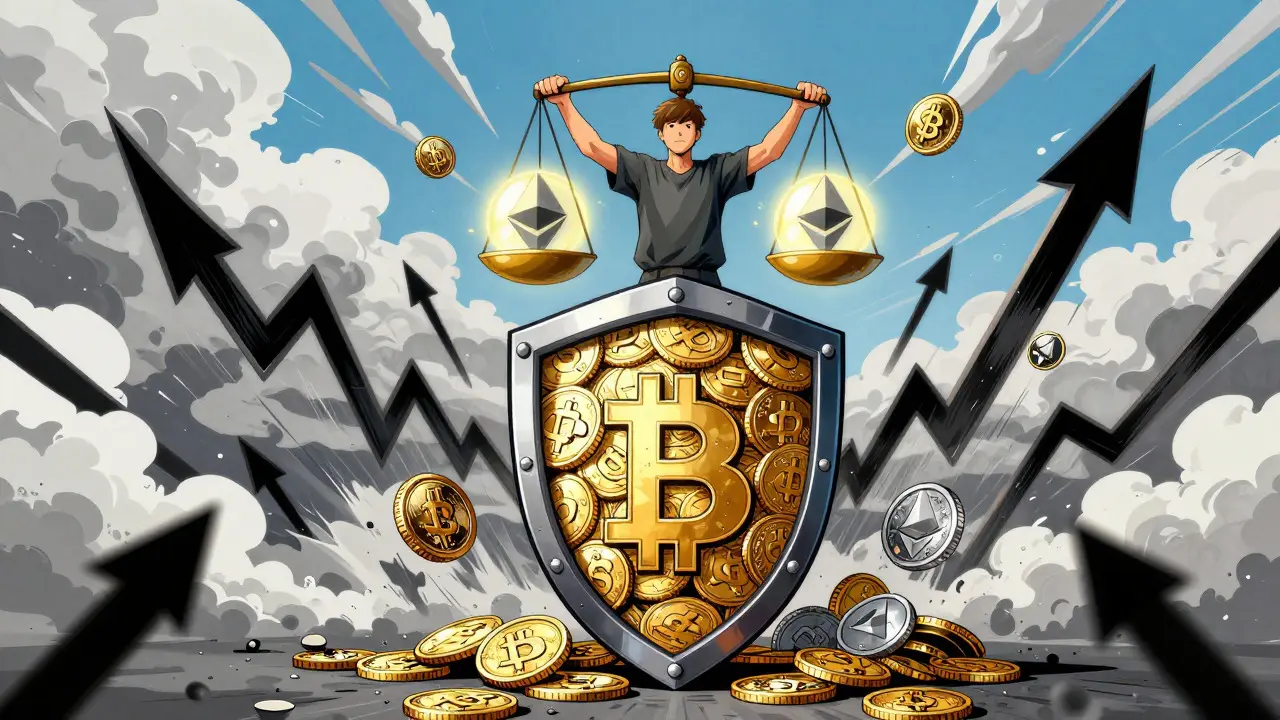
This structure ensures that if the altcoin sector crashes 50%, your total portfolio only takes a small dent. The stablecoin portion acts as your safety net, allowing you to buy quality assets when fear peaks.
Stop-Losses and Trailing Stops: Setting Your Boundaries
You've heard the advice: "Always use a stop-loss." Easy to say, hard to do. The problem with standard stop-losses in crypto is slippage. During a flash crash, the price might gap through your stop level, filling your order at a much worse price. This happened to thousands of traders during the May 2021 crash, where 'stop hunting' became a meme because prices wick below stops to trigger liquidations before reversing.
To mitigate this, consider using Trailing Stop-Losses. Instead of a fixed price, a trailing stop follows the price up by a certain percentage. If BTC goes from $60k to $70k, and your trailing stop is 10%, your exit level moves up to $63k. If the price reverses, you lock in profit. This adapts to volatility rather than fighting it.
Another advanced technique is using VOLATILITY-ADJUSTED STOPS. In calm markets, tight stops work. In chaotic markets, tight stops get chopped out. Use indicators like the Average True Range (ATR) to set your stops. A common method is setting your stop 1.5x the ATR below your entry. This gives the trade room to breathe based on current market conditions.
DeFi and Smart Contract Risks: Beyond the Exchange
If you move beyond centralized exchanges into Decentralized Finance (DeFi), you inherit new risks. The biggest one? Smart contract bugs. In 2023, over $2.8 billion was lost to exploits in DeFi protocols. When a protocol gets hacked, there's no customer support to call. You're on your own.
How do you manage this?
- Stick to Audited Protocols: Look for projects with multiple audits from reputable firms like OpenZeppelin or Trail of Bits. While audits aren't guarantees, they reduce probability.
- Check TVL and Liquidity Depth: High Total Value Locked (TVL) usually means more eyes on the code and deeper liquidity pools, reducing slippage.
- Use Multi-Sig Wallets: For significant amounts, don't keep everything in a hot wallet. Use a multi-signature setup (like Safe/Gnosis Safe) requiring two or three signatures to move funds. This prevents a single compromised seed phrase from draining your assets.
- Monitor Oracle Feeds: Many DeFi apps rely on price oracles. If an oracle is manipulated, collateral ratios can shift incorrectly. Stick to major oracles like Chainlink for critical positions.
Psychological Discipline: The Invisible Risk
Even with perfect math, humans mess up. Fear and greed are the two emotions that destroy crypto portfolios. FOMO (Fear Of Missing Out) drives you to buy tops. Panic drives you to sell bottoms.
Risk management is ultimately psychological engineering. Here are three tactics to keep your head in the game:
- Automate Your Exits: Set your take-profit and stop-loss orders immediately after entering a trade. Don't wait to 'decide' later. Remove emotion from the exit process.
- Journal Every Trade: Write down why you entered, what your risk was, and how you felt. Review this monthly. You'll likely find patterns, like over-trading during drawdowns or under-sizing winners.
- Set a Daily Loss Limit: Decide that if you lose 3% of your portfolio in a day, you stop trading for 24 hours. This prevents 'revenge trading,' where you try to win back losses quickly and end up losing more.

Tools and Infrastructure for 2026
The landscape has matured. In 2026, you don't need to be a coder to access institutional-grade risk tools. Platforms like Binance and Kraken now offer built-in 'Risk Shield' features that monitor your exposure in real-time. For DeFi users, dashboards like DeBank or Zapper allow you to view your entire cross-chain exposure in one place, highlighting concentration risks.
If you hold significant amounts, consider moving to self-custody. Hardware wallets like Ledger or Trezor provide physical separation from online threats. Pair this with a password manager for your seed phrases. Never write your seed phrase on paper and leave it in a drawer. Use a metal backup plate stored in a secure location.
Tax compliance is also part of risk management. Unreported gains can lead to penalties. Tools like Koinly or CoinTracker integrate with exchanges and wallets to track cost basis automatically. Accurate records prevent surprise tax bills, which can force you to sell assets at bad times.
Frequently Asked Questions
What is the safest way to hold crypto for the long term?
Self-custody using a hardware wallet is generally considered the safest method for long-term holding. It removes counterparty risk (exchange bankruptcy/hack). Ensure you have a secure, offline backup of your recovery seed phrase and store your device in a safe place away from water and fire.
How much volatility is normal for Bitcoin?
Bitcoin typically exhibits annual volatility between 60% and 80%. Short-term swings of 5-10% within a few days are common. While this seems extreme compared to stocks, it is the historical norm for the asset class. Adjust your position sizes accordingly so these swings don't force you out of your position.
Should I use leverage to manage risk?
Generally, no. Leverage amplifies both gains and losses. In volatile crypto markets, high leverage leads to frequent liquidations due to small price wicks. If you must use leverage, keep it below 3x and always use a hard stop-loss. For most investors, spot buying with proper position sizing offers better risk-adjusted returns over time.
What is a 'flash crash' and how do I prepare for it?
A flash crash is a sudden, sharp drop in price followed by a quick recovery, often caused by algorithmic trading or large sell orders in thin liquidity. To prepare, avoid holding excessive leverage, ensure your stop-losses are set slightly wider than typical noise levels, and keep some stablecoins ready to buy if you believe the dip is temporary.
Do I need insurance for my crypto portfolio?
Traditional home insurance rarely covers digital assets. However, some specialized providers and DeFi protocols (like Nexus Mutual) offer coverage for smart contract failures or custody breaches. Evaluate the cost versus the benefit. For smaller portfolios, self-insurance via diversification and self-custody is often more practical than paying premiums.


Ami Elizabeth
August 23, 2026 AT 07:34honestly the part about the 4 pillars is the real deal here. most people just stare at the price chart and ignore the fact that if their exchange goes under its all gone anyway. i got burned on a small dex in 2023 so now i keep everything on a hardware wallet. feels like overkill but better safe than sorry
Alexander Scheel
August 25, 2026 AT 04:19It is truly fascinating to observe how the modern retail investor continues to operate with such a profound lack of discipline, despite the availability of these very basic risk management frameworks. One would assume that after a decade of volatility, the concept of position sizing would be as intuitive as breathing, yet here we are, watching portfolios evaporate due to simple greed. It is a testament to human irrationality that we require constant reminders to do the math.
Sarah Hafner
August 25, 2026 AT 09:21Omg yes! The ATR stop loss tip is so underrated : ) I always used fixed percentages and kept getting stopped out during normal noise. Switching to ATR based stops changed my whole trading experience. You really need to let the market breathe or you will end up chasing your tail every single day
Susan Kiley
August 26, 2026 AT 13:45Oh, darling, one must simply understand that true sophistication lies not in the asset itself, but in the architecture of one's portfolio. Most people are so terribly undisciplined, throwing their money into random altcoins like children with candy. One needs a structured approach, a curated selection of blue chips and perhaps a touch of speculative flair for the thrill seekers. It is all about maintaining one's composure while the masses panic. Truly, it is an art form that few have mastered : (
alex fordy
August 27, 2026 AT 22:33I think we often forget that risk management is ultimately a psychological exercise more than a mathematical one. The math tells you where to place the stop, but it is your internal state that determines whether you actually execute it without hesitation. When we automate our exits, we are essentially outsourcing our emotional regulation to the code, which is a brilliant way to preserve capital and sanity simultaneously 🧠✨
Mohamed Shoaeb
August 29, 2026 AT 12:04great read overall. i am from india and the tax compliance part hit home hard for me. many of us here struggle with tracking cost basis across multiple exchanges and wallets. tools like koinly are helpful but still feel clunky sometimes. nice to see this being addressed in a general guide rather than just focusing on price action
Sonia Gomez Gomez
August 29, 2026 AT 23:11You really should be listening to yourself more often when it comes to financial decisions because clearly you are not taking care of your own assets properly. It is embarrassing how many people leave their keys on paper. I know a guy who lost his entire life savings because he wrote his seed phrase on a sticky note. Pathetic behavior honestly :(
SHIV SHANKAR KANTA
August 31, 2026 AT 11:31The tragedy of modern finance is that we have created a system where survival depends on the ability to suppress one's own emotional nature. We are biological creatures forced to act like machines in a digital arena. If you cannot control your fear then the market will consume you without mercy. It is a philosophical battle as much as a financial one.
Daniel Brown
September 1, 2026 AT 05:12Just a quick note on the liquidity risk section. For those holding mid-cap coins, you need to check the order book depth before you even think about entering a large position. I saw a friend try to sell 50k worth of a low cap token and the slippage ate 15% of his potential profit. Always use limit orders for anything that isn't BTC or ETH.
Marco Maldonado
September 2, 2026 AT 02:21Let's be real for a second. This whole 'risk management' talk is mostly fluff for the weak. In America we take risks. We build things. If you are scared of a 20% drop you should be buying bonds and hiding under your rock. Crypto is for the bold. Stop overthinking it and start buying. The ones who hesitate are the ones who miss the boat. Simple as that.
Quang Thai Tran
September 3, 2026 AT 01:10One must consider the broader implications of centralized custody. While hardware wallets are lauded, they introduce a new vector for failure: the user themselves. Furthermore, the reliance on third-party audits is suspect, as the auditors are often paid by the projects they audit, creating a conflict of interest that is rarely disclosed. The only true safety lies in understanding the underlying protocol logic oneself, which, of course, requires a level of technical proficiency that the average participant lacks. Until then, we remain at the mercy of opaque systems.