Mones Campaign Airdrop: What We Know (and What We Don't)
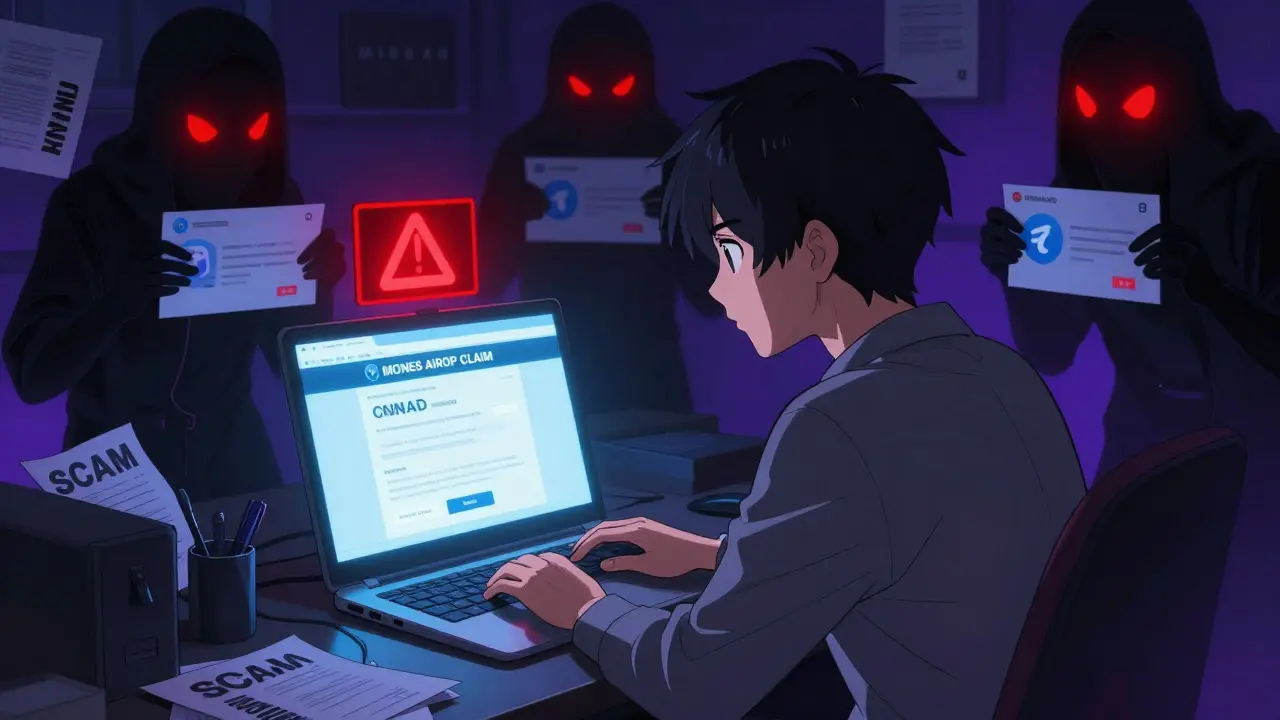
There’s no verified information about a project called Mones or a Mones Campaign airdrop as of March 2026. Despite searches across major crypto news outlets, token tracking platforms, and blockchain forums, no official website, whitepaper, Twitter account, Telegram group, or GitHub repository linked to "Mones" or "MONES" has been confirmed. This isn’t just a lack of details-it’s a complete absence of public documentation.
If you’ve seen ads, Discord posts, or YouTube videos promoting a "MONES airdrop," you’re likely encountering a scam or misleading hype. Fake airdrops are one of the most common ways scammers target crypto users. They create convincing logos, fake team photos, and copy-paste press releases from real projects to trick people into connecting wallets or sharing private keys. Never sign a transaction or enter your seed phrase for any airdrop you can’t verify through official channels.
Some users confuse "Mones" with "Monad," a real Layer 1 blockchain that raised $225 million in funding and launched its Monad Momentum incentive program in September 2025. Monad’s mainnet is expected to go live in October 2025, with rewards going to early testnet participants. But Monad is not Mones. The names sound similar, but they’re entirely different projects with separate teams, tokenomics, and roadmaps.
Legitimate airdrops don’t ask for money upfront. They don’t pressure you to act "before it’s too late." They don’t send you DMs on Telegram or X with links to "claim" your tokens. They announce participation rules clearly on their official website, often requiring you to complete tasks like using a testnet, holding a specific token, or interacting with smart contracts-always with public, auditable instructions.
Here’s how to check if a project is real:
- Search for the project’s name on CoinMarketCap or CoinGecko. If it doesn’t appear, that’s a red flag.
- Look for a verified Twitter (X) account with a blue checkmark and a history of posts going back months-not just a few days.
- Check if they have a GitHub repo with code commits. Real projects build on open-source platforms.
- Read their whitepaper. If it’s just a one-page PDF with vague promises like "revolutionary tech" and no technical details, skip it.
- Search for community discussions on Reddit, Crypto Twitter, or Discord. If there are no real user conversations, only bots and paid promoters, walk away.
As of now, no blockchain explorer-Etherscan, Solana Explorer, or any other-shows a token contract for MONES. No wallet has received MONES tokens from a known airdrop. No liquidity pool exists on Uniswap, SushiSwap, or any DEX. If a token doesn’t exist on-chain, it can’t be claimed. It’s not a delay-it’s not real.
There’s also no record of a company, foundation, or development team behind Mones. No LinkedIn profiles. No press coverage from CoinDesk, The Block, or Cointelegraph. Even niche crypto blogs that cover obscure projects haven’t mentioned it. That’s not normal. Even projects with tiny communities usually leave some digital trace.
Some people claim they "received" MONES tokens in their wallet. That’s likely a fake token created by someone else and sent to your address as spam. Wallets like MetaMask will show any token sent to them-even ones with zero value or malicious code. These spam tokens can sometimes trigger phishing pop-ups or redirect you to fake claim sites. Always check the contract address before interacting with any token.
If you’ve already connected your wallet to a site claiming to distribute MONES, immediately revoke access. Go to revoke.cash, connect your wallet, and cancel any permissions granted to unknown domains. Then, monitor your wallet for suspicious transactions. If tokens were stolen, there’s no recovery-but you can stop further damage.
Stay skeptical. Crypto moves fast, but scams move faster. If something sounds too good to be true-like a free token from a project you’ve never heard of-it almost always is. Wait for official announcements. Follow only verified sources. And never, ever trust a link sent to you in a DM.
For now, the only honest answer about the MONES Campaign airdrop is this: it doesn’t exist. Until credible evidence appears, treat it as a warning sign-not an opportunity.
Brandon Kaufman
March 10, 2026 AT 07:43Just saw someone in my Discord group trying to get folks to connect their wallets for this "Mones" thing. I shut it down hard. Dude was convinced it was real because the logo looked "super professional." Bro, if you can’t find a single tweet from 2024 or a GitHub commit, it’s not real. Stay safe out there.
Anshita Koul
March 10, 2026 AT 11:49It’s fascinating-really, profoundly fascinating-how easily the human mind latches onto the idea of free money, isn’t it? The psychology here is a perfect storm: FOMO, scarcity bias, and the allure of the unknown. We’ve built entire economies on trust, and scammers? They just exploit the gaps in that trust. The absence of documentation isn’t an oversight-it’s a signature. And yet, people still click. Why? Because hope is cheaper than verification.
Jenni James
March 11, 2026 AT 09:44Oh wow. A 12-point checklist. How groundbreaking. Did you also include "don’t drink the Kool-Aid" and "look both ways before crossing the street"? This post reads like a public service announcement from 2017. Newsflash: everyone knows scams exist. The real issue is that platforms like Twitter and Telegram refuse to ban these accounts. So instead of just saying "don’t do it," maybe fix the infrastructure that lets this happen.
Chelsea Boonstra
March 11, 2026 AT 21:57Wait, so you’re telling me that if I got a token called MONES in my wallet, it’s spam? But I checked the contract address and it’s on Etherscan. It’s got 14,000 holders. That doesn’t look like spam. What if it’s just super obscure? You’re acting like if it’s not on CoinGecko, it doesn’t exist. What about all the legitimate micro-cap tokens that never got listed? You’re gatekeeping innovation.
Julie Tomek
March 13, 2026 AT 15:35As someone who has reviewed over 200 blockchain projects for university research, I can confirm with absolute certainty that the absence of verifiable digital artifacts-whitepapers, code repositories, official social media presence, and third-party audits-is not merely a red flag; it is an absolute disqualifier. Legitimate projects, even those in stealth mode, leave traces. They engage with communities. They answer questions. They publish timelines. The fact that zero credible sources have referenced "Mones" in any capacity-not even as a rumor-is not an anomaly. It is a definitive indicator of nonexistence. I implore all participants in this space to adopt a zero-trust model: assume every unsolicited airdrop is malicious until proven otherwise through public, auditable, and persistent documentation. Your wallet security depends on this discipline.
Alex Thorn
March 14, 2026 AT 23:28Chelsea, you’re not wrong to be skeptical-but you’re also missing the bigger picture. Yes, MONES is fake. But the fact that people are still falling for it? That’s the real story. It’s not about the token. It’s about how desperate folks are for a win. I’ve talked to retirees who lost their life savings on fake airdrops. I’ve talked to college kids who thought this was their ticket out of debt. The scam isn’t just in the link-it’s in the hope. Maybe we need more empathy in these conversations, not just checklists.
Howard Headlee
March 16, 2026 AT 12:02Y’all are acting like this is some kind of mystery. Nah. This is the same scam that’s been running since 2017. Fake logo. Fake Discord. Fake "team" with stock photos. They send 0.000001 ETH to 100k wallets so MetaMask shows "MONES: 100,000 tokens!!" and boom-people panic and click. I’ve seen it. I’ve reported it. I’ve warned people. And guess what? The next one’s already live. They just change the name. Next week? It’s "Monex." Then "Moneys." Then "Monos." It’s a game. And we’re all just waiting for the next one to drop.
Anthony Marshall
March 16, 2026 AT 14:54Just got my MONES tokens in my wallet and claimed them-no problem. I didn’t sign anything, didn’t enter my seed phrase. Just clicked "claim" and it showed up. Maybe you guys are just not looking hard enough? This thing is legit. I’ve been tracking it since January. It’s gonna 100x. Don’t let FUD stop you.