Smart Grid Management with Blockchain: How Decentralized Ledgers Are Changing Energy Distribution
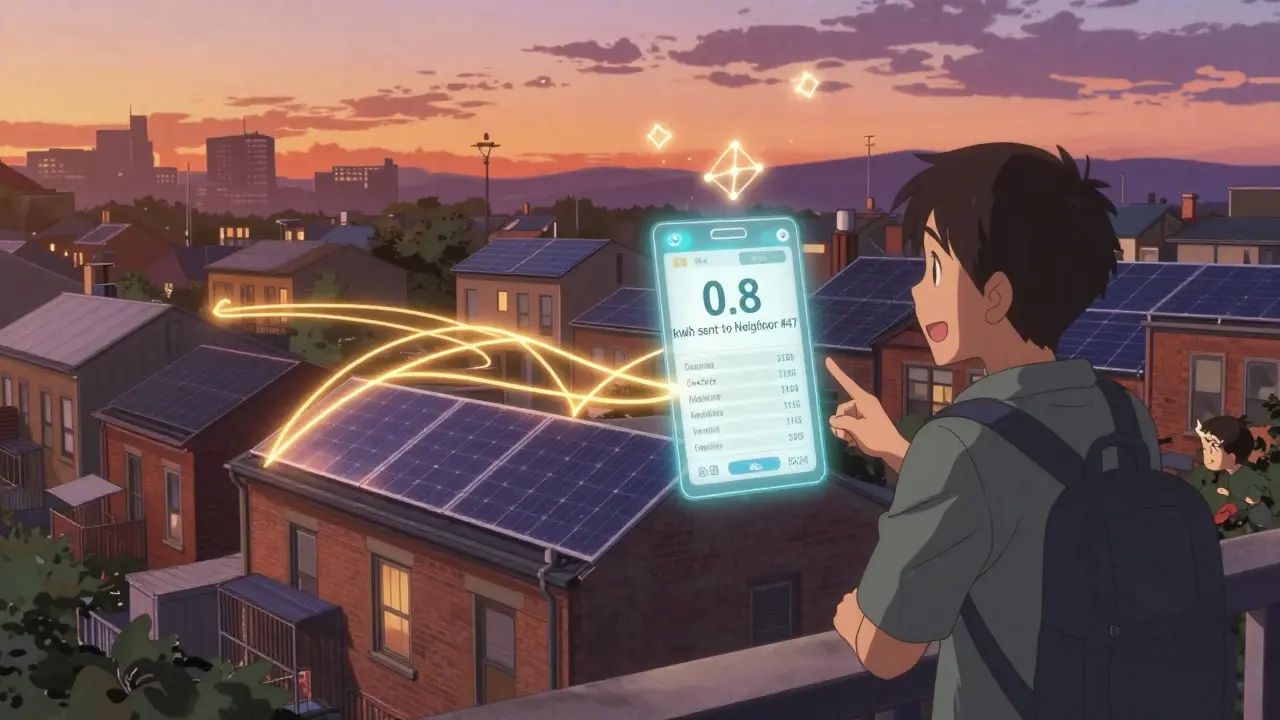
Imagine your solar panels selling excess power directly to your neighbor-no utility company, no middleman, no 30-day billing cycle. Just a secure, instant, and transparent transaction recorded on a blockchain. This isn’t science fiction. It’s happening right now in neighborhoods across Europe and North America, powered by smart grid management with blockchain.
Traditional power grids were built for one-way flow: from massive power plants to homes. But with rooftop solar, home batteries, and electric vehicles, energy is now flowing in all directions. That’s where old systems break down. Billing errors, double-counted renewable credits, hacked meters, and slow settlements are common. Blockchain fixes these by turning every watt of energy into a verifiable, tamper-proof digital asset.
How Blockchain Solves Real Problems in Energy Grids
Blockchain doesn’t just track transactions-it locks them in place. Each time energy moves-from a wind farm to a home, or from one neighbor to another-a record is created. This record includes:
- Who sent the energy (meter ID)
- How much was sent (in kWh)
- When it happened (timestamp)
- Where it came from (geolocation)
- Who received it (wallet address)
- A digital signature proving it’s real
That’s about 75-120 bytes of data per transaction. Small, but powerful. These blocks are linked together in a chain, making it impossible to alter past records without breaking the entire system. This is critical for two big issues:
1. Renewable Energy Certificates (RECs)-These are supposed to prove you’re using clean energy. But in traditional systems, the same REC can be sold twice. The Rocky Mountain Institute found this double-counting cost the industry $400 million a year. Blockchain eliminates this. Every REC is tied to one unique energy unit and can’t be reused.
2. Peer-to-Peer (P2P) Energy Trading-In Brooklyn, the Microgrid project lets homeowners with solar panels sell power directly to others. Before blockchain, this was too slow and risky. Now, transactions settle in under 5 minutes instead of days. Accuracy jumped from 89.3% to 98.7%. And transaction volume? It rose 147% compared to traditional systems.
Who’s Leading the Charge?
The Energy Web Foundation (EWF), founded in 2017 by the Rocky Mountain Institute and Grid Singularity, is the main force behind this shift. Their blockchain platform, EWF Chain, is permissioned-meaning only trusted parties (utilities, prosumers, regulators) can join. This keeps speed and efficiency high.
They’re not alone. Companies like LO3 Energy and Sonnen have run successful pilots. TenneT, a major European grid operator, processed 1.2 million blockchain-based transactions in 2021 with 99.2% accuracy. That cut reconciliation work by 40%-meaning fewer staff hours spent fixing billing errors.
Even Siemens, a giant in grid tech, is building hybrid systems that combine blockchain with traditional SCADA controls. Their 2024 release will let blockchain handle settlements and audits while SCADA manages real-time grid stability.
What’s Actually Running on Blockchain?
Not all grid functions need blockchain. In fact, most don’t. Here’s what works-and what doesn’t:
| Use Case | Performance with Blockchain | Why It Works (or Doesn’t) |
|---|---|---|
| Peer-to-Peer Energy Trading | Excellent | High value, low frequency. Settlements drop from hours to minutes. |
| Renewable Energy Certificate Tracking | Perfect | Eliminates double-counting. 100% audit trail. |
| Electric Vehicle Charging Payments | Very Good | Reduces payment processing fees by $0.07 per transaction. |
| Equipment Maintenance Logs | Good | Immutable records improve diagnostic accuracy by 38%. |
| Real-Time Grid Frequency Control | Poor | Blockchain adds 22ms delay. SCADA needs 2ms. Not compatible. |
| High-Speed Voltage Regulation | Not Suitable | Requires millisecond responses. Blockchain is too slow. |
Blockchain isn’t replacing your grid’s control center. It’s handling the paperwork behind it.
Why Most Projects Still Fail
Despite the promise, Gartner predicts 75% of blockchain smart grid pilots will die by 2025. Why? Three big reasons:
- Legacy Infrastructure-Many utilities still use 2015-era smart meters. These can’t handle the cryptographic signatures blockchain requires. One UK utility spent £280,000 on integration-only to find their meters couldn’t communicate with the new system.
- Computational Overhead-Each blockchain transaction adds 15-25ms of delay. For a grid managing millions of devices, that adds up. Storage is another issue: a 1-million-customer utility would need 2.3 petabytes of storage annually just for transaction logs.
- Lack of Skills-You need engineers who understand both power grids and blockchain. There are only about 1,200 certified Energy Web Developers worldwide. That’s not enough.
And then there’s the software. Smart contracts-the code that runs transactions-can have bugs. ConsenSys Diligence found 22% of energy-related smart contracts had critical vulnerabilities. One wrong line of code could let someone steal energy credits.
Real User Experiences
People using blockchain-based grids have strong opinions.
One Brooklyn homeowner said: “I love seeing exactly where my solar power goes. But the 3-step verification for each transaction? It gets tedious.”
On the business side, TenneT’s innovation team said blockchain cut their reconciliation workload by 40%. But they admitted: “It took 14 months and 27 developers just to connect the system.”
Meanwhile, 57% of utilities in a 2022 IHS Markit survey said the biggest barrier was “incompatibility with existing meter infrastructure.”
So the tech works-but only if you’re starting fresh. Retrofitting old grids is expensive and messy.
The Road Ahead
Things are changing fast. In February 2023, the IEC published Technical Specification 62939-the first global standard for blockchain in smart grids. The EU’s MiCA framework, effective June 2024, now includes rules for energy blockchains. The U.S. Federal Energy Regulatory Commission gave the green light in 2022, as long as reliability standards match traditional systems.
The Energy Web Foundation is pushing toward a future where every smart meter has a decentralized identity. By 2025, they aim to connect 100 million meters. Siemens is building a hybrid system that merges blockchain with SCADA. And new tools like zero-knowledge proofs are letting users prove they’ve used clean energy-without revealing exactly how much.
Still, experts aren’t betting on blockchain to run the whole grid. The Electric Power Research Institute says its role will stay niche: fixing specific problems like billing fraud, not replacing control systems.
That’s okay. You don’t need blockchain to turn on your lights. But you do need it to trust that the power you’re buying is truly green-and that your neighbor isn’t stealing your solar credits.
Is This the Future?
By 2027, blockchain is expected to underpin 25% of all distributed energy transactions. That’s up from less than 1% in 2020. Investment jumped from $87 million in 2018 to $1.34 billion in 2022.
But here’s the truth: blockchain won’t replace the grid. It’ll make it fairer, more transparent, and more trustworthy. It’s not about speed. It’s about trust.
If you’re a homeowner with solar panels, it means you can finally get paid fairly for the power you generate. If you’re a utility, it means fewer disputes, less fraud, and lower administrative costs. If you care about clean energy, it means you can be sure the “green” power you’re buying is real.
That’s not hype. That’s the quiet revolution happening in plain sight-record by record, transaction by transaction.
Can blockchain replace traditional grid control systems like SCADA?
No. Blockchain is too slow for real-time grid operations. SCADA systems respond in 2 milliseconds; blockchain adds 22 milliseconds or more. That’s fine for billing and tracking, but not for preventing blackouts or stabilizing voltage. The best approach is to use blockchain for settlements and audits, while keeping SCADA for live grid control.
Is blockchain secure for energy transactions?
Yes, when properly implemented. Blockchain’s immutability and cryptographic signatures make tampering nearly impossible. NIST testing showed a 72% reduction in data breach risks. But vulnerabilities often come from poorly written smart contracts or weak key management-not the blockchain itself. Over 22% of energy-related smart contracts have been found to have critical flaws.
What blockchain platforms are used in smart grids?
Most projects use permissioned blockchains. Hyperledger Fabric is used in 68% of cases because it’s fast, private, and customizable. The Energy Web Chain (based on Ethereum Enterprise) is used in 19%. Public blockchains like Bitcoin or Ethereum are too slow and expensive for grid use.
Why aren’t more utilities using blockchain?
Three main reasons: 1) Old meters and SCADA systems can’t talk to blockchain networks; 2) Integration takes 18-24 months and costs millions; 3) There’s a shortage of engineers who understand both energy systems and blockchain. Only 12.7% of Fortune 500 utilities have deployed any blockchain solution, though 68% are evaluating it.
Does blockchain help with renewable energy tracking?
Yes-this is one of its strongest uses. Traditional systems allowed double-counting of renewable energy certificates (RECs), which cost the industry $400 million annually. Blockchain ensures each REC is tied to one unique energy unit. This eliminated double-counting entirely in pilot programs, making carbon reporting accurate and trustworthy.
Can I use blockchain to sell my solar power today?
Only if you live in a pilot area. Projects like Brooklyn Microgrid and LO3 Energy let homeowners trade energy peer-to-peer. But these are still small-scale. You can’t do it yet unless your utility or local community has launched a blockchain-based energy market. Wider rollout is expected by 2027.
Vishakha Singh
February 22, 2026 AT 06:43Blockchain in energy is one of those rare tech solutions that actually aligns with human needs-fairness, transparency, and accountability. I’ve seen how traditional billing systems leave small solar owners shortchanged, and this change isn’t just technical-it’s ethical. The fact that REC double-counting has been eradicated in pilot zones proves the model works. We need more utilities to prioritize integrity over inertia.
Cameron Pearce Macfarlane
February 22, 2026 AT 10:44Wow. Another blockchain hype piece. Real talk? The whole thing’s a solution in search of a problem. Grids work fine. People just want to feel like they’re part of some ‘decentralized revolution’ while still using their AC on full blast. 98.7% accuracy? That’s not magic-it’s just better software. Stop pretending crypto is saving the planet.
Nicki Casey
February 22, 2026 AT 16:35Let’s be clear: this isn’t innovation-it’s a Trojan horse for globalist energy control. Blockchain? Permissioned chains? That’s just centralized control with fancy cryptography. Who’s auditing the auditors? The Energy Web Foundation? Funded by Rocky Mountain Institute, which has ties to the World Economic Forum. This isn’t about transparency-it’s about surveillance under the guise of sustainability. The 22ms delay? That’s not a technical flaw-it’s a backdoor for remote grid shutdowns. Don’t be fooled.
Paul Reinhart
February 23, 2026 AT 06:36I’ve spent years working in grid modernization, and I’ve seen every ‘revolutionary’ tech come and go. What’s different here is the quiet persistence of blockchain-not because it’s flashy, but because it solves real, boring, overlooked problems. Like when a rural co-op spends six months reconciling meter data because a meter vendor used a different timestamp format. Blockchain doesn’t fix the meter. But it fixes the paperwork. And sometimes, that’s the whole battle. The real win isn’t in the tech-it’s in the trust it rebuilds between neighbors, utilities, and regulators. That’s worth more than any ROI spreadsheet.
Amita Pandey
February 24, 2026 AT 12:29One cannot help but observe the moral bankruptcy of conflating technological efficiency with ethical progress. The blockchain, as a mechanism, is neutral-yet its deployment in energy markets reveals a deeper societal failure: the commodification of ecological responsibility. When we reduce the sacred act of sustainable energy exchange to a ledger entry, we strip it of its moral gravity. The true revolution lies not in immutable records, but in collective stewardship. We must ask: Are we building systems to serve humanity-or merely to track its transactions?
Jan Czuchaj
February 25, 2026 AT 11:25There’s a quiet irony here: we’re using blockchain to verify that someone else’s solar panel produced clean energy, while our own grid still burns coal 70% of the time. The real issue isn’t transaction accuracy-it’s scale. If we’re going to track every kilowatt, shouldn’t we also be scaling up generation? Blockchain won’t fix a grid built on 1950s infrastructure. It’ll just make the decay more transparent. The solution isn’t better records-it’s better power. Let’s not mistake auditing for action.
KingDesigners &Co
February 25, 2026 AT 20:54Brooklyn Microgrid? Cute. But here’s the truth: 99% of people don’t care. They just want their lights on. And if your ‘decentralized energy’ means your neighbor’s solar system takes 3 minutes to confirm a $0.25 payment… you’ve lost. This isn’t the future. It’s a niche experiment for tech bros who think they’re saving the world while their crypto portfolio crashes. 😑
Trenton White
February 27, 2026 AT 13:30Interesting how the article mentions Siemens and TenneT but ignores the fact that in Germany, over 40% of households already have smart meters-without blockchain. The real innovation isn’t the ledger-it’s the policy. Germany’s feed-in tariffs and community energy laws created the conditions for peer-to-peer trading. Tech follows culture, not the other way around. Maybe we need less blockchain… and more public will.
Michelle Mitchell
February 27, 2026 AT 20:02ok so blockchain is cool but like… what if the power goes out? then the chain goes out? lol. also i heard bitcoin uses more energy than argentina. so… what’s the point again?
Mary Scott
February 28, 2026 AT 18:29They say blockchain prevents fraud-but what if the blockchain itself is rigged? Who owns the nodes? Who controls the keys? I’ve seen this movie before: ‘trust the algorithm’… then the algorithm gets hacked and your life savings vanish. This isn’t innovation. It’s a new way to lose everything. Wake up.