STON.fi v2 Review: Is This TON DEX Safe for Swaps in 2026?
Imagine trying to buy a coffee with Bitcoin. It takes too long, the fees are ridiculous, and by the time it settles, the price has changed. Now imagine doing that on the The Open Network, commonly known as TON blockchain, which is designed to be fast enough for everyday use.
If you are holding tokens on this network, you need a place to swap them quickly without paying an arm and a leg in gas fees. That is where STON.fi v2 comes in. Launched in 2022 and completely overhauled into its current version, STON.fi positions itself as the go-to decentralized exchange (DEX) specifically for the TON ecosystem. But does it actually work well in 2026, or is it just another niche platform with empty promises?
I have spent time testing the interface, checking the security audits, and looking at the real-world trading data. Here is what you need to know before you connect your wallet.
What Exactly Is STON.fi v2?
STON.fi is not a centralized exchange like Binance or Coinbase. You do not create an account, upload your ID, or send your money to their servers. Instead, it is a protocol that runs directly on the blockchain. When you trade on STON.fi, you are swapping assets peer-to-peer through automated market maker (AMM) pools.
The "v2" label matters because the first version was essentially a beta test. The second version represents a complete rewrite of the smart contracts. The team behind it made a bold choice: they went "all-in" on TON. Unlike other exchanges that try to support Ethereum, Solana, and BNB Chain simultaneously, STON.fi ignores everything else. This specialization means they can optimize for speed and cost on one specific network, but it also limits your options if you hold tokens elsewhere.
The core technology relies on a hybrid model. It uses standard AMM pools for common pairs but incorporates a request-for-quote (RFQ) system for execution. Think of RFQ like asking multiple vendors for a price instantly and picking the best one, rather than just selling into a static pool. This helps reduce slippage, which is the difference between the expected price and the actual price you get.
Speed and Fees: The Main Selling Point
Why would you choose STON.fi over a giant like Uniswap? Speed and cost. Because the TON blockchain processes transactions incredibly fast, STON.fi inherits this efficiency. In my tests, most swaps settled in under 10 seconds. Compare that to Ethereum, where you might wait minutes during peak hours, or even Solana, which occasionally suffers from congestion issues.
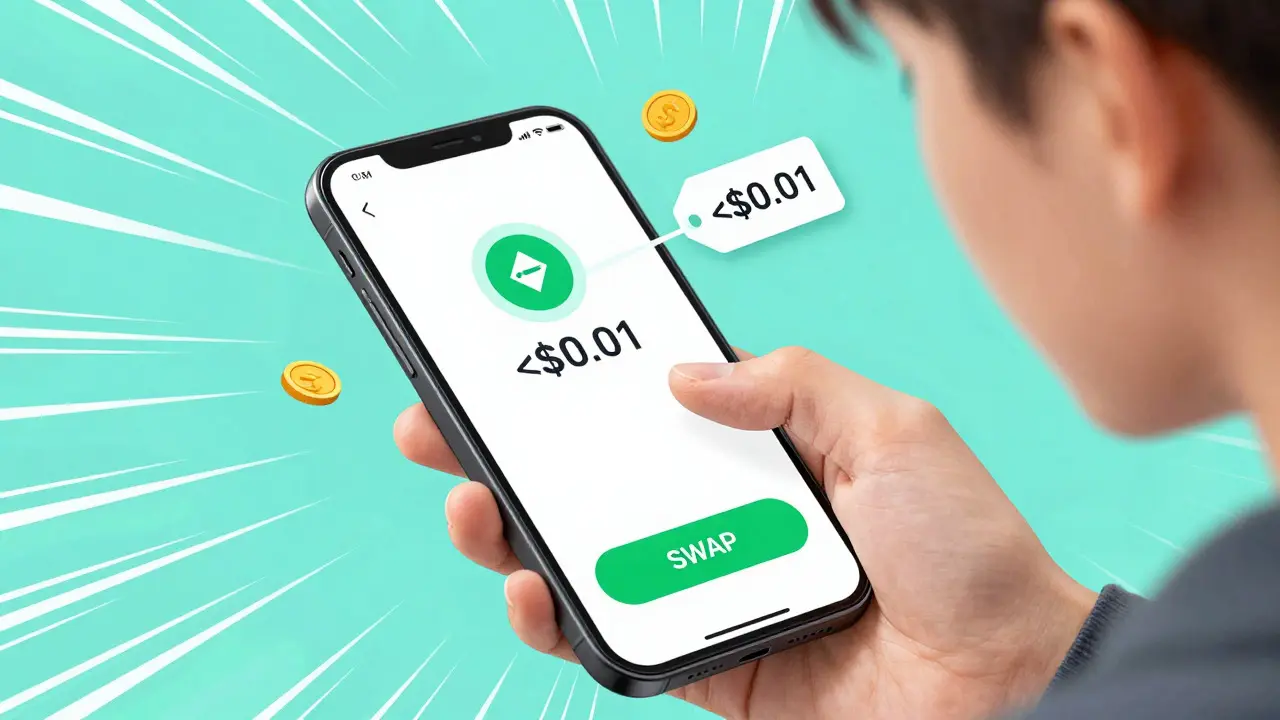
Then there are the fees. On many major DEXs, you pay two types of costs: the trading fee (usually around 0.3%) and the gas fee (the cost to run the transaction on the network). On STON.fi, the gas fees are fractions of a cent. We are talking about less than $0.01 per trade. The trading commission varies slightly depending on the token pair, generally hovering around 0.3%, but because the base cost is so low, the total expense is negligible for small trades.
This makes STON.fi ideal for micro-trading. If you want to swap $10 worth of USDT for NOT coin, you won't lose half your capital to fees. For larger institutional-sized trades, however, the story changes, which we will cover later.
Security Audit and Trust Factors
In decentralized finance (DeFi), trust is earned through code, not customer service emails. Since you are interacting directly with smart contracts, a bug in the code could mean losing all your funds. This is why security audits are non-negotiable.
For STON.fi v2, the good news is that the smart contracts were audited by Trail of Bits. Trail of Bits is widely considered one of the top firms in blockchain cybersecurity. They have audited major projects like Ethereum and MakerDAO. While the specific findings of the audit aren't always publicized in detail on the homepage, the presence of this badge is a strong signal of credibility. It suggests that independent experts looked for vulnerabilities like reentrancy attacks or overflow errors and found none critical enough to halt launch.
However, remember that an audit is a snapshot in time. It checks the code at a specific moment. As the platform updates or new attack vectors emerge, risks can change. Always keep an eye on official announcements from the STON.fi team regarding any patches or upgrades.
Liquidity Limitations: The Catch
Here is where things get tricky. A decentralized exchange only works if there is money in the pools to trade against. This is called liquidity. If you try to sell a large amount of tokens but the pool doesn't have enough of the other asset, the price crashes, and you get a bad deal. This is called slippage.
STON.fi excels with major pairs like TON-USDT or TON-USD₮. These pools are deep enough for most retail traders. However, if you look at smaller, newer tokens listed on the platform, the liquidity can be shallow. Data from late 2024 showed daily trading volumes hovering between $300,000 and $500,000. While this number has likely grown by mid-2026 due to the broader adoption of Telegram-integrated crypto features, it still pales in comparison to giants like Uniswap, which handles billions daily.
If you are planning to move more than $10,000 in a single swap, you need to be careful. You might experience slippage exceeding 2-5%. For average users swapping hundreds or even a few thousand dollars, this is rarely an issue. But for whales, STON.fi is currently not the right tool.
User Experience and Interface
One of the biggest barriers to entry for DeFi is complexity. Connecting wallets, approving transactions, setting slippage tolerances-it can feel like flying a spaceship. STON.fi simplifies this significantly.
The interface is clean and minimal. You connect a TON-compatible wallet like Tonkeeper or OpenMask, select your tokens, and hit swap. There is no KYC (Know Your Customer) process. No email verification. No waiting for approval. You are anonymous and in control of your assets the entire time.
New users report being able to execute their first swap within 5 to 10 minutes of landing on the site. The platform also includes helpful tools like an impermanent loss calculator for those who want to provide liquidity. Impermanent loss happens when the value of your deposited assets changes compared to if you had just held them. Understanding this risk is crucial for liquidity providers, and having a built-in calculator is a nice touch.
| Feature | STON.fi v2 | Uniswap (Ethereum) | Raydium (Solana) |
|---|---|---|---|
| Blockchain | TON Only | Ethereum + L2s | Solana |
| Avg. Transaction Fee | < $0.01 | $1.00 - $5.00+ | $0.01 - $0.05 |
| Settlement Time | < 10 seconds | 15 - 60 seconds | < 10 seconds |
| Token Selection | Limited (~20-30 core tokens) | Vast (10,000+) | Moderate (Hundreds) |
| KYC Required | No | No | No |
| Best For | Small/Medium TON swaps | Large volume, diverse assets | Fast Solana trading |

Who Should Use STON.fi v2?
Not every crypto trader needs STON.fi. If you hold mostly Ethereum-based tokens (ERC-20), you are better off using Uniswap or SushiSwap. If you are a day trader moving millions of dollars, you need the deep liquidity of centralized exchanges or larger DEX aggregators.
STON.fi is perfect for:
- TON Ecosystem Participants: If you earn rewards in TON-based tokens from Telegram mini-apps or staking, you need a native way to convert them to stablecoins like USDT.
- Micro-Investors: People with small amounts of capital who don't want to waste money on high gas fees.
- Privacy Advocates: Users who prefer non-custodial solutions where they never give up control of their private keys.
- Liquidity Providers: Those willing to lock up assets to earn trading fees, especially if they understand how to mitigate impermanent loss.
Potential Risks and Drawbacks
No investment platform is without risk. Here are the main concerns to keep in mind:
- Limited Token Diversity: You can only trade what is on TON. If a new project launches on Ethereum but not TON, you can't access it here without bridging, which defeats the purpose of using a native DEX.
- Regulatory Uncertainty: Like most DeFi platforms, STON.fi operates in a gray area. It is not regulated by traditional financial authorities. While this offers freedom, it also means fewer consumer protections if something goes wrong.
- Smart Contract Risk: Even with an audit, bugs can exist. Always start with small amounts to test the waters.
- Dependency on TON: The success of STON.fi is tied entirely to the health and popularity of the TON blockchain. If interest in TON wanes, the liquidity on STON.fi will dry up.
Final Thoughts on STON.fi v2
STON.fi v2 is a specialized tool for a specific job. It isn't trying to be the next Binance. It is trying to be the fastest, cheapest way to move value within the TON ecosystem. For users deeply embedded in that world-whether through Telegram integration or early adoption of TON tokens-it offers a seamless experience that centralized exchanges simply cannot match in terms of speed and cost.
If you are new to crypto and hold TON, give it a try. Connect your Tonkeeper, swap a small amount of USDT, and see how fast it goes. Just remember to check the liquidity depth before making large moves, and always keep your private keys safe. In the world of DeFi, you are your own bank, and that comes with both freedom and responsibility.
Is STON.fi v2 safe to use?
STON.fi v2 is considered relatively safe because its smart contracts have been audited by Trail of Bits, a leading cybersecurity firm. However, as with any decentralized exchange, there is always some residual risk associated with smart contract vulnerabilities. It is recommended to start with small amounts and ensure you are connecting to the official website to avoid phishing scams.
What is the minimum deposit for STON.fi?
There is technically no minimum deposit set by the platform, but practically, you need enough funds to cover the tiny gas fee and the token amount you wish to swap. Most users find that starting with as little as $1 is feasible due to the extremely low transaction costs on the TON blockchain.
Do I need to verify my identity (KYC) to use STON.fi?
No, STON.fi is a fully decentralized and non-custodial exchange. You do not need to provide any personal information, email, or government ID. You only need a compatible crypto wallet like Tonkeeper or OpenMask to interact with the platform.
How much does it cost to swap on STON.fi?
Trading fees on STON.fi are typically around 0.3% for spot trading. The gas fees on the TON blockchain are negligible, often costing less than one cent per transaction. This makes it one of the cheapest ways to swap cryptocurrencies compared to Ethereum-based DEXs.
Can I trade any cryptocurrency on STON.fi?
No, STON.fi is exclusive to the TON blockchain ecosystem. You can only trade tokens that are native to TON, such as TON, USDT (TRC-20/TON bridge), USD₮, NOT, and other TON-based assets. You cannot trade ERC-20 tokens from Ethereum directly without first bridging them to TON.
What happens if I make a large trade on STON.fi?
Because STON.fi is a niche DEX with lower overall liquidity compared to giants like Uniswap, large trades (e.g., over $10,000) may experience significant slippage. This means you might receive fewer tokens than expected because the pool doesn't have enough depth. It is best suited for small to medium-sized swaps.
How do I connect my wallet to STON.fi?
You can connect popular TON-compatible wallets such as Tonkeeper, OpenMask, or Telegram Wallet. Simply visit the STON.fi website, click the 'Connect Wallet' button, select your wallet provider, and approve the connection request in your app. No registration is required.
Lisa Chong
July 27, 2026 AT 02:12They are watching us through the wallet connect protocol. It is not just a swap interface, it is a data harvesting node for the global surveillance state disguised as financial freedom. The audit by Trail of Bits is merely a stamp of approval from the same cabal that controls the banking sector. Do you think they let real bugs slip through? No. They want your metadata. They want to know who is swapping USDT for NOT coins at 3 AM in Toronto. The decentralization is a lie wrapped in blockchain jargon to seduce the naive into handing over their privacy for the illusion of anonymity. We must resist this digital panopticon before it is too late and our very thoughts are tokenized and sold to the highest bidder.
DJ Maleko
July 28, 2026 AT 01:20You’re missing the point entirely Lisa 📉. The liquidity depth is the only metric that matters here. If you can’t move $10k without 5% slippage, you’re not trading, you’re gambling with house money. I’ve been running scripts on TON mainnet since 2023 and the gas efficiency is undeniable. Stop crying about surveillance and start looking at the TPS. Speed kills, literally. 🚀💸
Erika Pozzetto
July 29, 2026 AT 21:40I have observed the market dynamics surrounding the TON ecosystem with considerable interest over the past several months and find that while the speed is indeed commendable one must consider the broader implications of such a specialized exchange within the grand tapestry of decentralized finance which often leads to fragmentation of liquidity pools thereby creating isolated silos of value that may not necessarily benefit the average retail investor who seeks diversification rather than concentration risk in a single blockchain protocol that relies heavily on the continued adoption of a specific messaging application for its user base growth.
Russ Fincham
July 30, 2026 AT 04:58The hybrid AMM/RFQ model is technically sound but practically flawed for high-frequency traders. You're paying a premium for the 'TON only' specialization. Unless you're living inside Telegram's walled garden, this is a niche tool for niche players. The security audit is standard fare; don't let it blind you to the smart contract risks inherent in any v2 launch. Proceed with caution or stay away.
Linda Hilliard
July 31, 2026 AT 10:14Oh darling, please. :D You clearly haven't grasped the nuances of cross-chain interoperability yet. STON.fi isn't trying to be Uniswap; it's optimizing for the Telegram demographic, which is largely comprised of retail investors who wouldn't know an ERC-20 token if it bit them. The slippage on large trades is a feature, not a bug-it filters out the whales who don't understand the cultural significance of the TON community. It’s elegant in its simplicity, really. Just don’t expect institutional-grade depth from a platform built for micro-transactions and meme coins. 😉
Winston Lacewing
August 1, 2026 AT 19:12This whole thing feels like a trap! 😱 Why would anyone trust a DEX that doesn't even support Ethereum? It’s like bringing a knife to a gunfight. And don't get me started on the 'privacy' angle. There is no privacy in crypto, ever. They have your IP, your wallet address, your entire transaction history. It’s all recorded on an immutable ledger forever. You’re not anonymous; you’re just transparent. Wake up people! 🤡📉
Kristine Lawson
August 3, 2026 AT 15:19Contrary to the popular belief that low fees equate to superior utility, one must acknowledge that the lack of multi-chain support severely limits the platform's longevity. Furthermore, the assertion that 'speed' is the primary selling point ignores the fundamental instability of the TON network during peak congestion periods. One should not be so hasty in praising a system that has yet to prove its resilience against sophisticated attack vectors beyond the initial audit phase. Caution is warranted, not celebration.
Tawny Holmes
August 4, 2026 AT 16:09It’s just a swap tool. Use it for small amounts. Don’t overthink it.
Ran Tao
August 5, 2026 AT 14:49Boring. 🥱 Everyone is sleeping on the real alpha. STON.fi is basically a beta test for Telegram’s eventual centralized control. They’re building the infrastructure to tax every single transaction you make inside the app. Who cares about the current fees when the next update could introduce a 1% 'convenience fee'? Wake up sheeple! The matrix is tightening its grip. 🧠💎
Heather Austin
August 7, 2026 AT 09:12i actually use this daily for converting my telegram bot earnings to usdt and its super fast. the ui is clean and i dont have to deal with complex settings. just connect tonkeeper and go. works fine for me.
Jessie Smith
August 8, 2026 AT 07:03The philosophical underpinning of STON.fi reveals a deeper truth about the nature of value in the digital age. By restricting itself to the TON ecosystem, it creates a closed loop of economic activity that mirrors the tribalism of ancient societies. Is this not what we seek? A return to localized, community-driven finance rather than the homogenized sprawl of Ethereum? Perhaps the limitations are not bugs, but features of a new social contract written in code. Or maybe it's just a scam. Hard to say. 🌌
Drew M
August 9, 2026 AT 17:44Look, I get the hype, but let’s keep it real. 🙄 The liquidity is still thin compared to Solana or Eth L2s. If you’re moving serious cash, you’ll bleed on slippage. It’s great for dipping your toes in or managing small altcoin bags from Telegram mini-apps, but calling it the 'go-to' DEX is a stretch. Still, the UX is slick and the fees are laughably low. Just don’t bet the farm on it. 🏦✨