Underground Crypto Trading in Nepal: Risks, Methods, and Legal Realities

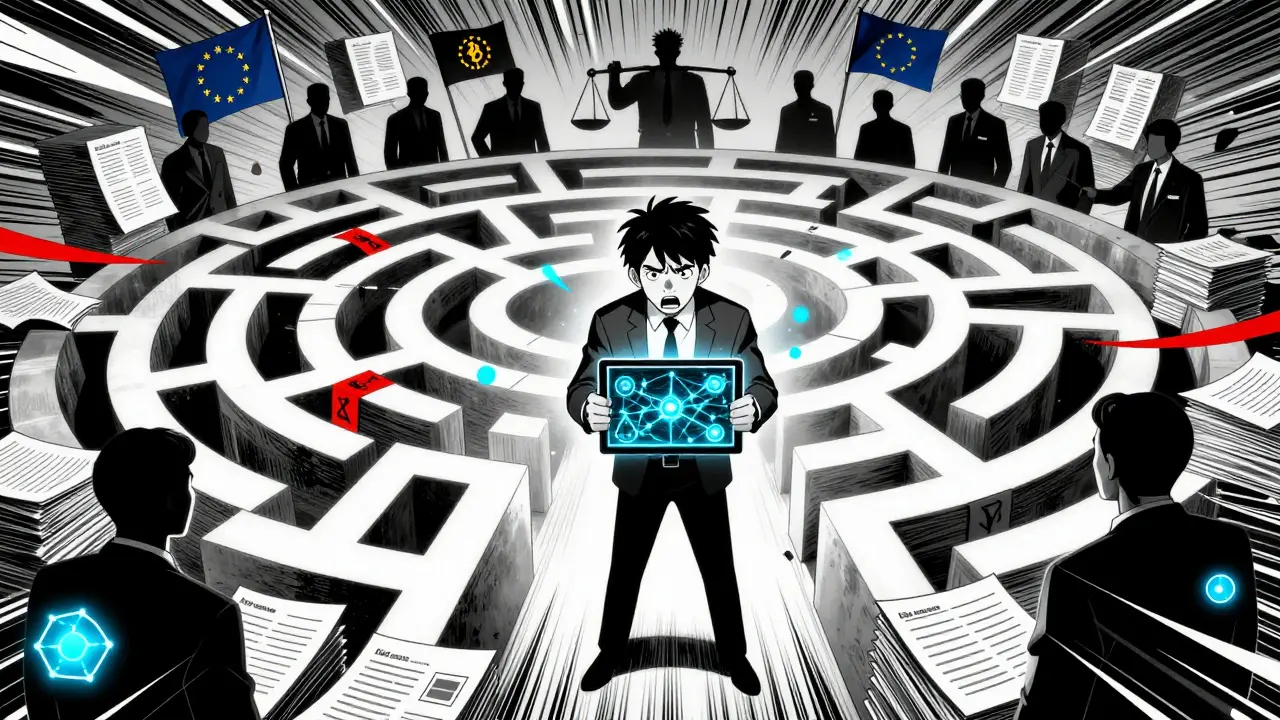
Imagine risking a prison sentence just to buy some Bitcoin. In Nepal, this isn't a hypothetical scenario-it's the daily reality for thousands of people engaging in underground crypto trading in Nepal. Since 2017, the government has maintained a wall of prohibition, making the mere possession of digital assets a legal gamble. Yet, the market hasn't vanished; it has simply gone dark, evolving into a sophisticated shadow economy that pits tech-savvy citizens against state surveillance.
The Iron Fist: Why Crypto is Illegal in Nepal
The Nepal Rastra Bank the central bank of Nepal responsible for monetary policy and financial stability isn't playing around. Their ban is comprehensive, covering everything from mining to trading and even holding crypto in a private wallet. The core of the issue is control. The government views decentralized currencies as a direct threat to the national monetary system and a gateway for money laundering and illegal hundi (informal money transfer) operations.
By 2025, the crackdown has intensified. It's no longer just about stopping the trade; the authorities are now targeting the tools used to bypass the ban. This means using a VPN to access a foreign exchange is now explicitly listed as a violation in central bank circulars. If you're caught, you're not just looking at a fine; you're facing charges under the country's strict cybercrime and foreign exchange laws.
How the Shadow Market Actually Works
If the risks are so high, why do people still do it? For many, it's about survival and global connectivity. Nepali citizens often use cryptocurrency for cross-border remittances, allowing them to move money in and out of the country faster than traditional bank wires. To do this, they've built a technical toolkit to stay invisible.
The primary engine of this underground economy is P2P Trading peer-to-peer trading where two individuals trade assets directly without a centralized intermediary. Instead of using a public exchange that would flag a Nepali IP address, traders use platforms like Binance P2P. The actual exchange of money happens through local payment apps like eSewa or direct bank transfers. To a bank auditor, it looks like a simple transfer between two friends, but in reality, it's a crypto purchase.
To access these platforms, traders rely heavily on VPNs Virtual Private Networks that mask a user's IP address and encrypt their internet connection. Since the Nepal Telecommunication Authority (NTA) blocked most crypto-related domains in 2021, the VPN has become the essential key to the digital kingdom. Coordination usually happens on encrypted apps like Telegram or WhatsApp, where private groups share "safe" payment methods and warn each other about recent police raids.
The High Cost of Getting Caught
The government isn't just waiting for people to get caught; they are actively hunting. The Central Investigation Bureau (CIB) of the Nepal Police has shifted its focus toward high-value targets and those operating under the guise of legitimate businesses.
| Entity Involved | Cover Operation | Scale of Transaction | Outcome |
|---|---|---|---|
| Two Indian Nationals | Grocery Store in Lalitpur | Over Rs 1.5 Billion | Arrested under Criminal Code 2074 |
This specific case proves that the police are monitoring financial patterns. They didn't just find crypto; they found a massive gap between the reported income of a small grocery store and the actual movement of billions of rupees. This "transaction trail analysis" is now the government's most effective weapon. If your bank account shows a sudden surge of transfers from various unrelated people, you've essentially left a digital breadcrumb trail straight to your door.
Comparing Nepal to Its Neighbors
Nepal's approach is an outlier in the region. While it's not the only country with restrictions, the absolute nature of the ban is stark when compared to neighbors. India, for instance, has moved toward a taxation-heavy model. While the Indian government doesn't necessarily "love" crypto, they've accepted its existence and now tax the gains. Bhutan has even explored integrating blockchain into its national infrastructure.
This creates a psychological tension for Nepalis. They see their neighbors across the border treating digital assets as an investment class, while they are treated as criminals for doing the exact same thing. This divergence is exactly why the underground market persists; the demand for financial modernization is simply stronger than the fear of the law.
The Technical Hurdles for New Traders
Entering the underground scene in Nepal isn't as simple as downloading an app. It requires a steep learning curve in operational security (OpSec). A beginner can't just sign up for an exchange; they need to master several layers of anonymity to avoid detection.
- Infrastructure: Setting up a reliable VPN that doesn't leak IP addresses.
- Financial Obfuscation: Managing multiple bank accounts or using trusted intermediaries to hide the pattern of P2P payments.
- Communication: Learning to use "burnable" accounts and encrypted channels for deal coordination.
- Verification: Finding ways to pass KYC (Know Your Customer) requirements on international exchanges without using documents that would instantly flag their nationality.
Because there are no official guides, new traders rely on a handful of "mentors" in private communities. This creates a risky dependency where a new user might trust a "guide" who is actually a scammer or, worse, an undercover agent.
Will the Ban Ever Lift?
As of 2026, there is no official plan to legalize cryptocurrency in Nepal. The government remains committed to its 2017 stance. However, the reality is that the ban is leaking. The more people use VPNs and P2P networks, the less effective the ban becomes. The government is caught in a loop: the more they crack down, the more sophisticated the underground methods become.
Some legal experts argue that the government might eventually shift toward a "regulated" model-similar to India's-simply because the cost of enforcement is becoming too high. But for now, the risk remains absolute. Anyone trading in the shadows is playing a high-stakes game of cat and mouse with the state.
Is it legal to own Bitcoin in Nepal?
No. The Nepal Rastra Bank has banned the possession, trading, and mining of cryptocurrency. Holding digital assets can lead to legal action, including fines and imprisonment under cybercrime and foreign exchange laws.
Can the government detect crypto trades via bank accounts?
Yes. While the crypto transaction itself is on the blockchain, the "on-ramp" and "off-ramp" usually involve bank transfers or e-wallets. Authorities use transaction trail analysis to identify suspicious patterns-such as numerous transfers from unrelated individuals-which often trigger investigations.
Do VPNs protect traders in Nepal?
VPNs hide your IP address from the website you are visiting, but they are not a legal shield. The Nepal Rastra Bank has explicitly stated that using a VPN to access blocked crypto exchanges is a violation of their regulations.
What is P2P trading and why is it used in Nepal?
P2P (Peer-to-Peer) trading involves buying and selling crypto directly between two people. It is used in Nepal because it avoids the need for a central exchange to handle the local currency, making the trade look like a personal transfer between two individuals.
What happens if someone is caught trading crypto in Nepal?
Depending on the scale, individuals can face heavy fines, seizure of assets, and imprisonment. Large-scale operations are often charged under the Criminal Code 2074 for illegal hundi transactions and unauthorized use of virtual currency.
Eric Raines
April 23, 2026 AT 10:31Actually, it's basic economics. If there's a demand for a hedge against inflation and the govt says no, people will just find a way around it. It's not some secret art, just supply and demand 101.
Yvette P
April 23, 2026 AT 19:46Oh honey, imagine thinking a simple VPN is a silver bullet for your OpSec when the central bank is literally running heuristic analysis on your fiat on-ramps and off-ramps, because honestly, the sheer audacity of believing that a basic tunnel protocol can obfuscate the blatant transactional anomalies of a P2P shuffle is just precious. We're talking about massive liquidity shifts hitting accounts that usually trade in small-fry retail volumes, so unless you're utilizing an advanced layering strategy with multi-sig cold storage and a very sophisticated set of mixer protocols-which, let's be real, most of these people aren't-you're basically just screaming your location to the CIB through your bank statements while pretending to be an anonymous cyber-phantom. It's almost impressive how the Dunning-Kruger effect scales perfectly with the adoption of decentralized finance in restrictive regimes where the regulatory capture is absolute and the enforcement is just waiting for one clumsy mistake in a Telegram group to collapse the whole house of cards.
Matthew Morse
April 25, 2026 AT 13:53just sounds like a way to get scammed by some random guy on telegram
praveen subbiah
April 26, 2026 AT 13:15India is far ahead in this game! We have the perfect balance of taxation and regulation that keeps the economy booming while the world watches in awe at our digital transformation! Truly a golden era!
Miranda Jamieson
April 26, 2026 AT 18:03Only an idiot would risk a prison sentence for a volatile asset. This isn't "survival," it's gambling with your life and it's pathetic.
Greg Reynolds
April 28, 2026 AT 05:14The claim that demand for financial modernization outweighs fear of the law is a reach. Most of these people are just chasing a pump-and-dump scheme.
Candace Sherrard
April 29, 2026 AT 07:30It is fascinating to observe the tension between a state's desire for absolute monetary sovereignty and the inevitable tide of global digitalization that renders physical borders irrelevant in the realm of value exchange. There is a certain poetic tragedy in the way these individuals must navigate a digital shadow world, creating a parallel society where trust is the only currency and a single mistake can erase a lifetime of effort, reflecting a broader human struggle to find freedom within the confines of an outdated legal framework that simply cannot keep pace with the speed of light.
Benjamin Forg
April 29, 2026 AT 12:34the cib is probably just a front for some globalist agenda to track every single cent on the planet and they use these bans to force people into monitored channels so they can map the entire social graph of dissidents
Ali Tate
April 29, 2026 AT 18:49this whole mess is just a circus of clowns trying to play big league with pocket change no real alpha here just peasants fighting over crumbs
Larry Yang
May 1, 2026 AT 08:50the logic here is flawed. if the govt really wanted to stop it they would just shut down the internet entirely like some other places do but they're just playing a game of pretend for the public image
Guy Bianco
May 2, 2026 AT 20:48It is truly concerning to see such risks being taken. I hope there comes a time when a safe, regulated path is provided for all citizens. :)
Alex Wan
May 4, 2026 AT 16:16I am deeply moved by the resillience of these peopel! It is a testament to the human spirit to seek out progrress even in the face of such dire consquences!!
Tony Gurley-Ward
May 5, 2026 AT 03:06Call it what you want, but these shadow markets are just the organic evolution of the black market. It's the same as smuggling cigarettes in the 80s, just with more math and fewer ships.
Lisa Camp
May 5, 2026 AT 07:10Stop whining about the law and just get the bag! If you're too scared to take the risk, you don't deserve the profit!
Paige Raulerson
May 7, 2026 AT 02:45The level of desperation described here is almost quaint. I can't believe some people actually think using a grocery store as a front is a "sophisticated shadow economy." It's amateur hour.