Understanding BIP39 Seed Phrase Standard for Crypto Wallet Recovery

Imagine losing your phone, your wallet, or even your entire laptop-then realizing the only thing standing between you and your life savings is a 12-word sentence you wrote on a piece of paper. If you’ve ever held cryptocurrency, you’ve likely encountered the BIP39 seed phrase. It’s not just a backup. It’s your master key. And if you don’t understand how it works, you’re risking everything.
What Exactly Is a BIP39 Seed Phrase?
BIP39 stands for Bitcoin Improvement Proposal 39. It’s not a fancy app or a new blockchain. It’s a technical standard that turned cryptocurrency backups from a nightmare into something almost human-friendly. Before BIP39, users had to manage long strings of random letters and numbers-private keys-each one unique to a wallet. Lose one character, and your crypto was gone forever.
BIP39 changed that. Instead of raw keys, it gives you a list of 12 or 24 words from a fixed dictionary of exactly 2,048 English words. These words are not random. They’re carefully chosen so that even if you misread or miswrite one, the system can often still figure out what you meant. The first four letters of each word are unique. That’s why "abandon" and "ability" won’t get confused-even if your handwriting is messy.
These word lists aren’t just for English. BIP39 supports Spanish, French, Italian, Chinese, Japanese, Korean, and more. The same 2,048-word structure applies across languages. So whether you’re in Tokyo or Toronto, your recovery phrase works the same way.
How Does BIP39 Turn Words Into Money?
It’s not magic. It’s math. Here’s how it works in simple terms:
- Your wallet generates a long string of random bits-like flipping a coin 256 times, but digitally.
- It splits those bits into chunks of 11 bits each.
- Each 11-bit chunk becomes a number between 0 and 2047.
- That number matches a word in the BIP39 wordlist.
- A checksum is added at the end to catch mistakes.
For a 12-word phrase, you get 128 bits of security. For a 24-word phrase, you get 256 bits. That’s more than enough to resist even the most powerful computers today. The 12-word version is considered secure by experts, and most wallets default to it because it’s easier to write down and remember.
But here’s the catch: the words themselves don’t hold your money. They’re a map. When you enter them into a wallet, the software uses them to regenerate the exact same private keys that control your crypto. That’s why any BIP39-compatible wallet-whether it’s MetaMask, Ledger, Trust Wallet, or Exodus-can restore your funds. The system is universal.
Why BIP39 Is the Industry Standard
Before BIP39, every wallet had its own backup method. Some used private keys. Others used encrypted files. Some didn’t even let you back up at all. If you switched wallets, you lost access. That was a huge barrier to adoption.
BIP39 fixed that. Now, no matter which wallet you use, you can move your crypto between them. Want to switch from Coinbase Wallet to Phantom? Just enter your 12 words. Done. No transfers. No fees. No waiting.
That’s why every major wallet, hardware or software, supports BIP39. It’s not a suggestion. It’s the rule. Ethereum, Bitcoin, Solana, Polygon, Cardano-all of them rely on BIP39 for user recovery. Even institutional custody solutions use it behind the scenes.
Companies like Ledger call it the "low-key guardian of your crypto freedom." That’s because BIP39 puts control back in your hands. No middleman. No bank. Just you and your words.

The Hidden Danger: Passphrases
BIP39 has a secret feature: the optional passphrase. Also called a "25th word," it’s an extra secret you can add on top of your 12 or 24 words. Think of it like a password for your password.
It sounds great, right? More security. But here’s the problem: if you forget the passphrase, your crypto is gone. Forever. There’s no recovery. No customer support. No reset button.
Most wallets hide this feature by default because it’s too risky for average users. If you don’t know you’re using one, you won’t remember it. And if you do use one, you have to store it separately from your seed phrase. Write it on the same paper? Someone who steals your paper gets everything. Store it digitally? Now you’ve created a new attack surface.
Experts agree: unless you’re a security professional with a locked safe and a backup plan, skip the passphrase. The 12-word phrase alone is already secure enough. Adding a passphrase doesn’t make you safer-it just makes it easier to lose everything.
Real-World Problems: People Mess Up
Here’s the uncomfortable truth: BIP39 is flawless. But people aren’t.
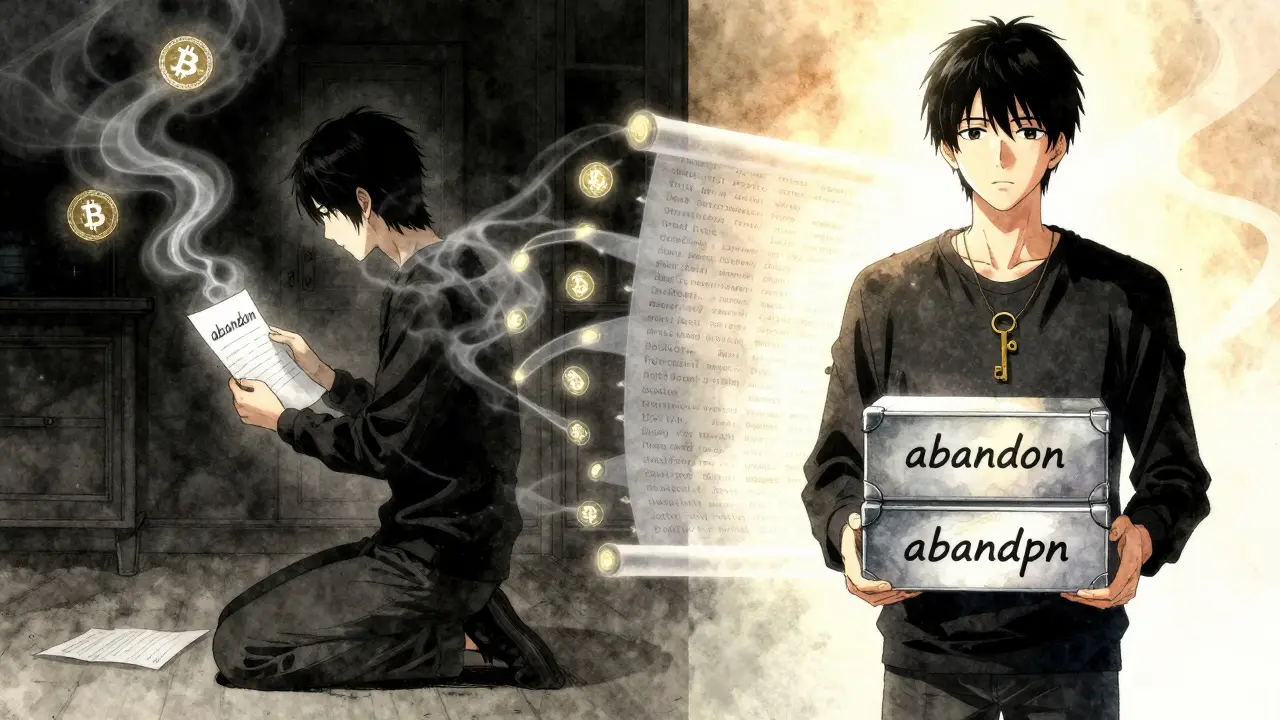
Companies like DataRecovery.com say they get hundreds of cases every month from people who lost access because they wrote down the wrong word. "abandon" instead of "abandon." "cabbage" instead of "cabinet." Even a single letter wrong can break the checksum and make the phrase unusable.
Some users try to "improve" their seed phrase. They change "sunset" to "sunset123" because they think it’s "more secure." That’s not how it works. The system expects exact words from the BIP39 list. Any change-capitalization, punctuation, extra letters-will fail.
Others write their seed phrase on a phone note, a Google Doc, or a cloud drive. That’s not backup. That’s leaving your house key under the mat. If your device is hacked, your crypto is gone.
Even the way you write matters. Use a pen, not a pencil. Use a permanent marker, not a highlighter. Store copies in different places-a safe, a fireproof box, a trusted family member. Don’t rely on one copy.
How to Generate and Store Your Seed Phrase Safely
There’s only one rule: never create your own seed phrase. Never type it in manually. Never guess. Never reuse words from another wallet.
Always let your wallet generate it for you. Wallet software uses cryptographically secure random number generators. Humans are terrible at randomness. You’ll pick words you like. You’ll avoid "abandon" because it sounds negative. That’s not random. That’s predictable.
When your wallet shows you the 12 or 24 words:
- Write them down in order, exactly as shown.
- Double-check each word against the official BIP39 wordlist (you can find it online).
- Don’t take a photo. Don’t store it digitally.
- Store at least two physical copies in separate, secure locations.
- Never tell anyone your seed phrase-not your partner, not your crypto guru, not a "support agent."
If you’re using a hardware wallet like Ledger or Trezor, write the phrase when you first set it up. Never re-enter it later. Never type it into a website. Never use it on a public computer.
What Happens If You Lose It?
If you lose your seed phrase and don’t have a backup, your crypto is gone. No one can recover it. Not the wallet company. Not the blockchain. Not the police.
There are companies that claim they can recover partial seed phrases. They use brute-force tools to guess missing words. But success is rare. If you’re missing more than two words, the chances are near zero. Even if you get it right, it takes months of computing power-and costs thousands of dollars.
And here’s the kicker: if you used a passphrase, recovery is impossible. Even if they guess your 12 words, without the passphrase, your funds stay locked.
The only real solution? Don’t lose it in the first place.
Final Thought: Your Words Are Your Wallet
BIP39 is one of the most important inventions in cryptocurrency history. It made crypto accessible. It gave users real control. But it also put the entire burden of security on you.
Your seed phrase isn’t like a password you can reset. It’s not like a bank account you can call and recover. It’s your identity on the blockchain. Lose it, and you lose everything you own on it.
Understand it. Respect it. Treat it like your last lifeboat.
What is a BIP39 seed phrase?
A BIP39 seed phrase is a list of 12 or 24 words generated by cryptocurrency wallets to back up and restore access to your crypto assets. It’s based on a standardized dictionary of 2,048 words and works across nearly all modern wallets, making it the universal recovery method for Bitcoin, Ethereum, and thousands of other cryptocurrencies.
Can I create my own BIP39 seed phrase?
No. Never create your own. Seed phrases must be generated using a cryptographically secure random number generator built into your wallet. Humans are terrible at generating randomness, and any pattern you introduce makes your wallet vulnerable to attacks. Always let your wallet generate the phrase for you.
Are 12-word seed phrases secure enough?
Yes. A 12-word BIP39 phrase provides 128 bits of security, which is considered more than sufficient by cryptographic experts. It would take billions of years for even the most powerful supercomputers to guess it by brute force. A 24-word phrase offers 256 bits, which is overkill for most users.
What’s the difference between a seed phrase and a passphrase?
The seed phrase is the 12 or 24-word backup that restores your wallet. A passphrase is an optional extra secret you can add to create a completely different set of keys. It’s like a password for your seed phrase. But if you lose the passphrase, you lose access to your funds-even if you have the seed phrase. Most users should avoid using one.
Can I use my BIP39 seed phrase on any wallet?
Yes. Any wallet that supports BIP39 can restore your funds using your seed phrase. This includes MetaMask, Ledger, Trust Wallet, Exodus, Phantom, and hundreds of others. That’s why BIP39 is the industry standard-it ensures your crypto stays accessible no matter which wallet you choose.
What should I do if I lose my seed phrase?
If you lose your seed phrase and have no backup, your crypto is permanently inaccessible. No company, government, or expert can recover it. There are recovery services that try to guess missing words, but success is extremely rare unless you’re missing only one or two words. Prevention is the only real solution: always back up your phrase securely and in multiple places.
Khaitlynn Ashworth
December 31, 2025 AT 05:02So let me get this straight - I’m supposed to trust some 12-word magic spell written in pen on a napkin that could vanish in a fire, a flood, or my cat’s chew toy? And you call this ‘security’? I’ve seen people write their seed phrase on a sticky note next to their coffee mug. At this point, my crypto is just a really expensive art project titled ‘Hopeful Delusion.’
rachael deal
December 31, 2025 AT 14:34Actually, I think BIP39 is one of the most elegant solutions crypto has ever had. It turns something terrifyingly technical into something you can write with your hand and understand without a degree in computer science. I keep two copies - one in a fireproof safe, one with my sister. Simple. No cloud. No phone. Just paper and discipline. It’s not glamorous, but it works.
Elisabeth Rigo Andrews
January 1, 2026 AT 15:40Let’s be real - BIP39 is just a glorified entropy-to-words translator. The real vulnerability isn’t the standard, it’s the human layer. You’ve got people taking screenshots of their seed phrases, uploading them to Telegram groups for ‘verification,’ and then wondering why their ETH vanished. The checksum is irrelevant if the user is a walking zero-day exploit. This isn’t a crypto problem - it’s a cognitive bias problem.
Bruce Morrison
January 3, 2026 AT 12:56One thing I’ve learned the hard way - never trust a wallet that lets you type in your own seed phrase. Always generate it on the device. I used to think I was being clever by writing down words I liked. Turns out ‘sunset’ and ‘lucky’ are the most common words people pick. That’s not randomness. That’s a password dictionary waiting to happen.
nayan keshari
January 5, 2026 AT 01:30Why do Americans make everything so complicated? In India, we just memorize it. No paper. No boxes. No fear. If you can’t remember 12 words, you don’t deserve crypto. This whole ‘backup culture’ is just weakness dressed up as safety.
Raja Oleholeh
January 6, 2026 AT 16:25Passphrase? Bro, if you need a 25th word, you’re already dead. 🤡
Prateek Chitransh
January 8, 2026 AT 11:53People think the seed phrase is the only thing that matters. But the real danger is the wallet interface. Some apps auto-fill your phrase when you click ‘restore’ - on a public computer. Others log your keystrokes. The BIP39 spec is perfect. It’s the apps around it that are trash. Always use hardware wallets. Always. No exceptions.
Alex Strachan
January 9, 2026 AT 21:44Just had a friend lose $40K because they wrote ‘abandon’ as ‘abandon.’ 😅 Same word. Different spelling. The checksum didn’t catch it because they added an extra ‘n.’ I told them to stop trying to be poetic with their crypto backup. Words aren’t poetry. They’re keys.
Rick Hengehold
January 11, 2026 AT 05:03Stop romanticizing paper backups. Paper burns. Paper fades. Paper gets thrown out by cleaning staff. I keep mine on a stainless steel plate engraved by a professional. It’s expensive, yes. But so is losing everything. This isn’t a hobby - it’s your life’s work. Treat it like it.
Brandon Woodard
January 12, 2026 AT 04:46It is, without hyperbole, one of the most profound democratizations of financial sovereignty ever engineered. The elegance of BIP39 lies not in its cryptographic robustness - though that is indisputable - but in its radical accessibility. A child in Lagos, a retiree in Ohio, and a programmer in Tokyo can all, with equal fidelity, reclaim their digital assets using a sequence of words. This is not merely a technical standard. It is a philosophical triumph. Treat it with the reverence it deserves - not as a convenience, but as a covenant.