Vesting and Token Unlock Schedules Explained

When you hear about a new cryptocurrency project raising millions, it’s easy to assume everyone involved gets rich overnight. But that’s not how it works. Behind the scenes, there’s a quiet but powerful system controlling who gets tokens, when, and how much - and it’s called a vesting schedule.
Imagine a startup gives you 10,000 tokens as part of your job offer. Sounds great, right? But if you could sell all of them the day you get them, you might cash out and leave. The project could crash. That’s why vesting exists: to tie token access to long-term commitment. It’s not a reward you get all at once - it’s a promise you earn over time.
What Exactly Is a Vesting Schedule?
A vesting schedule is a smart contract rule that locks up tokens and releases them gradually. It’s not a suggestion - it’s code. Once set, it runs automatically. No one can change it, pause it, or skip ahead. The system waits until the conditions are met, then sends the tokens to the wallet.
These schedules apply to almost everyone involved in a project: founders, early investors, team members, and sometimes even community contributors. Each group often has a different schedule. For example, founders might have a 4-year vesting period with a 1-year cliff, while investors might have a 2-year linear unlock. The goal? Prevent panic selling and keep everyone focused on building value.
The Three Core Parts of Every Vesting Schedule
Every vesting schedule has three key ingredients:
- Cliff period - This is the waiting room. No tokens unlock during this time. It’s usually 6 months to a year. If you leave before the cliff ends, you get nothing. That keeps people from jumping ship right after funding.
- Vesting duration - How long until all tokens are fully unlocked? Most projects use 2 to 4 years. Longer durations mean stronger alignment with the project’s long-term health.
- Vesting frequency - After the cliff, how often do tokens get released? Monthly is common. Quarterly works too. Annual releases are rare because they create big spikes in supply that can crash prices.
Let’s say you’re given 100,000 tokens with a 1-year cliff and 3-year linear vesting. You get zero tokens for the first 12 months. Then, every month for the next 36 months, you get 2,777 tokens (100,000 ÷ 36). By month 48, you own them all.
Types of Vesting Schedules You’ll See
Not all vesting is the same. Projects pick different styles depending on their goals.
Linear Vesting
This is the simplest. Tokens unlock evenly over time. Think 1/48th per month for a 4-year schedule. It’s predictable, fair, and reduces market pressure. Most employee vesting uses this model. It’s the go-to for projects that want steady, calm token flow.
Graded Vesting
Instead of monthly releases, tokens unlock in chunks tied to milestones. For example: 25% after 6 months, 25% after 12 months, 25% after 18 months, and the final 25% at 24 months. This works well for teams whose work has clear phases - like finishing the whitepaper, launching the testnet, or hitting 10,000 users.
Cliff Vesting (with Linear Follow-Up)
This is the most common structure for founders and early investors. No tokens for the first year. Then, 25% unlocks all at once - and the rest follows monthly. The cliff acts like a loyalty test. If you’re still around after 12 months, you prove you’re in it for the long haul. Then, the linear release keeps you engaged without flooding the market.
Reverse Vesting
Less common, but growing. Here, you get all your tokens upfront - but you have to earn them back over time. If you leave early, you forfeit part of them. It’s used in some DAOs and team compensation plans to discourage quick exits.
Why Vesting Matters More Than You Think
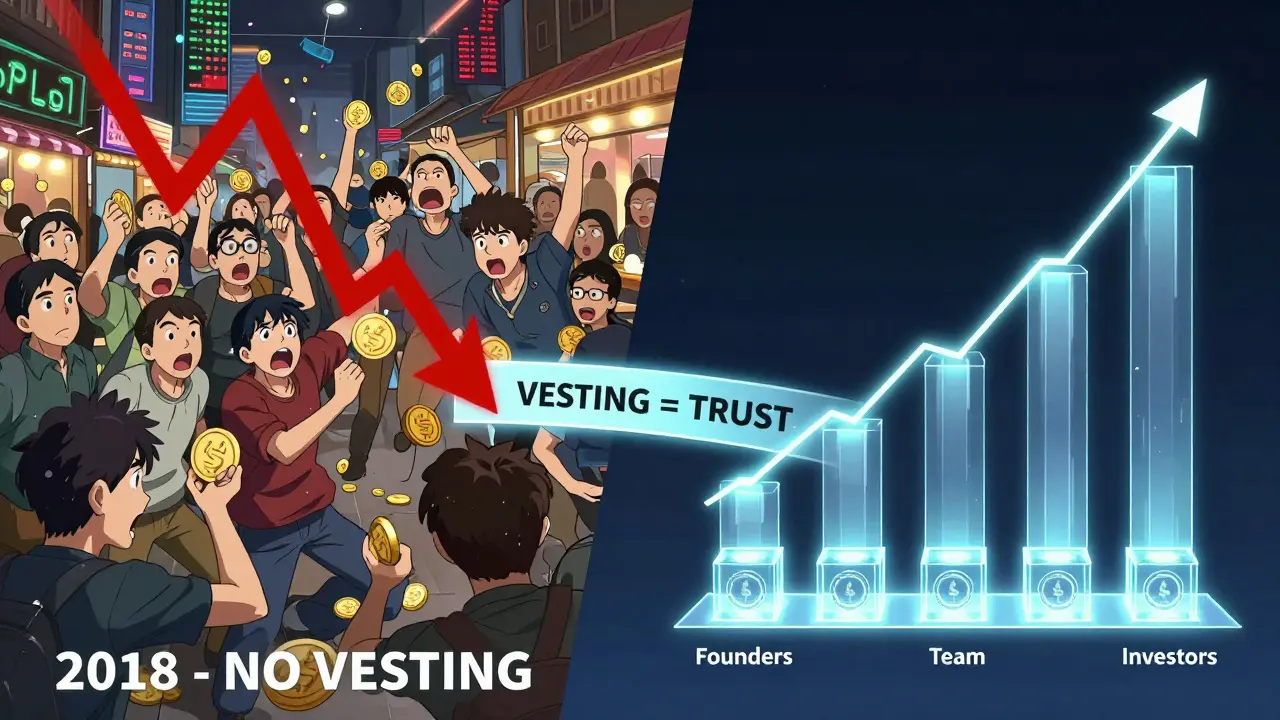
Early crypto projects made mistakes. In 2017 and 2018, many teams got their tokens the day the ICO ended - and sold them immediately. Prices crashed. Investors lost money. Projects died. That’s why vesting became non-negotiable.
Three big problems vesting solves:
- Price stability - If 10% of a project’s total supply unlocks in one day, it can drop 30% in hours. Gradual unlocks prevent that.
- Team retention - If founders can cash out after 30 days, why stick around? Vesting keeps them building.
- Investor trust - If you’re buying tokens, you want to know the team isn’t about to dump their holdings. Vesting proves they’re aligned with you.
Look at Ethereum. Its early investors had a 4-year vesting schedule. That helped the network survive its early volatility. Same with Solana, Polygon, and others that survived the 2022 crash - they had strong vesting rules in place.
Who Gets What? Common Stakeholder Schedules
Not everyone gets the same deal. Here’s what’s typical in 2026:
| Stakeholder | Cliff Period | Vesting Duration | Release Frequency |
|---|---|---|---|
| Founders | 12 months | 4 years | Monthly after cliff |
| Early Investors | 6-12 months | 2-3 years | Monthly or quarterly |
| Team Members | 6 months | 3-4 years | Monthly |
| Advisors | 3 months | 1-2 years | Monthly |
| Public Sale Buyers | 0 months | 0-12 months | Immediate or linear |
Notice something? Public buyers often get tokens right away. That’s because they’re not part of the core team. But insiders - the ones building the project - have to wait. That’s fair. It’s not about locking up money. It’s about locking up commitment.
What Happens If You Leave Early?
If you’re on a vesting schedule and quit before it’s done, you lose the unvested tokens. They go back to the project’s treasury. No refunds. No exceptions.
This isn’t punishment - it’s design. If someone leaves after 6 months of a 4-year vest, they shouldn’t walk away with half the tokens. That’s why cliffs exist. A 1-year cliff means if you leave before year one, you get zero. That’s harsh, but it keeps people honest.
Some newer projects use “partial vesting” - you keep a percentage based on time served. But that’s rare. Most stick to the hard cliff model because it’s cleaner, simpler, and harder to game.
How Projects Set Up Vesting - The Tech Side
Vesting isn’t managed by HR. It’s handled by smart contracts on blockchains like Ethereum, Solana, or Polygon. These contracts are public. You can check them yourself.
For example, if you want to see how many tokens a founder has unlocked so far, you can look up their wallet address on Etherscan. The contract will show:
- How many tokens were allocated
- When the cliff ends
- How many have been released so far
- How many remain locked
That’s transparency. No one can hide anything. That’s why vesting works - because everyone can verify it.
Platforms like Streamflow Finance and Magna have made it even easier. They let projects build custom schedules with drag-and-drop tools. You can set multiple cliffs, different frequencies per group, or even tie unlocks to on-chain milestones - like “unlock 10% when the app hits 100,000 active users.”

Common Mistakes Projects Make
Even smart teams mess up vesting. Here’s what goes wrong:
- Too short a cliff - 1-month cliff? That’s useless. People can leave after a month and still keep 80% of their tokens.
- No cliff at all - If tokens unlock immediately, you’re back to the 2018 problem. Everyone dumps.
- Too many different schedules - If you have 10 different vesting plans for 10 groups, it becomes a mess. Keep it simple.
- Forgetting to lock tokens in a smart contract - If tokens are just “assigned” in a spreadsheet, they’re not locked. Anyone can move them. Always use on-chain contracts.
- Not disclosing the schedule - If investors can’t find the vesting details, they’ll assume the worst. Always publish it in the whitepaper or website.
What Should You Do as an Investor?
Before you buy tokens, ask: Who gets tokens, and when?
Look for:
- A clear, published vesting schedule
- A cliff of at least 6 months for insiders
- Duration of 2+ years for founders and team
- Publicly verifiable smart contracts
If you can’t find this info, walk away. A project that hides its vesting schedule is hiding its true intentions.
And if you’re on the team? Don’t treat tokens like cash. They’re a long-term bet. The real value comes from building something people want - not from selling early.
Final Thought: Vesting Isn’t a Lock - It’s a Bridge
Vesting doesn’t mean you can’t access your tokens. It means you earn them. It’s not a punishment. It’s a structure that protects everyone - investors, teams, and users alike.
The best crypto projects don’t just raise money. They build trust. And vesting schedules? They’re one of the most powerful tools to do that.
What happens if a project doesn’t have a vesting schedule?
If a project has no vesting schedule, it’s a major red flag. Founders and investors could dump their tokens the moment they’re available, crashing the price. Many failed projects in 2017-2018 had no vesting - and that’s why they collapsed. Always check for vesting before investing.
Can vesting schedules be changed after launch?
No - not if they’re built into a smart contract. Once deployed, the rules are fixed. Some projects use governance votes to adjust future schedules, but the original locked tokens can’t be altered. This immutability is why vesting works - it can’t be cheated.
Do I pay taxes when tokens vest?
Yes. In most countries, including the U.S., vesting triggers a taxable event. The value of the tokens at the time they unlock counts as income. You’ll owe income tax on that amount. Later, if you sell them for more, you pay capital gains. Always consult a crypto-savvy tax professional.
How do I check if my tokens are locked?
Find the project’s official token contract address. Use a blockchain explorer like Etherscan or Solana Explorer. Paste your wallet address into the contract’s token holder section. You’ll see how many tokens are locked, how many are unlocked, and the unlock dates. If you can’t find this, ask the team.
Are there any projects that don’t use vesting?
A few early-stage or community-driven projects skip vesting, especially if they’re giving away tokens for free (like airdrops). But any project that raised money from investors or hired a team almost always uses vesting. If they don’t, it’s a sign they don’t care about long-term sustainability.
Chelsea Boonstra
March 9, 2026 AT 14:36Let me just say this: if a project has a 1-month cliff, they’re not building a blockchain-they’re building a pyramid scheme with a whitepaper. I’ve seen this play out three times. Teams walk away with millions while retail investors get stuck with worthless tokens. No vesting? No trust. Period.
Anshita Koul
March 11, 2026 AT 05:45Think about it-vesting isn’t just about locking tokens; it’s about locking *intent*.
It’s the difference between someone who wants to build a cathedral and someone who wants to sell the bricks.
When you tie value to time, you’re not just preventing dumps-you’re filtering out the fair-weather builders.
The real magic? It turns speculation into stewardship.
And honestly? That’s the only kind of crypto I’m willing to believe in anymore.
Allison Davis
March 12, 2026 AT 03:45Public sale buyers getting immediate tokens is completely fair. They’re not contributing labor or capital in the long term-they’re speculating. Founders and team members are the ones taking the real risk: years of unpaid work, sleepless nights, and reputational exposure. If you’re buying on a launchpad, you’re not an investor-you’re a customer. Treat it like that.
Tom Jewell
March 12, 2026 AT 22:35There’s something deeply poetic about vesting schedules-they’re the quiet poetry of blockchain.
It’s not just code, it’s covenant.
Every locked token is a whispered promise: ‘I’ll be here when it gets hard.’
Most people think crypto is about greed, but the real revolution is about patience.
And yet, we still treat it like a casino.
Maybe we’re not broken-we’re just forgetting what we’re really building.
Not wealth. Trust.
karan narware
March 14, 2026 AT 11:54Oh wow, another ‘vesting is sacred’ sermon.
Let me guess-you also believe in moon math, crypto Christmas, and that ‘real degens’ don’t take profits?
Newsflash: if your founder has a 4-year cliff, they’re probably already planning their exit to Bali.
Smart contracts don’t stop people from selling on OTC desks or laundering through mixers.
And yes, I’ve checked the wallets-half of them are already empty.
Stop romanticizing locking mechanisms. They’re just theater with gas fees.
Michael Suttle
March 16, 2026 AT 05:56EVERY SINGLE PROJECT uses vesting… until they don’t.
And then? The dev team moves all the tokens to a private wallet and vanishes.
Remember when the Ethereum team had a 4-year vest? LOL.
They all cashed out by year 2 and started a new project with the same name.
Blockchain is a lie. The real power is in the private keys.
Don’t trust the contract-trust no one.
💎🔥
Jenni James
March 16, 2026 AT 06:54While I appreciate the structural clarity of this exposition, I must assert with the utmost formality that the underlying assumption-that vesting schedules inherently promote long-term value creation-is empirically unsubstantiated.
One need only examine the tokenomics of Web3 projects post-2021 to observe that vesting periods correlate inversely with team retention metrics.
Furthermore, the notion that ‘transparency’ via blockchain explorers equates to accountability is a fallacy of reification.
One may view unlocked balances, but one cannot observe intent.
Therefore, I must conclude: this entire framework is a performative illusion, designed to pacify retail participants while institutional actors execute staggered liquidations through derivatives and over-the-counter channels.
It is not a bridge-it is a mirage.
Howard Headlee
March 17, 2026 AT 10:20You know what’s wild? People act like vesting is some revolutionary idea.
It’s just corporate equity-except now it’s on-chain and you can’t sue anyone if they lie.
Founders get 4 years? Cool. But they still got 10% of the whole supply.
Meanwhile, the dev who coded the whole thing for 3 years gets 0.5% with a cliff.
That’s not alignment-that’s a power play dressed up as fairness.
And don’t get me started on ‘community contributors’-they get 0.01% with a 6-month cliff.
It’s not about commitment. It’s about who gets to keep the cake while everyone else gets crumbs with a countdown timer.
Julie Tomek
March 18, 2026 AT 10:08As someone who has advised over a dozen blockchain startups on governance and token design, I feel compelled to offer a nuanced perspective.
While the foundational logic of vesting schedules is sound, the real challenge lies in their implementation and cultural alignment.
Too often, teams adopt vesting as a compliance checkbox rather than a behavioral incentive.
For true long-term success, vesting must be paired with transparent communication, milestone-based recognition, and community co-ownership models.
Moreover, the tax implications-particularly in jurisdictions like the U.S., where vesting triggers ordinary income tax-are frequently overlooked by both projects and recipients.
It is not enough to lock tokens; we must also educate holders on the responsibilities and opportunities that come with them.
Ultimately, vesting is not a technical solution-it is a social contract, and like all contracts, its strength depends on the integrity of those who uphold it.