What Is an Order Book in Cryptocurrency Trading?
When you trade Bitcoin or Ethereum on an exchange, you’re not just clicking a button to buy or sell. You’re stepping into a live, constantly changing marketplace - and the order book is the map that shows you exactly where everyone stands. It’s not magic. It’s not guesswork. It’s a real-time list of every buy and sell order waiting to be filled. If you want to understand how prices actually move in crypto, you need to understand the order book.
How an Order Book Works
Think of the order book as two mirrored lists. On one side, you have buyers - people who want to purchase a cryptocurrency. On the other, sellers - people who want to sell. Each side shows prices and how much of the coin is available at each price. The bid side (buy orders) is usually shown in green. These are the highest prices people are willing to pay right now. The ask side (sell orders) is red. These are the lowest prices people are willing to sell at. The top bid is the highest offer someone has made to buy. The bottom ask is the lowest price someone is asking to sell. For example, if you look at the BTC/USDT pair, you might see:- Bids: $99,800 (5.2 BTC), $99,750 (3.1 BTC), $99,700 (8.7 BTC)
- Asks: $99,850 (2.8 BTC), $99,900 (4.5 BTC), $99,950 (1.9 BTC)
Why Order Books Matter
Most people think price is just a number on a chart. But that number comes from the order book. Every time someone places a limit order - say, to buy Bitcoin at $99,700 - it gets added to the book. When someone else comes along and sells at that exact price, the trade happens instantly. The order book is the engine behind every transaction on centralized exchanges like Binance, Coinbase, and Kraken. It also reveals hidden market depth. If you see a big wall of buy orders at $99,500, that’s a sign many traders believe that price is a strong support level. If you see a huge sell wall at $100,200, it might mean sellers are waiting to dump their coins there. These aren’t random numbers. They’re signals from real traders.Order Books vs. AMMs
Not all crypto trading works the same way. Centralized exchanges (CEXs) use order books. Decentralized exchanges (DEXs) like Uniswap use something called Automated Market Makers (AMMs). AMMs don’t have order books. Instead, they use mathematical formulas to set prices based on how much of each coin is in a liquidity pool. So what’s the difference? Order books give you control. You pick the exact price you want to buy or sell at. AMMs set the price for you. Order books show you depth - how much is available at each level. AMMs hide that. If you’re a serious trader, order books give you more precision. If you just want to swap tokens quickly, AMMs are simpler. Some newer DEXs are now trying to combine both. They’re building on-chain order books so traders get the best of both worlds: decentralization and transparency. But right now, if you want to trade like a pro, you’re still using a centralized exchange with a real order book.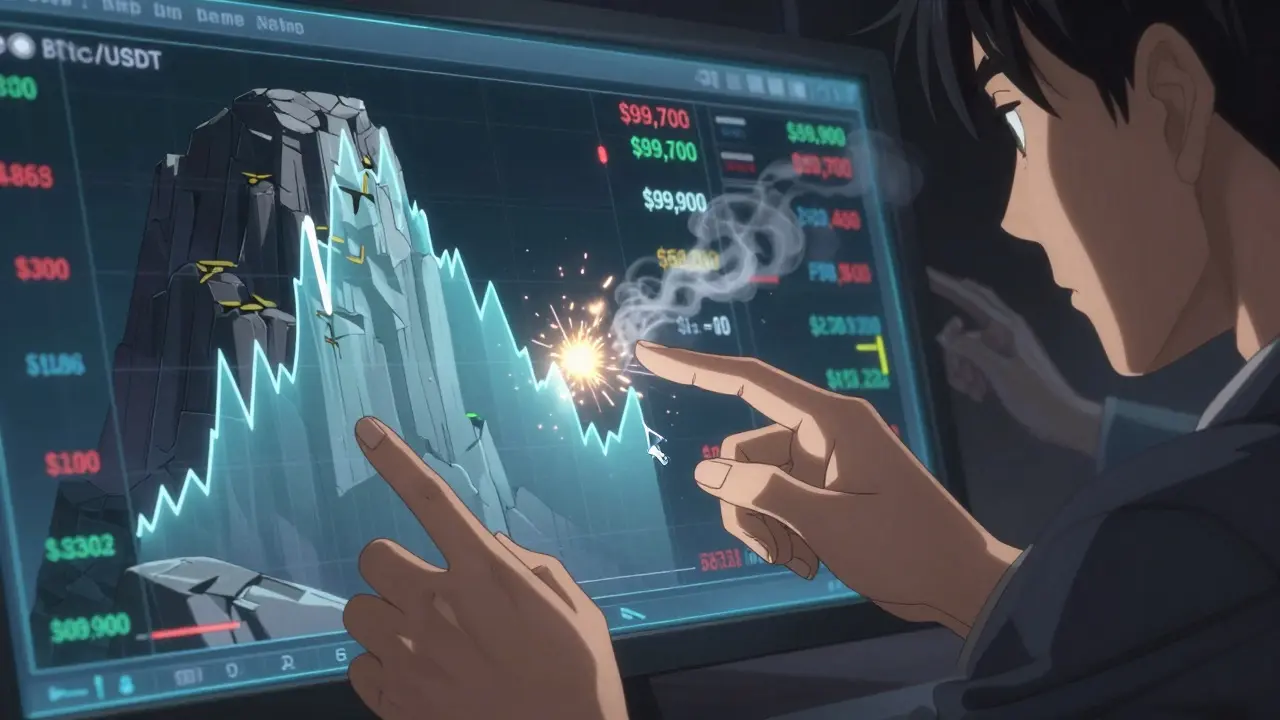
What You Can See - and What You Can’t
The order book looks simple, but it’s full of traps. You might see a huge buy order for 100 BTC at $99,700. Looks like strong demand, right? Maybe. But it could be a spoof - a fake order placed by a bot to trick others into thinking there’s buying pressure. Then it gets canceled before anyone can trade. This is called spoofing, and it’s common. Also, the order book only shows open orders. It doesn’t show what’s happening in dark pools or over-the-counter (OTC) trades. Big players often move large amounts off the public book. So what you see isn’t the whole picture. Another thing: the book updates in milliseconds. During a spike in volatility - say, when Elon Musk tweets - hundreds of orders can vanish or appear in seconds. If you’re not used to it, it can feel chaotic. That’s why beginners often panic. The trick isn’t to react - it’s to watch.How to Use an Order Book for Better Trades
You don’t need to be a quant to use the order book. Here’s how real traders use it:- Find support and resistance - Look for clusters of orders. If price keeps bouncing off $99,500, that’s a support level. If it keeps hitting resistance at $100,100, traders are selling there.
- Place limit orders wisely - Instead of market orders (which execute immediately at whatever price is available), use limit orders. If you want to buy Bitcoin, place your order just below the top bid. You might get filled faster, and you’ll avoid paying too much.
- Watch for liquidity gaps - If there’s a big jump between $99,800 and $99,900 with almost no orders in between, that’s a gap. If price moves into that gap, it could race through quickly. Avoid trading into gaps unless you’re prepared for slippage.
- Check volume at each level - A price level with 100 BTC in orders is more reliable than one with 0.5 BTC. Depth matters.
Who Uses Order Books - And Why
Retail traders use order books to avoid slippage. Instead of buying at $99,900 because the market moved fast, they place a limit order at $99,750 and wait. It takes patience, but it saves money. Institutional traders rely on order books for large trades. They use algorithms to scan the book for hidden liquidity, then break big orders into smaller pieces to avoid moving the market. Hedge funds and market makers have teams dedicated to reading order flow. Even crypto whales - traders with millions in holdings - study the book before moving. If they want to sell 500 BTC, they’ll check where the biggest sell walls are. If there’s a wall at $99,800, they might sell just below it. If not, they might wait for a spike.
Challenges and Risks
Order books aren’t perfect. Here’s what trips people up:- Overwhelming data - New traders stare at the book and freeze. All those numbers look like noise. Start small. Watch one pair for 10 minutes. Learn the rhythm.
- Manipulation - Fake orders, wash trading, and spoofing are real. Don’t assume every big order is genuine.
- Latency - On fast-moving markets, the order book you see on your screen is already a split-second old. High-frequency traders have servers right next to the exchange’s matching engine. You don’t.
- Emotional pressure - Watching prices tick up and down while your limit order sits unfilled can be nerve-wracking. Stick to your plan.
Getting Started
You don’t need to be an expert to start. Here’s how:- Choose a major exchange like Binance or Coinbase Pro. Their order books are clean and easy to read.
- Open a small trade - say, $50 worth of Ethereum. Watch the order book as you place a limit buy order.
- Observe what happens when your order gets filled. Did it take from the top ask? Did it move the price?
- Use free educational tools. Binance Academy, Coinbase Learn, and Kraken’s trading guides have step-by-step order book tutorials.
- Join communities like r/cryptocurrency or Discord servers focused on order flow. Watch how experienced traders talk about book depth.
The Future of Order Books
As crypto matures, order books are getting smarter. Exchanges are reducing latency to under a millisecond. AI tools now analyze order flow to predict short-term moves. Some platforms are testing cross-chain order books that let you trade Bitcoin against Solana tokens directly - no bridges needed. Institutional demand is pushing for more transparency. Regulators are starting to require exchanges to show more data about order matching and potential manipulation. That means better tools for everyone. But the core won’t change. As long as people want to trade at specific prices, the order book will be the foundation. It’s not going away. It’s evolving. And if you understand it, you’re ahead of 90% of traders.What is the difference between a market order and a limit order on an order book?
A market order buys or sells immediately at the best available price, no matter what it is. A limit order lets you set a specific price. The system only fills it if someone else matches that price. Limit orders give you control over price but might not fill right away. Market orders guarantee speed, not price.
Why do some crypto exchanges not have order books?
Decentralized exchanges (DEXs) like Uniswap use Automated Market Makers (AMMs) instead of order books. AMMs rely on liquidity pools and math formulas to set prices automatically. They don’t show individual buy and sell orders. Some newer DEXs are now adding on-chain order books, but most still use AMMs for simplicity and decentralization.
Can you see all orders in the order book?
No. Only open limit orders are visible. Large traders often use hidden orders, iceberg orders (showing only part of the total), or trade off-exchange through OTC desks. Also, some exchanges don’t display the full depth - only the top 10-20 price levels. So you’re seeing a snapshot, not the full picture.
How does the bid-ask spread affect my trading?
The spread is the cost of trading. A wide spread means you pay more to enter and exit a trade. For example, if the spread is $100 on Bitcoin, you need the price to move $100 just to break even. Narrow spreads mean lower trading costs and better liquidity - common on major pairs like BTC/USDT. Wide spreads happen on low-volume coins or during sudden market moves.
Are order books the same across all crypto exchanges?
The core structure is the same, but the interface and depth vary. Binance and Coinbase Pro show deep liquidity with hundreds of price levels. Smaller exchanges might only show the top 5. Some have advanced tools like heat maps, volume profiles, or time-and-sales feeds. Institutional platforms offer API access and order types like IOC (immediate or cancel) or FOK (fill or kill).
Can order books be manipulated?
Yes. Common tactics include spoofing (placing large fake orders to trick others), wash trading (buying and selling to yourself to create false volume), and layering (placing multiple small orders to hide real intent). While exchanges have systems to detect this, it still happens - especially on less-regulated platforms. Always check for order book behavior that looks unnatural, like large orders vanishing right before price moves.
Melissa Ritz
March 6, 2026 AT 13:54Ugh, another one of these 'order book = god mode' posts. I’ve been trading since 2017, and let me tell you - most of this is just regurgitated Binance Academy fluff. The real edge isn’t in reading the book, it’s in knowing who’s *behind* the orders. Spoofing? Please. It’s not some rare glitch - it’s the entire game. If you think you’re outsmarting bots with limit orders, you’re the bot’s lunch.
Also, why are we still pretending CEXs are 'transparent'? Your 'deep order book' on Binance is just a sanitized version of what’s really happening. Half the liquidity is hidden in dark pools, and the rest is manipulated by whales with algorithmic front-running. You’re not trading the order book. You’re playing chess with ghosts.
Emily Pegg
March 6, 2026 AT 20:40Y’all are overthinking this. I just look at the green and red bars, click 'buy' when it looks like a mountain of green, and walk away. If it goes up, cool. If it goes down, I buy more. It’s called dollar-cost averaging, not rocket science. Why does everyone need to turn trading into a PhD thesis? 🤦♀️
Basil Bacor
March 8, 2026 AT 09:16lol u think u can outsmart the algos? u dont even know what a iceberg order is. i seen a 200 btc buy wall on binance, looked solid, then poof gone 2 sec before price spiked. classic spoof. noob move. also, why do people still use limit orders? market orders are faster, less stress. u just pay a lil more, who cares? 🤷♂️
Jane Darrah
March 9, 2026 AT 18:14Okay, but let’s be real - the entire premise of this post is built on a fantasy. Order books are not 'maps' of the market. They’re theater. A carefully curated performance for retail traders to feel like they have control. The truth? The biggest players don’t even use public order books. They route through OTC desks, private liquidity networks, and off-chain matching engines. What you see is a distraction - a placebo for people who need to believe they’re 'analyzing' something.
And don’t get me started on 'support and resistance' levels. Those aren’t psychological barriers - they’re just where bots and market makers place their stop hunts. You think $99,500 is a 'strong support'? Nah. That’s where the algo dumps 100 BTC after triggering all the stop-losses above it.
It’s not about understanding the book. It’s about understanding that the book doesn’t want you to understand it. You’re not a trader. You’re a data point.
And yet… here we are. Still staring. Still hoping. Still thinking we’re one limit order away from enlightenment. 😔
Jeffrey Dean
March 10, 2026 AT 09:53Everyone’s missing the point. The order book isn’t about price. It’s about time. Every order placed is a timestamped declaration of intent. The real power isn’t in the volume - it’s in the sequence. Who placed their order first? Who canceled? Who adjusted? The market doesn’t move because of supply and demand. It moves because of *urgency*. And no retail trader has access to the order flow timeline. Not even close.
You think you’re reading depth? You’re reading a delayed, filtered, sanitized feed that’s been scrubbed to make you feel safe. Meanwhile, the HFTs are already 17 microseconds ahead, flipping positions while you’re still deciding whether to click 'buy' or 'cancel'.
So yes - study the book. But know this: you’re not playing the game. You’re watching it on a 30-second delay from a couch in Ohio.
Brian T
March 11, 2026 AT 23:52I’ve been reading this whole thing and I just… don’t care. Why does this even matter? Crypto’s a casino. The order book is just the slot machine’s payout table. You think you’re 'reading the market'? You’re just staring at flashing lights hoping one of them means you won.
I’ve seen people lose six figures because they 'waited for a dip' on the order book. Meanwhile, the price went up 30% and they’re still stuck at $99,700 like it’s a holy number.
Just trade. Or don’t. But stop pretending this is finance. It’s not. It’s gambling with extra steps.
Nash Tree Service
March 12, 2026 AT 05:46It is imperative to recognize that the foundational premise of this discourse, while ostensibly informative, fundamentally misrepresents the ontological nature of market liquidity in decentralized financial ecosystems. The order book, as presented, is a construct of centralized authority - a vestigial artifact of pre-blockchain financial paradigms.
One must interrogate: if liquidity is algorithmically generated via AMMs, then is the order book not merely a performative illusion? Does the illusion of depth serve to pacify the retail participant, rendering them docile in the face of systemic asymmetry?
Furthermore, the notion of 'watching' the order book implies agency - but agency is an epistemological fallacy in a system where latency differentials are measured in nanoseconds and institutional actors possess direct API access to matching engines.
Thus, the true utility of the order book is not in its informational value, but in its psychological function: to sustain the myth of fairness in an inherently predatory architecture.
Lydia Meier
March 14, 2026 AT 04:54While I appreciate the thoroughness of this exposition, I must respectfully challenge the assertion that order books are inherently superior to AMMs. The notion that 'control' equates to 'advantage' is a classical fallacy. AMMs, by design, eliminate order book manipulation, reduce front-running, and provide immutable price discovery. The so-called 'precision' of limit orders is rendered meaningless when the underlying infrastructure is subject to centralization, censorship, and regulatory capture.
Moreover, the assumption that retail traders benefit from order book analysis ignores the reality that the majority of liquidity on major exchanges is sourced from market makers with co-located servers and proprietary data feeds. To suggest that a retail trader can meaningfully 'read' the book is akin to suggesting that a spectator can predict the outcome of a Formula 1 race by watching the pit crew’s hand signals.
The future lies not in refining outdated market structures, but in embracing decentralized, permissionless alternatives - even if they lack the aesthetic appeal of a color-coded depth chart.
Denise Folituu
March 15, 2026 AT 23:10I just lost everything last week because I trusted the order book. Saw a huge buy wall at $99,800 - thought it was solid. Turned out it was a trap. Price dropped 12% in 90 seconds. I cried. I really did. I’m not even mad. I’m just… disappointed. Like, why does the market hate me? 😭
Now I just buy when I feel like it and hope for the best. I miss the days when crypto was just a meme and I didn’t have to think about bids and asks. I just wanted to buy Dogecoin and laugh.
jack carr
March 16, 2026 AT 19:32Hey, just wanted to say - this was actually really helpful. I’ve been trading for a year and never really understood the spread until now. Took me 10 minutes just to watch the BTC/USDT book on Binance. Saw how small orders kept getting eaten, then a big one popped up… and vanished. Felt like magic. But now I get it. Not magic. Just math. Thanks for laying it out. 🙌
Ethan Grace
March 17, 2026 AT 07:35The order book is a mirror. Not of the market - but of the trader’s soul. When you stare into the bids and asks, you don’t see prices. You see your fears. Your greed. Your desperation to be right.
That wall of sell orders at $100,200? That’s not resistance. That’s your inner voice screaming, 'You’re not ready.'
That gap between $99,800 and $99,850? That’s the chasm between who you are and who you think you should be.
Trade the book? No. Heal the self. The market will follow.
Jeffrey Dean
March 19, 2026 AT 06:33Of course the 'Chill Observer' above says 'this was helpful.' Of course he did. He’s the type who thinks reading a 10-minute guide makes him a trader. Meanwhile, the rest of us are out here watching how institutional algos bait retail into buying at the top of a spoofed order wall - and then they short it into oblivion.
You didn’t 'learn' anything. You just got a dopamine hit from someone saying 'trust the process.'
Go ahead. Keep watching the book. I’ll be here, trading the invisible liquidity.