What is Celestia (TIA)? A Simple Guide to the Modular Blockchain

You’ve probably heard the term "blockchain" thrown around for years. But if you look closely at how most of them work-like Ethereum or Bitcoin-they try to do everything at once. They handle transaction execution, consensus, and data storage all in one massive bundle. This "monolithic" approach creates a bottleneck. As more people use the network, it gets slower and more expensive.
Celestia is the world’s first modular blockchain network that separates these functions to solve scalability issues. Instead of trying to be a general-purpose computer, Celestia focuses on just two things: ensuring transaction data is available and ordering that data securely. It launched its mainnet in October 2023, introducing a new way to build blockchains that promises faster speeds and lower costs. If you are wondering what makes this project different from the hundreds of other coins out there, the answer lies in its architecture and its native token, TIA.
The Problem with Monolithic Blockchains
To understand why Celestia matters, you have to look at the problem it solves. Traditional blockchains are like Swiss Army knives. They attempt to execute smart contracts, reach consensus on the state of the ledger, and store every single piece of historical data simultaneously. This works fine when usage is low. But as demand grows, the network clogs up.
This congestion leads to high gas fees and slow transaction times. Developers have tried to fix this by building Layer 2 solutions, but those often rely on the underlying Layer 1 chain for security and data availability, which can still become a bottleneck. Celestia takes a different route. It adopts a modular blockchain architecture. Think of it like separating the kitchen from the dining room in a restaurant. The kitchen (execution) prepares the food, while the dining room (data availability) ensures everyone has a seat and knows what was ordered. By splitting these roles, each part can scale independently.
How Celestia Works: Data Availability Sampling
Celestia’s core innovation is a technology called Data Availability Sampling (DAS). In traditional blockchains, every node must download the entire history of transactions to verify the network’s integrity. This requires massive amounts of storage and bandwidth, leading to centralization because only wealthy entities can afford to run full nodes.
DAS changes the game. It allows light nodes to verify that block data is available without downloading the whole block. Imagine checking if a library book exists by looking at a few random pages rather than reading the entire volume. If the sampled pages are present and valid, you can mathematically guarantee the rest of the book is there too. This efficiency means anyone can participate in securing the network with minimal hardware, keeping the system decentralized and secure.
| Feature | Monolithic (e.g., Ethereum) | Modular (e.g., Celestia) |
|---|---|---|
| Execution | Built-in | Handled by separate Rollups |
| Data Availability | Built-in (expensive) | Dedicated layer (cheap) |
| Scalability | Limited by node size | Highly scalable via DAS |
| Flexibility | Low (one-size-fits-all) | High (customizable rollups) |

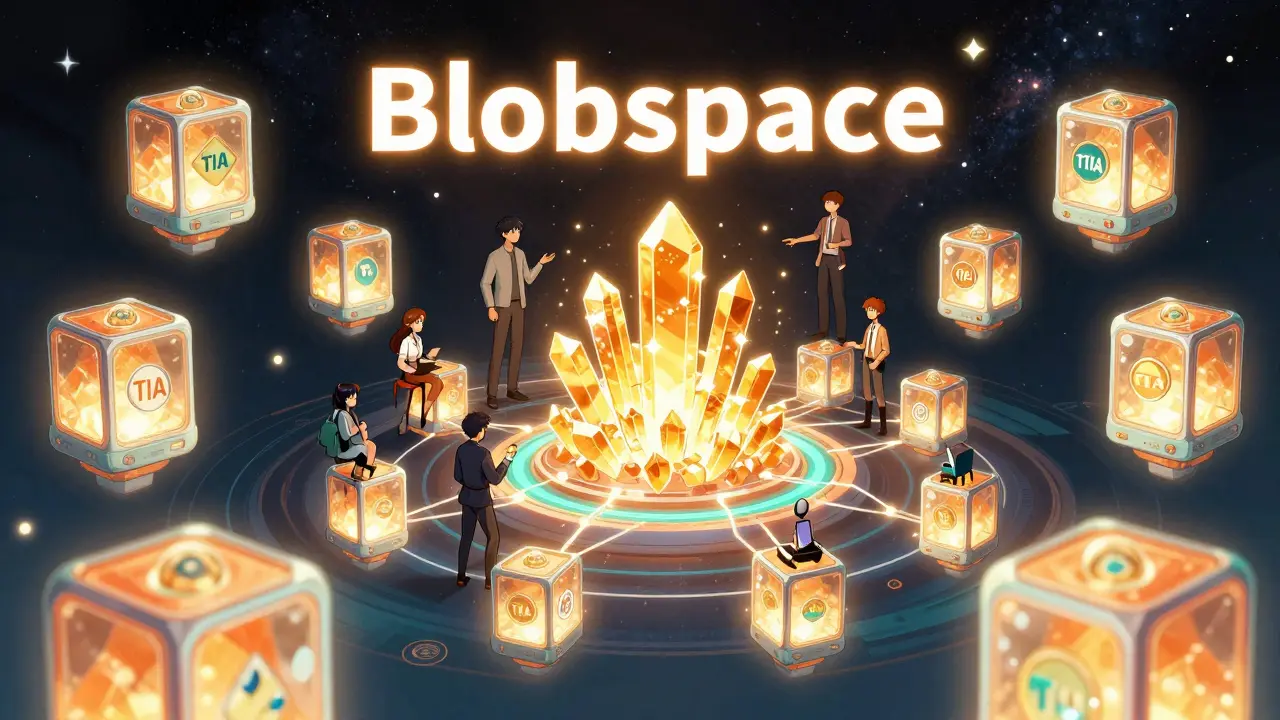
What is Blobspace?
A key concept you will hear about with Celestia is Blobspace. When developers build applications on Celestia, they don’t write code directly on the base layer. Instead, they create "rollups." These rollups process transactions quickly and then publish their data to Celestia as "blobs" (binary large objects).
Celestia provides the space to store these blobs securely. Developers pay for this space using the TIA token. This mechanism, known as PayForBlobs, ensures that data remains accessible for verification. It is similar to paying rent for server space, but instead of a centralized company hosting your data, the entire network guarantees its availability through cryptographic proofs. This model allows rollups to be sovereign-they control their own rules and tokens-while relying on Celestia for security and data integrity.
TIA Token Utility and Economics
The TIA token is the fuel that keeps the Celestia ecosystem running. It serves three primary purposes:
- Network Security: Celestia uses a Proof-of-Stake (PoS) consensus mechanism. Validators stake TIA to secure the network and produce blocks. In return, they earn rewards. This economic incentive aligns the interests of stakeholders with the health of the network.
- Governance: TIA holders can vote on proposals that affect the protocol’s development. This includes changes to fee structures, software upgrades, and ecosystem funding. Holding TIA gives you a voice in how the platform evolves.
- Paying for Blobspace: As mentioned earlier, developers must pay TIA to post their transaction data to the network. This demand for TIA helps maintain the token’s value as the ecosystem grows.
The tokenomics of TIA are designed to balance inflation with sustainability. At launch, the annual inflation rate was set at 8%. This rate decreases by 10% each year until it reaches a long-term issuance rate of 1.5%. This gradual reduction aims to reward early participants while preventing excessive dilution over time. Additionally, Celestia conducted a significant genesis airdrop, distributing 60 million TIA tokens to active users across Ethereum, Cosmos, and other ecosystems to bootstrap adoption.
Celestia vs. Competitors
Celestia isn’t the only player in the data availability space. Projects like EigenDA and Avail also offer similar services. However, Celestia distinguishes itself by being a fully independent Layer 1 blockchain rather than a service built on top of another chain. This independence gives it greater sovereignty and flexibility.
Compared to Ethereum, Celestia offers cheaper data posting costs, making it attractive for high-throughput applications like gaming or micro-transactions. Compared to other modular solutions, Celestia’s integration with the Cosmos SDK makes it easier for developers familiar with the Cosmos ecosystem to deploy rollups. Its focus on simplicity and specialization allows it to outperform general-purpose chains in specific metrics like throughput and cost-efficiency.
Is Celestia Right for You?
If you are a developer looking to build a scalable application without managing complex infrastructure, Celestia provides a compelling foundation. Its modular design lets you focus on execution logic while offloading data availability concerns. For investors, TIA represents exposure to the growing trend of modular blockchains. However, remember that the crypto market is volatile. The value of TIA depends on adoption rates, technological advancements, and broader market conditions.
Celestia represents a shift in how we think about blockchain architecture. By specializing in data availability, it enables a future where blockchains can scale infinitely without sacrificing decentralization. Whether it becomes the standard for rollup deployment remains to be seen, but its technical approach offers a clear solution to longstanding industry challenges.
What is the main purpose of Celestia?
Celestia’s main purpose is to provide a decentralized data availability and consensus layer for other blockchains. It does not execute transactions itself but ensures that transaction data is publicly available and verifiable, allowing rollups to scale efficiently.
How does TIA differ from ETH?
ETH is used to pay for computation and execution on Ethereum. TIA is primarily used to pay for data storage (blobspace) on Celestia and to secure the network through staking. While both are PoS networks, their primary utilities and architectural roles differ significantly.
Can I stake TIA?
Yes, you can stake TIA to support network validators and earn rewards. Staking helps secure the Celestia network and provides you with governance rights. You can stake TIA through various wallets and exchanges that support the Cosmos ecosystem.
What is Data Availability Sampling (DAS)?
DAS is a cryptographic technique that allows nodes to verify that block data is available without downloading the entire block. It samples small pieces of data to ensure completeness, enabling lightweight participation and improving network scalability.
When did Celestia launch?
Celestia’s mainnet officially launched on October 31, 2023. This marked the beginning of its operations as a functional data availability layer, coinciding with the release of the TIA token and initial airdrops.