What is Roko (ROKO) Crypto? Temporal Layer vs Meme Reality
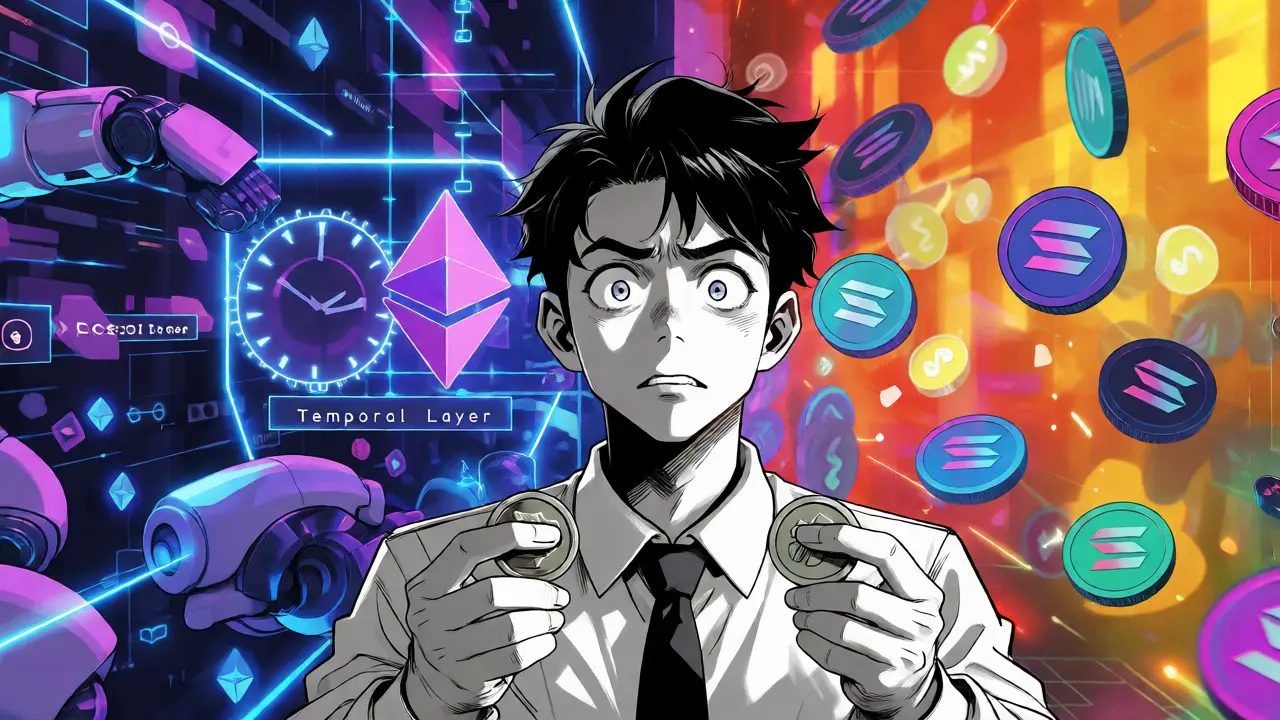
You’re staring at a chart. The price of Roko (ROKO) is a small-cap cryptocurrency with conflicting identities: an Ethereum-based infrastructure token and several unrelated Solana meme coins has moved 15% in an hour. Is this the next big AI-robotics play? Or did you just buy a random meme coin on Solana because it shares the same ticker? If you’ve ever confused these two, you’re not alone. Roko is a perfect case study in why verifying contract addresses matters more than reading headlines.
As of mid-2026, Roko sits in a weird limbo. It’s not dead, but it’s certainly not mainstream. With a market cap hovering around $1-2 million, it’s a ghost town compared to giants like Bitcoin or even smaller DePIN projects. But for developers and high-risk traders, it offers something unique: a "temporal layer" for Web3. Does that mean anything if the network is still in testnet? Let’s break down what Roko actually is, who it’s for, and why you need to be careful before sending any funds.
The Identity Crisis: One Ticker, Multiple Tokens
Here is the first trap. When you search for "Roko," you don’t find one asset. You find a family of unrelated tokens sharing the name ROKO. This isn’t a fork; these are distinct entities built on different blockchains with completely different goals.
- Roko Network (Ethereum/EVM): This is the "serious" project. It claims to be a temporal layer for Web3, focusing on nanosecond-level timing and deterministic ordering for robotics and IoT. It uses an EVM-compatible architecture with Chain ID 52370.
- Solana ROKO Variants: These are SPL tokens on the Solana network. Examples include "Roko AI" and "Roko’s Basilisk." They have tiny supplies (some under 1 million tokens) and minuscule liquidity pools, often trading for less than $22,000 in total value locked. These are largely speculative meme plays.
Confusing them is easy and expensive. A trader looking for the infrastructure play might accidentally buy a Solana meme coin with $3 daily volume. Always check the chain ID. For the main Roko Network, you want Chain ID 52370. If your wallet says "Solana," you’re in the wrong place.
What Does Roko Network Actually Do?
Forget the meme narrative for a second. The core promise of the Ethereum-based Roko Network is technical precision. Most blockchains care about what happened. Roko cares about when it happened, down to the nanosecond.
Why does this matter? Think about autonomous robots or high-frequency sensor data. If two machines send data to a blockchain simultaneously, standard chains might struggle to order those events accurately enough for industrial coordination. Roko aims to solve this by providing a "deterministic ordering" service. It combines hardware-grade timing measurements with blockchain settlement. This allows applications to reason precisely about machine work.
The official documentation describes it as a layer for custody-aware packaging and settlement for physical or digital work. In plain English: it wants to be the clock and referee for the machine economy. However, there is a massive caveat. As of August 2026, the network is operating as a public testnet. Testnet ROKO has no monetary value. The production mainnet hasn’t fully launched with its final economic security model. You are buying into a promise, not a finished product.
Tokenomics and Market Reality
Let’s look at the numbers. Data providers disagree slightly, which is common for microcaps, but the picture is consistent: Roko is small, volatile, and thinly traded.
| Metric | Value / Status | Context |
|---|---|---|
| Price Range | $0.000004 - $0.000016 | Fractions of a cent; highly volatile |
| Market Cap | ~$1.2M - $2.2M | Microcap tier; low institutional interest |
| Circulating Supply | ~208 Billion ROKO | ~56% of max supply (369B) |
| 24h Volume | $1,200 - $100,000 | Extremely low liquidity; high slippage risk |
| Network Status | Public Testnet | Mainnet economics not finalized |
The circulating supply is roughly 208 billion tokens out of a maximum 369 billion. That’s a lot of coins floating around. The price history shows classic boom-and-bust cycles. In early 2024, it hit an all-time high of ~$0.00015. By March 2026, it had retraced to ~$0.0000045. This isn’t steady growth; it’s speculation driven by narrative shifts.
Liquidity is the biggest danger here. On some days, 24-hour volume drops to $1,260. That means if you try to sell a position larger than a few hundred dollars, you might move the price against yourself significantly. Order book depth outside ±2% is shallow. You can get in, but getting out without taking a haircut requires patience and limit orders.
Meme Coin vs. Infrastructure: Which Narrative Wins?
This is where Roko gets confusing for analysts. Some sources, like TokenInsight, label it a "meme token" leveraging AI branding. Others, including DePIN explorers, classify it as infrastructure. Why the disconnect?
Project branding evolves. Early marketing may have leaned into the "AI + Meme" hype cycle of 2023-2024 to attract attention. Later technical docs pivoted to serious robotics use cases. Community sentiment reflects this split. You’ll see Reddit threads discussing it as a speculative lottery ticket alongside GitHub commits about timestamping protocols.
There are no publicly cited audits from major firms like CertiK or Hacken in the accessible data. No famous founders are listed. This opacity suggests a community-driven project rather than a VC-backed institution. For investors, this increases risk. Without audits, smart contract vulnerabilities remain unverified. Without known founders, accountability is harder to enforce.

How to Buy and Interact with Roko Safely
If you decide to take the risk, how do you actually do it? Since Roko is primarily Ethereum-based (ERC-20), you’ll use standard tools, but with custom settings.
- Verify the Contract Address: Never trust a search result blindly. Copy the address from the official Roko Network site or a trusted aggregator like CoinGecko/CoinMarketCap. Ensure it matches the Ethereum mainnet listing.
- Use EVM-Compatible Wallets: MetaMask, Rabby, or Coinbase Wallet work fine. Add the custom RPC if you are interacting with the testnet directly, though most trading happens via centralized exchanges or DEX aggregators.
- Check the Chain ID: For development or direct interaction, remember Chain ID 52370. This prevents you from sending ETH to a contract that doesn’t exist on the correct network.
- Start Small: Given the low liquidity, start with a position size you can afford to lose entirely. Slippage can eat 5-10% of your trade in illiquid moments.
For Solana ROKO variants, the process is simpler but riskier due to lower liquidity. Use a Solana wallet like Phantom or Backpack. Check the liquidity pool size on Raydium or Jupiter. If the pool has less than $50k in TVL, avoid large trades.
Is Roko a Good Investment?
Honestly? It depends on your risk tolerance. Roko is not a safe bet. It lacks the adoption metrics of established DePIN projects like Helium or IoTeX. Its market cap is under $2.5 million, placing it deep in the microcap graveyard where many projects go to die.
However, if you believe in the niche of "temporal layers" for robotics, Roko is one of the few tokens attempting this specific technical problem. The upside potential exists if they launch a successful mainnet and attract real industrial partners. The downside is total loss if the project stalls in testnet forever or if the meme narrative fades completely.
Treat Roko as a venture capital-style bet within your portfolio. Allocate only what you can afford to wait years for. Don’t expect quick flips based on current volume trends. The volatility is high, but the direction is uncertain.
Is Roko (ROKO) a scam?
Not necessarily a scam, but it is high-risk. There are no confirmed rug pulls, but the lack of public founder identities and audits raises red flags. The presence of multiple unrelated tokens with the same ticker also creates confusion that scammers could exploit. Always verify contract addresses.
What is the difference between Roko Network and Solana ROKO?
Roko Network is an Ethereum/EVM-based project focused on temporal data and robotics. Solana ROKO tokens are SPL assets, often meme-coins or experimental communities, with much smaller supplies and liquidity. They are not interoperable and serve different purposes.
Is Roko live on mainnet?
As of mid-2026, the Roko Network is primarily operating on a public testnet. While the ERC-20 token trades on exchanges, the underlying infrastructure for its claimed temporal services is still in testing phases. Production mainnet economics are not fully finalized.
Where can I buy ROKO?
The main Ethereum-based ROKO is listed on several centralized exchanges and decentralized exchanges. Liquidity is concentrated on a few pairs, often against ETH. Check aggregators like CoinMarketCap for current active markets, as listings change frequently for microcaps.
What is the max supply of ROKO?
The maximum supply for the main Ethereum-based ROKO token is approximately 369.36 billion tokens. About 56% of this supply is currently circulating. Note that Solana-based ROKO variants have vastly different supplies, ranging from hundreds of thousands to nearly a billion.