What is zkVerify (VFY)? A Deep Dive into the ZK Proof Verification Layer

Imagine you need to prove you are over 18 to buy a ticket, but you don't want to hand over your entire driver's license with your home address and birthdate. You just want to show the 'over 18' part. That is the promise of zero-knowledge proofs. But here is the catch: verifying these complex mathematical proofs on major blockchains like Ethereum is expensive and slow. This is where zkVerify comes in. It is a specialized Layer 1 blockchain designed for one job only: verifying these proofs quickly and cheaply.
If you have seen the ticker symbol VFY popping up on exchanges or heard whispers about it in crypto communities, you might be wondering what it actually does. Is it another generic smart contract platform? No. It is a modular infrastructure piece built specifically to handle the heavy lifting of cryptographic verification so that other networks don't have to.
The Core Problem: Why Do We Need a Dedicated Verification Layer?
To understand zkVerify, you first need to understand the bottleneck it solves. In the world of Web3, scalability often relies on Layer 2 solutions like ZK-rollups. These rollups bundle thousands of transactions off-chain, generate a single cryptographic proof that everything is correct, and then submit that proof to the main chain (Layer 1) for final settlement.
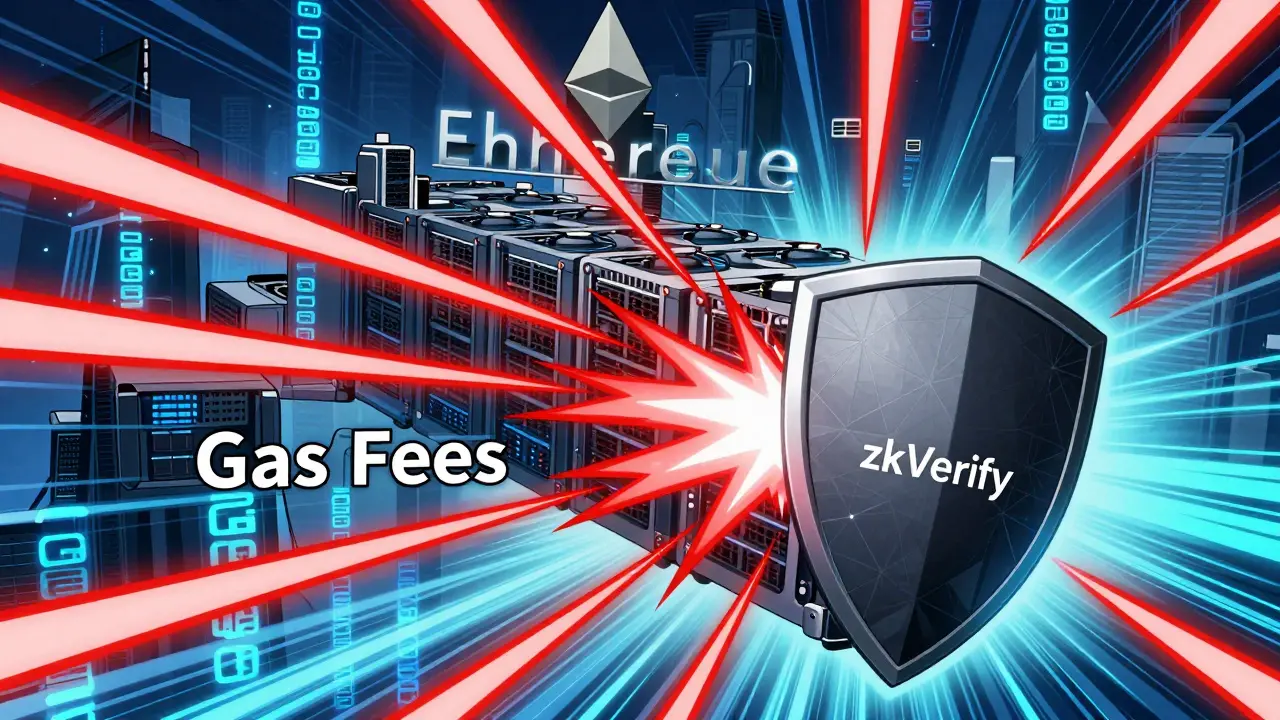
The problem? Verifying that proof on a general-purpose blockchain like Ethereum costs a significant amount of gas fees. As more applications adopt privacy features or use ZK technology for gaming and identity, the cost of verification becomes a major hurdle. Developers are stuck choosing between high security (verifying on Ethereum) and low cost (verifying on cheaper, less secure chains).
zkVerify positions itself as the middle ground. It is a dedicated network optimized solely for this task. By offloading the verification process to zkVerify, developers can achieve near-instant validation at a fraction of the cost, while still maintaining the rigorous security standards of zero-knowledge cryptography.
Who Built zkVerify and What Is Their Background?
In the crypto space, the team behind the code matters almost as much as the code itself. zkVerify was developed by Ellipsis Distributed Systems, with Horizen Labs serving as the lead contractor. Horizen Labs is a well-established name in the industry, known for its work on the Horizen ecosystem and contributing to major projects like ApeCoin. This partnership suggests a level of engineering maturity that many early-stage protocols lack.
The project launched publicly with its token generation event around late September, listing initially on major centralized exchanges like KuCoin and Gate.io. The all-time high price hit around $0.20 during this initial discovery phase, reflecting strong speculative interest before settling into its current trading range.
How Does the VFY Token Work?
The native currency of the network is the VFY token. Unlike tokens that serve as speculative assets first and utility second, VFY has clear, defined roles within the zkVerify ecosystem. Here is how it functions:
- Gas Fees: Every time a developer submits a zero-knowledge proof to the network for verification, they must pay a fee in VFY. This creates direct demand for the token based on network usage.
- Staking and Security: zkVerify uses a Nominated Proof-of-Stake (NPoS) consensus mechanism. Holders can stake their VFY to become validators (running nodes) or nominators (backing validators). This secures the network and rewards participants with newly minted tokens.
- Governance: Token holders have a say in the future of the protocol. They vote on upgrades, parameter changes, and other critical decisions.
- Ecosystem Growth: A portion of the supply is reserved for grants and incentives to encourage developers to build on the platform.
Tokenomics: Supply, Emissions, and Economics
Understanding the economic model is crucial for any investor. zkVerify has a fixed maximum supply of 1,000,000,000 VFY. At genesis, approximately 306.57 million VFY (about 30.66%) entered circulation. The remaining ~693 million tokens were locked or subject to vesting schedules for key ecosystem participants, ensuring that not all tokens hit the market at once.
The protocol emits new tokens at an annual rate of 2.5%. This means roughly 25 million new VFY are created each year to fund staking rewards and network security. Compared to some high-inflation PoS chains that emit 5-20% annually, 2.5% is relatively conservative. It aligns closer to the structural inflation models seen in mature networks like Ethereum post-Merge, though without the burn mechanism to offset it.
| Metric | Value |
|---|---|
| Max Supply | 1,000,000,000 VFY |
| Circulating Supply | ~361 Million VFY |
| Annual Emission | 2.5% |
| Consensus | Nominated Proof-of-Stake (NPoS) |
| Primary Use Case | ZK Proof Verification |
Technical Architecture: How Verification Happens
Let’s break down the workflow. When a Layer 2 rollup or a decentralized application needs to verify a computation, it doesn’t do it on zkVerify. Instead, the process looks like this:
- Proof Generation: Off-chain provers (using systems like zk-SNARKs or zk-STARKs) generate a cryptographic proof that a specific calculation was performed correctly.
- Submission: This proof is submitted as a transaction to the zkVerify network. The sender pays gas in VFY.
- Verification: zkVerify nodes run the verification algorithm. Because the network is optimized for this single task, it can process these verifications much faster and cheaper than a general-purpose blockchain.
- On-Chain Record: The result is recorded on the zkVerify ledger. Other chains can then reference this result via bridges or light clients to trust the outcome without re-running the math themselves.
This modular approach allows zkVerify to support "any proof, from any system." Whether it’s Groth16, PLONK, or STARKs, the goal is universal compatibility. This makes it a potential backbone for various sectors, including DeFi, private identity credentials, secure voting systems, and even AI model verification.
Market Performance and Risk Profile
As of mid-May 2026, VFY trades in the range of $0.0085 to $0.0095. With a circulating supply of around 361 million, the market capitalization sits between $2.6 million and $3.4 million. This places zkVerify firmly in the "micro-cap" category.
Why does this matter? Micro-caps are high-risk, high-reward assets. They are highly volatile and susceptible to large price swings based on relatively small trading volumes. Daily trading volume typically ranges from $150,000 to $600,000 across exchanges like KuCoin, Gate.io, and LBank. While this indicates active interest, it also means liquidity can be thin during market stress, leading to higher slippage for large orders.
Rankings vary by platform, generally placing VFY between #1,400 and #2,600 globally. It is not a household name yet, which presents both an opportunity for early adopters and a warning sign for those seeking stability. The price has dropped significantly from its all-time high of ~$0.20, reflecting the broader cooling of speculative interest in niche infrastructure plays after the initial launch hype.
Competition and Alternatives
zkVerify isn't alone in trying to solve the verification bottleneck. However, its competitors take different approaches:
- Ethereum & General L1s: Most rollups currently verify directly on Ethereum for maximum security. zkVerify argues this is too expensive. If Ethereum lowers gas fees significantly through further upgrades, zkVerify’s value proposition weakens.
- Mina Protocol: Mina focuses on keeping the entire blockchain size constant using recursive ZK proofs. zkVerify, conversely, acts as a service layer for external proofs rather than embedding them into its own consensus history in the same way.
- Data Availability Layers (Celestia, EigenDA): These projects focus on storing data cheaply, not verifying computations. They are complementary, not direct competitors, but they compete for developer attention and funding in the modular blockchain narrative.
- Rollup-Native Verification: Some large rollups are building their own verification logic. Convincing them to outsource to zkVerify requires proving that the cost savings outweigh the added complexity of cross-chain communication.

Real-World Use Cases Beyond Speculation
Beyond the price chart, what can you actually do with zkVerify? Here are three concrete scenarios:
1. Privacy-Preserving Identity: Imagine a decentralized app that lets you prove you are a citizen of a certain country without revealing your passport number. The app generates a ZK proof, sends it to zkVerify for validation, and then grants access. zkVerify ensures the proof is valid without storing your personal data.
2. Secure Gaming: In blockchain games, fairness is paramount. zkVerify can verify that a card shuffle was random and fair without revealing the cards until they are played. This prevents cheating while maintaining suspense.
3. AI Model Verification: As AI moves on-chain, users may want to verify that a model inference was computed correctly without exposing proprietary weights or user input data. zkVerify provides the computational layer to validate these complex AI proofs efficiently.
How to Buy and Store VFY
If you decide to participate in the ecosystem, here is the practical path:
- Create an Exchange Account: Sign up on a supported centralized exchange like KuCoin, Gate.io, or LBank. Complete the necessary KYC (Know Your Customer) verification.
- Fund Your Wallet: Deposit USDT or another stablecoin into your exchange account.
- Trade for VFY: Navigate to the spot trading section, search for the VFY/USDT pair, and place a buy order. Be mindful of the spread and liquidity; limit orders are often safer than market orders for micro-caps.
- Withdraw to a Cold Wallet: For long-term holding, move your VFY to a non-custodial wallet that supports custom RPC connections or hardware wallets compatible with the zkVerify network. Leaving assets on an exchange exposes you to counterparty risk.
Final Thoughts: Is zkVerify Worth Watching?
zkVerify addresses a genuine pain point in the blockchain industry: the high cost of zero-knowledge proof verification. Its technical foundation, backed by experienced developers from Horizen Labs, gives it credibility. The NPoS model and conservative 2.5% emission rate suggest a thoughtful approach to token economics.
However, the biggest risk is adoption. Technology is useless if no one uses it. zkVerify needs major Layer 2 rollups or dApps to integrate its verification services for the VFY token to gain sustained utility-driven demand. Until we see significant daily proof verification volumes, the token remains largely speculative.
For developers, it offers a compelling alternative to expensive Ethereum gas fees. For investors, it is a high-risk bet on the future of modular blockchain infrastructure. Keep an eye on their GitHub activity, partnership announcements, and actual on-chain usage metrics rather than just price movements.
Is zkVerify a Layer 1 or Layer 2 blockchain?
zkVerify is a Layer 1 blockchain. However, it is a specialized Layer 1 designed specifically for verifying zero-knowledge proofs generated by other networks, particularly Layer 2 rollups. It does not aim to be a general-purpose smart contract platform like Ethereum or Solana.
What is the maximum supply of the VFY token?
The maximum supply of VFY is fixed at 1,000,000,000 (one billion) tokens. Approximately 30.66% were in circulation at launch, with the rest allocated to ecosystem participants under vesting schedules.
How does zkVerify make money or sustain itself?
The network sustains itself through transaction fees paid in VFY. Developers and applications pay gas fees to submit proofs for verification. Additionally, the protocol emits 2.5% of the total supply annually to reward stakers and validators who secure the network.
Can I stake VFY to earn rewards?
Yes. zkVerify uses a Nominated Proof-of-Stake (NPoS) consensus. You can either run a validator node (requiring technical expertise and hardware) or act as a nominator by staking your VFY to trusted validators. Both roles earn rewards funded by block production and the annual token emissions.
Where can I buy VFY tokens?
VFY is listed on several centralized exchanges, including KuCoin, Gate.io, and LBank. You can typically trade it against USDT. Always check the latest listings on aggregators like CoinMarketCap or CoinGecko for the most current availability.
Is zkVerify secure?
Security in PoS networks depends on the distribution and honesty of validators. zkVerify employs slashing mechanisms to penalize malicious behavior. However, as a newer and smaller network, it has less accumulated security (total value locked) compared to giants like Ethereum. Users should always assess the risk profile of smaller cap networks.
What types of ZK proofs does zkVerify support?
zkVerify aims to be universal, supporting "any proof, from any system." This includes popular systems like zk-SNARKs (e.g., Groth16, PLONK) and zk-STARKs. The goal is to provide a single verification layer for diverse cryptographic schemes used across different blockchains and applications.
Larry Port
May 23, 2026 AT 09:46I've been digging into modular blockchain architectures for a while now, and this actually makes a lot of sense. The gas fees on Ethereum for ZK verification are genuinely prohibitive for smaller projects. If zkVerify can handle the heavy lifting cheaply, it solves a real bottleneck. Just curious if there are any known latency issues when bridging the result back to L1?
Jocelyn Garcia
May 24, 2026 AT 15:47The tech stack looks solid with Horizen Labs involved, but let's be real about the tokenomics. A micro-cap with low liquidity is basically a casino right now. I see the utility in theory, but until major rollups actually integrate it, VFY is just speculation dressed up as infrastructure. Don't FOMO in.
Amit Varpe
May 26, 2026 AT 01:55Another western project trying to solve problems we don't have yet :P India is building real utility not just verification layers. Keep dreaming though
Bronwen Butler
May 27, 2026 AT 03:19everyone is sleeping on the fact that eth will just lower gas fees eventually making this obsolete why do we need another chain for one thing its bloat pure and simple
Pauline Larocco71
May 28, 2026 AT 15:54I totally get where you guys are coming from but i think privacy features are going to be huge soon. Imagine proving your identity without giving away your whole life story. That’s pretty exciting stuff! Also love how they explained the staking part, feels very accessible for regular folks like me who aren’t devs 😊
beti macedo
May 29, 2026 AT 18:14It is indeed a fascinating development in the realm of cryptographic verification. The structured approach to token emissions demonstrates a level of foresight that is often lacking in newer protocols. One must remain optimistic about the potential for widespread adoption, provided the technical hurdles are overcome efficiently.
Michelle Bonahoom
May 30, 2026 AT 10:02another overhyped nothingburger. nobody cares about another l1 that does one thing. save your money and buy btc or go home. typical crypto bro garbage
Matt Davis
May 31, 2026 AT 15:16Oh, please. Another 'modular' solution? We have enough chains already clogging up the ecosystem. This is precisely the kind of fragmented nonsense that prevents interoperability. You people are celebrating bloat and calling it innovation. It is absolutely ridiculous that anyone thinks adding another verification layer is the answer rather than fixing the base layer efficiency.
Albert Lee
June 2, 2026 AT 13:40Hey Matt, take a breath! I know it’s frustrating to see so many new projects, but each one tries to solve a specific pain point. Larry made a good point about gas fees being a barrier for smaller devs. Maybe zkVerify isn’t for everyone, but for niche use cases like private gaming or AI verification, it could actually help democratize access. Let’s give them a chance to prove their worth!
Ankush Pokarana
June 2, 2026 AT 18:55i believe the philosophical underpinning of decentralization requires us to look beyond immediate utility and consider the long term structural implications of specialized networks by creating a dedicated layer for verification we are essentially acknowledging that general purpose blockchains cannot do everything well and perhaps that specialization is the natural evolution of complex systems much like biological organisms developing specialized organs
Bianca Vilas Boas Lourenço
June 4, 2026 AT 03:57Ugh, why is everyone so serious about this boring math stuff? 🙄 I just want my tokens to moon, not read a textbook on zero-knowledge proofs. Can we talk about something fun instead? Like which exchange has the best UI? Because honestly, reading all this technical jargon gives me a headache and I’m already stressed enough with the market volatility 😩💔