Wrapped Token Supply and Reserves: How the 1:1 Peg Actually Works
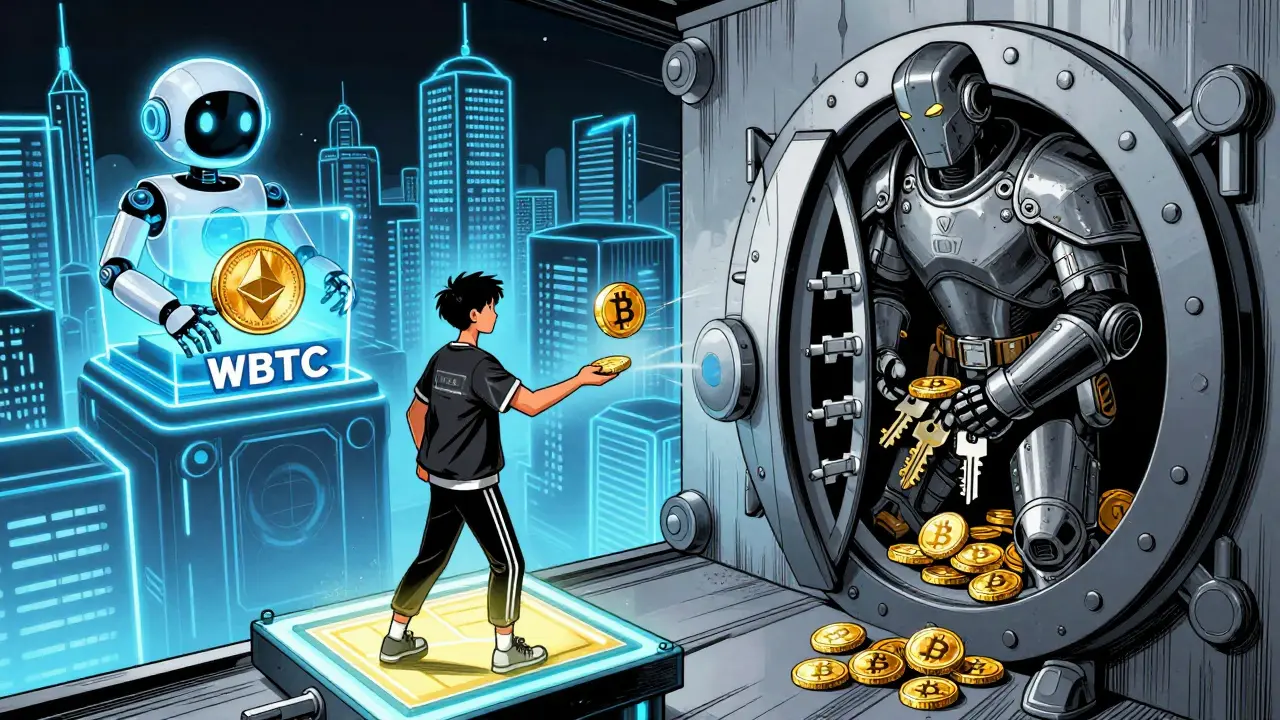
Imagine you want to use your Bitcoin in an Ethereum-based lending protocol. You can’t just send BTC directly; the networks don’t talk to each other natively. So, what do you do? You swap it for a "wrapped" version-like WBTC. But here is the scary part that most users ignore: when you hold that wrapped token, you are no longer holding actual Bitcoin on the Bitcoin blockchain. You are holding a promise.
That promise relies entirely on wrapped token supply and reserves. If the reserve doesn't match the supply exactly, your asset loses its peg, and value evaporates. This isn't just technical jargon; it is the backbone of billions of dollars in decentralized finance (DeFi). Understanding how this lock-and-mint system works is the difference between being a passive holder and an informed participant in the crypto economy.
The Lock-and-Mint Mechanism Explained
To understand wrapped tokens, you have to look at the physical process behind the digital magic. It starts with a custodian. When you decide to wrap your Bitcoin into WBTC, you don't interact with a smart contract directly on the Bitcoin network. Instead, you send your native BTC to a specific wallet controlled by a trusted entity-in WBTC's case, BitGo acts as the primary custodian.
Once BitGo confirms they have locked those coins in their multi-signature vaults, they signal the Wrapped Token DAO (Decentralized Autonomous Organization). The DAO then triggers a smart contract on the Ethereum network to mint an equivalent amount of WBTC. These new tokens are sent to your Ethereum wallet. The ratio is strict: one BTC locked equals one WBTC created.
| Action | User Step | Custodian/DAO Step | Result |
|---|---|---|---|
| Minting | Send BTC to custodian address | Lock BTC; DAO approves mint | New WBTC issued to user |
| Burning | Send WBTC to burn address | Verify burn; DAO approves release | Native BTC released to user |
This creates a closed loop. The total supply of WBTC circulating on Ethereum should never exceed the amount of BTC sitting in BitGo’s cold storage. If you want your Bitcoin back, you reverse the process. You send your WBTC to a designated "burn" address. The smart contract destroys those tokens, reducing the total supply. The DAO sees the reduction and instructs the custodian to release the corresponding native BTC from the reserve to your Bitcoin wallet. This 1:1 parity is the holy grail of wrapped assets.
Why Reserves Matter More Than Price
You might think, "If I need my money back, I’ll just sell the WBTC." That works in a liquid market, but it ignores systemic risk. The integrity of the entire ecosystem depends on transparent reserve verification. Without proof that the reserves exist, the wrapped token is essentially an unbacked IOU.
In January 2019, when WBTC launched via a joint initiative by Kyber, Ren, and BitGo, transparency wasn't the standard it is today. Now, trust is maintained through rigorous auditing. For instance, WBTC publishes monthly attestations from accounting firms like Armanino. These reports confirm that the number of WBTC tokens in circulation matches the BTC held in custody down to the decimal point.
Consider the alternative. Centralized exchanges often issue their own wrapped versions, like Binance’s BTCB. While convenient, these systems historically operated with opaque reserve processes. Users had to trust the exchange’s word rather than independent, public audits. After the collapse of FTX in 2022, where internal ledgers showed massive discrepancies between user balances and actual reserves, the industry shifted. As Changpeng Zhao noted, transparent reserve verification became non-negotiable. Today, if a wrapped token project cannot prove its reserves in real-time or through frequent third-party audits, sophisticated investors avoid it.

Comparing Custodial Models: WBTC vs. Decentralized Alternatives
Not all wrapped tokens are built the same way. The method used to secure the reserves defines the risk profile. Currently, three main models dominate the landscape, each with distinct trade-offs regarding control, speed, and security.
- The Custodial Model (WBTC): This is the dominant approach, holding about 90% of the wrapped Bitcoin market share. A centralized entity (BitGo) holds the keys. The advantage is institutional-grade security and regulatory compliance. The disadvantage? You must trust a single company not to be hacked, go bankrupt, or freeze assets. It contradicts the core "don't trust, verify" ethos of crypto.
- The Decentralized Network Model (renBTC): Projects like renVM use a distributed network of nodes to lock funds rather than a single custodian. This eliminates the single point of failure. However, it introduces higher technical complexity and has faced challenges with node operator incentives and liquidity depth.
- The Native Wrap (WETH): Wrapped Ether is unique because it wraps ETH on the Ethereum chain itself. There is no cross-chain bridge risk. Users deposit ETH into a smart contract, and the contract mints WETH. Since the code controls the reserves directly, there is no human custodian to fail. This is why WETH is the standard for DeFi trading pairs-it’s trustless by design.
If you are looking at market data from late 2024, WBTC still commands roughly $12.7 billion in market cap, driven largely by institutions that prefer the legal clarity of a known custodian over experimental decentralized networks. However, the tension remains. Gavin Andresen, a former Bitcoin lead developer, has criticized custodial wrapped tokens for reintroducing trusted third parties, arguing they undermine blockchain’s value proposition.

Risks: What Happens When the Peg Breaks?
Even with robust systems, risks persist. The most common issue isn't theft; it's friction. During periods of extreme network congestion, such as high gas fee spikes on Ethereum, the minting and burning queues can back up. Users have reported waiting 17 hours or more to unwrap their assets during peak traffic. While the reserves remain intact, the inability to access them quickly creates temporary arbitrage opportunities and panic selling.
More severe is the risk of smart contract vulnerabilities. The bridge connecting the two chains is a target for hackers. If a bug allows someone to mint WBTC without depositing BTC, the supply exceeds the reserves. The peg breaks. We saw echoes of this fear during the Terra/Luna collapse in 2022, which taught the industry that algorithmic pegs are fragile. Wrapped tokens rely on hard collateral, which is safer, but only if the collateral is actually there and accessible.
Regulatory scrutiny is also tightening. The European Union’s MiCA framework, effective from January 2025, requires monthly third-party attestations for wrapped assets operating within EU jurisdictions. This pushes smaller, less transparent projects out of the market, consolidating power around major players like WBTC who can afford the compliance overhead.
The Future: Moving Toward Trustless Bridges
The current custodial model is widely viewed as a transitional technology. Experts at Gartner suggest that only 37% of blockchain professionals believe custodial wrapped tokens will remain dominant beyond 2028. Why? Because better technology is coming.
The Ethereum Foundation is funding research into account abstraction (EIP-4337) and trustless cross-chain messaging protocols. The goal is to eliminate the middleman entirely. Imagine a future where you sign a transaction on Bitcoin, and a cryptographic proof instantly unlocks liquidity on Ethereum without any central server holding your keys. Chainlink’s recent integrations aim to provide real-time, on-chain proof of reserves with 99.999% accuracy, moving us closer to that ideal.
For now, however, we live in the era of audited trusts. When you use wrapped tokens, you are betting on the competence of the custodian and the honesty of the auditor. Always check the latest attestation report before deploying significant capital into any wrapped asset. Don't assume the peg is safe just because the price looks right. Look at the source.
Is WBTC actually backed by real Bitcoin?
Yes, WBTC is backed 1:1 by Bitcoin held in cold storage by BitGo. Monthly attestations from independent accounting firms like Armanino verify that the total supply of WBTC matches the reserves held. You can view these reports on the official WBTC website.
What happens if the custodian goes bankrupt?
This is the primary risk of custodial wrapped tokens. If the custodian (e.g., BitGo) faces insolvency, there could be legal freezes on the reserved assets, preventing you from unwrapping your tokens. This is why many experts advocate for decentralized alternatives like renBTC or native wraps like WETH, which remove the central custodian risk.
How long does it take to wrap or unwrap Bitcoin?
Under normal conditions, minting or burning WBTC takes between 30 to 60 minutes. This includes the time for Bitcoin network confirmations, DAO approval, and Ethereum transaction processing. During high network congestion, delays can extend to several hours due to queue backups.
Why do I need wrapped tokens instead of just using native crypto?
Most DeFi protocols are built on Ethereum. They cannot natively understand Bitcoin transactions. Wrapped tokens act as a bridge, allowing Bitcoin holders to participate in Ethereum lending, borrowing, and yield farming markets while maintaining exposure to Bitcoin's price movements.
Are there fees associated with wrapping tokens?
Yes. You typically pay network gas fees for both the Bitcoin transaction and the Ethereum transaction. Additionally, some merchants or services may charge a small service fee for facilitating the minting process. Unwrapping usually incurs similar network costs.
Lee Paige
June 8, 2026 AT 10:51It is absolutely hilarious how everyone just blindly trusts these centralized custodians like BitGo.
They tell you it's safe, but look at the history of finance. It's all a rigged game designed to keep your money locked up while they play with the keys. I don't trust any entity that holds my assets. The whole 'trust me bro' narrative of WBTC is a ticking time bomb waiting for a regulatory crackdown or a simple hack.
We need true decentralization, not this corporate wrapper nonsense.
Mark Corpuz
June 10, 2026 AT 04:39I understand the skepticism regarding centralization, and it is certainly a valid concern in the crypto space. However, dismissing the entire mechanism ignores the practical utility it provides for institutional adoption.
The transparency reports from Armanino are publicly available and have consistently shown a 1:1 backing. While not perfect, this level of auditability is significantly better than traditional banking systems where reserve ratios are often opaque. It seems reasonable to acknowledge that while decentralized alternatives exist, the current model offers a necessary bridge for liquidity that many users currently rely on.
Lee Paige
June 11, 2026 AT 10:42Auditability means nothing when the auditor can be pressured or bought.
You are looking at this through rose-tinted glasses. The moment things go south, those audits won't help you get your Bitcoin back. History shows that centralized points of failure always fail eventually. It is only a matter of time before we see another FTX-style collapse involving wrapped assets. Stop pretending there is safety in numbers when the system is fundamentally flawed by design.
Caitlin Donahue
June 12, 2026 AT 07:07i mean its kinda scary but also kinda cool how it works?
like i dont really get all the tech stuff but if i send btc and get wbtc back it feels like magic. as long as i dont lose my keys i guess im good? lol
Steven Jacobowitz
June 12, 2026 AT 13:14Listen here, you need to wake up!
This isn't just 'magic,' it's a complex financial instrument with real risks. You think holding keys is enough? What about smart contract vulnerabilities? What about the DAO governance attacks?
The jargon-heavy reality is that you are exposing yourself to counterparty risk, oracle manipulation, and bridge exploits. If you don't understand the underlying mechanics of the minting and burning process, you are essentially gambling. Educate yourself on the technical architecture before you dump your life savings into a wrapped token pool. It is aggressive to say the least, but someone has to tell you the truth.
Caitlin Donahue
June 12, 2026 AT 21:31whoa easy there tiger!
i was just saying it seems neat. no need to yell at me about smart contracts. i'll read more maybe later. thanks for the info though i guess?
Karthikeyan S
June 13, 2026 AT 05:20u guys r so dumb 😒
the whole point of crypto is to not trust anyone. why r u still using wBTC? it's literally a scam waiting to happen. bitgo could run away with ur money anytime. use renBTC or just stick to native chains. stop being sheep 🐑📉
Dinesh Pattigilli
June 13, 2026 AT 11:58Oh please, spare me the naive idealism of renBTC.
Let us discuss the actual market dynamics for a moment. WBTC dominates because it provides the liquidity depth required for serious DeFi operations. RenVM has struggled with node incentives and liquidity fragmentation for years.
While the purists among you cry about 'trustlessness,' the market has spoken. Institutions prefer the legal recourse and established security protocols of BitGo over experimental decentralized networks that have yet to prove their scalability. Your preference for obscure tokens is merely a lack of understanding of how global capital flows operate. It is quite pretentious to assume that a small network of nodes can compete with institutional-grade custody solutions.