Enforcement Comparison: Which Countries Prosecute Crypto Users Most in 2025

Crypto Enforcement Risk Calculator
How Risky Is Your Crypto?
Select your country and crypto activity to see your enforcement risk level based on 2025 enforcement data
If you hold cryptocurrency, you might assume it’s safe anywhere-after all, it’s decentralized, right? But the truth is, your crypto isn’t safe if you live in a country that treats it like a crime. While some governments turn a blind eye or even welcome crypto, others are actively hunting down users, freezing wallets, and sending people to jail. So where are you most at risk just for owning or trading Bitcoin, Ethereum, or any other digital asset? The answer isn’t what you think.
China: The Global Leader in Crypto Prosecution
China doesn’t just regulate crypto-it erases it. Since 2017, the country has banned all cryptocurrency exchanges, initial coin offerings, and mining operations. By 2021, it shut down the last major mining farms. Today, if you’re caught trading crypto in China, you’re not just breaking a rule-you’re violating criminal law. Chinese authorities don’t wait for complaints. They use surveillance systems, bank transaction monitoring, and blockchain analysis to track down individuals. In 2023, over 1,200 people were prosecuted for crypto-related offenses, mostly for peer-to-peer trading or running unlicensed wallets. Fines can reach hundreds of thousands of dollars, and prison sentences of up to 10 years are common for repeat offenders or those involved in large-scale transactions. The government’s goal isn’t just to stop speculation-it’s to eliminate any alternative to the digital yuan. If you’re using crypto to move money outside the state-controlled financial system, you’re seen as a threat to national security.Algeria and Bolivia: Total Bans, Zero Tolerance
Outside of China, Algeria and Bolivia are the only two countries with outright bans on cryptocurrency possession and use. In Algeria, the 2018 decree makes it illegal to buy, sell, hold, or even promote crypto. Violators face fines up to 5 million Algerian dinars (about $37,000) and up to five years in prison. Bolivia’s Central Bank issued a similar ban in 2014, declaring cryptocurrencies “illegal” and warning that any transaction involving them would be considered fraudulent. The government doesn’t just target exchanges-it goes after individuals. In 2022, a Bolivian citizen was sentenced to three years in prison for using Bitcoin to pay for online services. There’s no gray area: owning crypto is a crime. These countries don’t have the infrastructure to track blockchain transactions like China does. Instead, they rely on bank reports, cash transaction monitoring, and tips from neighbors or family members. If you’re caught using crypto, it’s often because someone reported you.Bangladesh: Crypto as a Financial Crime
Bangladesh doesn’t have a formal law banning crypto, but its central bank and law enforcement treat it like one. Under the country’s Money Laundering Prevention Act, any crypto transaction is considered a potential act of terrorism financing or money laundering. That means even sending $10 in Bitcoin to a friend could land you in court. In 2024, Bangladesh police raided 47 homes in Dhaka and Chittagong, seizing phones, laptops, and hard drives linked to crypto wallets. Over 80 people were arrested. The government doesn’t need proof of criminal intent-possession alone is enough to trigger prosecution. Fines range from $2,000 to $20,000, and jail time is common. Unlike China, Bangladesh doesn’t have advanced blockchain tracking tools. Instead, they rely on bank records and telecom data to trace who’s using crypto apps like Binance or KuCoin. If your phone shows crypto wallet apps and your bank account shows unexplained transfers, you’re already on their radar.India: Taxation as a Weapon
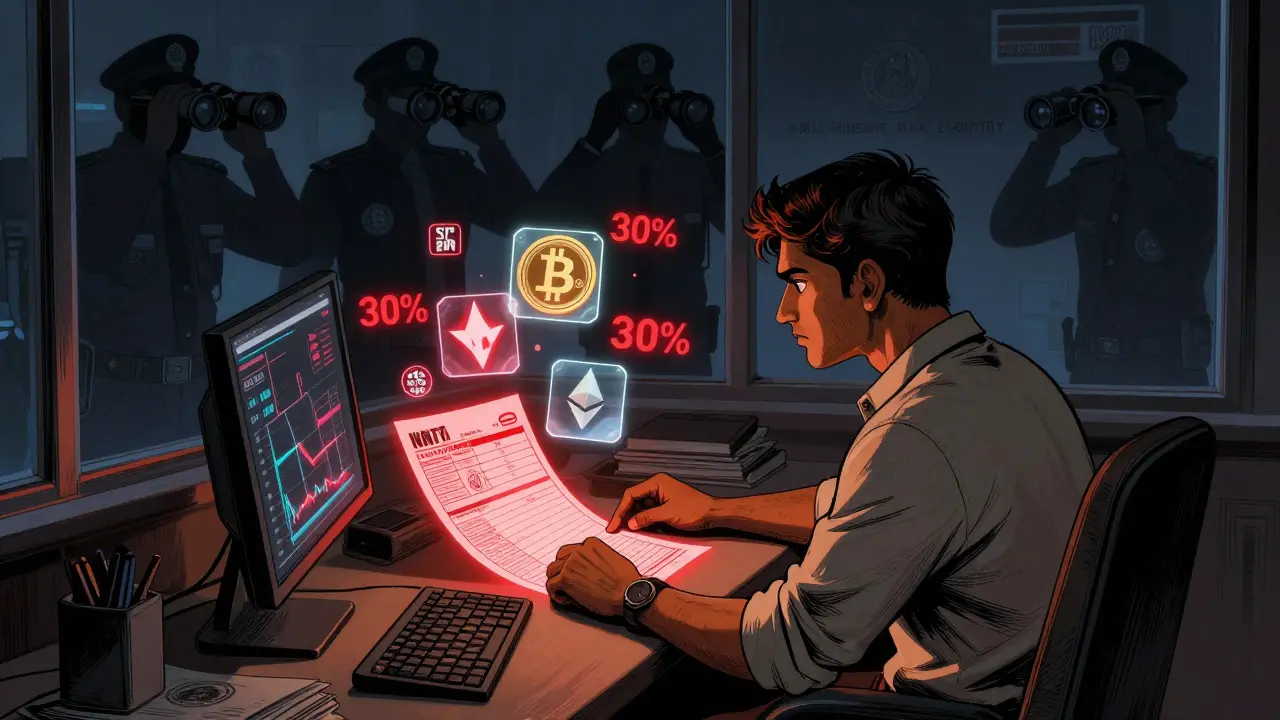
India doesn’t ban crypto. You can own it. But the government makes it painfully expensive to use. In 2022, it introduced a 30% tax on all crypto gains-no deductions, no offsets, no exceptions. On top of that, every single transaction, even sending crypto to your own wallet, triggers a 1% tax deducted at source (TDS). This isn’t just about revenue. It’s enforcement by friction. If you’re trading regularly, you’re forced to report every trade to the tax department. The Income Tax Department now cross-references wallet addresses with bank statements and exchange data. In 2024, over 1.2 million Indian crypto users received notices for non-compliance. While most get fines, some are being investigated for tax evasion, which can lead to criminal charges. The Supreme Court lifted the banking ban in 2020, but the tax regime has made crypto trading a high-risk activity. If you’re making $50,000 in gains, you owe $15,000 in taxes-and the government already knows about it.
United States: Targeting Criminals, Not Users
The U.S. doesn’t prosecute ordinary crypto users. It goes after the big players. In September 2024, the Treasury’s OFAC sanctioned Cryptex, a Russia-linked exchange that laundered over $5.88 billion in crypto tied to ransomware, darknet markets, and fraud. The State Department offered a $10 million reward for information leading to the arrest of its operator, Sergey Sergeevich Ivanov. The U.S. focuses on money laundering, fraud, and sanctions evasion-not personal trading. If you’re buying Bitcoin on Coinbase and holding it, you’re not on their radar. But if you’re using decentralized exchanges to move funds from sanctioned entities, you’re in danger. Operation Endgame, a joint U.S.-Dutch operation in early 2025, seized €7 million in crypto tied to a payment processor that funneled $97 million to Cryptex. The operation used Chainalysis and Tether’s blockchain data to trace the flow. The message is clear: if you’re helping criminals, you’ll be caught. If you’re just holding crypto, you’re fine.Europe: Regulation Over Prosecution
Europe isn’t cracking down on users-it’s cracking down on exchanges. The new Anti-Money Laundering Authority (AMLA), launched in July 2025, now oversees all crypto firms across the EU. Exchanges must verify users, monitor transactions, and report suspicious activity. Failure means heavy fines or losing their license. The EU’s Fifth Anti-Money Laundering Directive (AMLD5) requires exchanges to collect ID, track wallet addresses, and keep records for five years. But individuals? No one’s being arrested for owning Ethereum in Germany or trading Solana in France. The goal is compliance, not punishment. If you’re using a licensed exchange, you’re protected. If you’re using an unregulated platform that doesn’t ask for ID, you’re taking a risk-but the government isn’t hunting you down. They’re hunting the platforms.Singapore and South Korea: Rules, Not Rackets
Singapore and South Korea are two of the most crypto-friendly countries in Asia-but they’re not lax. They’ve built clear, strict rules. Singapore’s Monetary Authority (MAS) requires all crypto firms to be licensed. Stablecoin issuers must hold 100% reserves in regulated banks. Exchanges must prove they’re secure. But users? No taxes on gains, no reporting requirements. As long as you’re not laundering money, you’re free to trade. South Korea’s 2024 Act on Protection of Virtual Asset Users (VAUPA) forces exchanges to keep client assets separate, carry insurance, and report fraud. It’s designed to protect users-not punish them. In 2025, South Korea launched a government-backed crypto registry to track legitimate exchanges. If you’re using one of those, you’re safe.
Jonathan Sundqvist
December 5, 2025 AT 00:39China’s got it right. If you’re using crypto to bypass state control, you’re not a freedom fighter-you’re a liability. The digital yuan isn’t some dystopian nightmare, it’s the future. Anyone who thinks otherwise is just clinging to a fantasy. No one’s stopping you from buying Bitcoin… but if you do, don’t cry when the Feds come knocking.
Thomas Downey
December 6, 2025 AT 16:44One must inevitably confront the moral bankruptcy of a society that equates financial autonomy with criminality. The authoritarian impulse to surveil, penalize, and eradicate decentralized monetary alternatives is not merely policy-it is epistemological tyranny cloaked in the garb of national security. One wonders whether the architects of these draconian measures have ever read Hayek-or if they simply fear the erosion of their monopoly on the means of exchange.
Annette LeRoux
December 6, 2025 AT 23:48Bro, Portugal is the real MVP 🇵🇹✨ No taxes, no drama, just chill vibes and Bitcoin in your pocket. I moved there last year and my wallet’s never been happier. Also, I now own a cat named Satoshi. He’s very judgmental. Like, he stares at my phone when I check my portfolio. 😼
Krista Hewes
December 8, 2025 AT 20:52i just dont get how people think its safe to use crypto in places like bangladesh?? like, yeah the law might not say 'owning btc is illegal' but if the cops show up at your door because your bank flagged a transfer… you’re already cooked. i know a guy who got arrested for sending 50 bucks to his cousin using binance. he spent 3 months in jail. no trial. just… gone. dont risk it. really.
Mairead Stiùbhart
December 10, 2025 AT 09:19Oh sweetie, India’s 30% tax is just the government saying, 'We know you’re trading, and we’re going to make you pay for the privilege of being financially literate.' It’s not a ban-it’s a guilt tax. And honestly? I respect the audacity. At least they’re not throwing people in jail… just their tax returns.
jonathan dunlow
December 12, 2025 AT 05:15Listen up, everyone. This isn’t just about crypto-it’s about freedom. China’s cracking down because they know crypto gives people power outside their control. And that terrifies them. But here’s the thing: the more they try to shut it down, the more people will find ways around it. Underground P2P networks are growing faster than ever. People in China are using ghost wallets, burner phones, even cash trades in alleyways. You can’t kill an idea with a law. You can only make it more dangerous. And guess what? That’s exactly what’s happening. This isn’t the end of crypto-it’s the beginning of a real resistance. Stay strong. Stay decentralized. And if you’re in one of those countries? Don’t give up. You’re not alone.
Mariam Almatrook
December 13, 2025 AT 00:42It is profoundly disquieting to observe the moral and intellectual decay of democratic societies that, under the guise of 'regulation,' have become complicit in the very authoritarianism they claim to oppose. The United States, ostensibly the bastion of liberty, now employs blockchain surveillance with the same zeal as any totalitarian regime-albeit with a more polished PR department. The EU’s AMLA is not a shield for users-it is a digital panopticon draped in the velvet of compliance. One must ask: if the state can trace your every transaction, where is your sovereignty? The answer, my dear interlocutors, is nowhere. You have been surveilled, taxed, and neutered-and you call it 'freedom.'
Chris Mitchell
December 14, 2025 AT 11:04It’s not about the tech. It’s about who controls money. China bans crypto because it can’t control it. The U.S. taxes it because it can. Portugal lets you keep it because it doesn’t care. Your risk isn’t the blockchain-it’s your passport.
rita linda
December 14, 2025 AT 15:37Let’s be clear: if you’re using crypto in Bangladesh or Algeria, you’re not a pioneer-you’re a walking compliance violation. These aren’t 'harsh laws.' They’re the only rational response to unregulated financial chaos. The fact that you think this is 'oppression' just proves you haven’t done the work. Real financial sovereignty doesn’t mean breaking laws-it means operating within them. And if you’re not, you’re not a hero. You’re a liability. And liability gets cleaned up.
Cristal Consulting
December 15, 2025 AT 16:06Biggest takeaway? Location is your real wallet. If you’re in a country that treats crypto like contraband, don’t play. If you’re in a place that just wants taxes and paperwork? Do the thing. Use the exchange. Keep receipts. Pay up. And if you’re in Portugal? Congrats-you won the crypto lottery. 🍾