How DeFi is Disrupting Traditional Finance: Costs, Speed, and Control
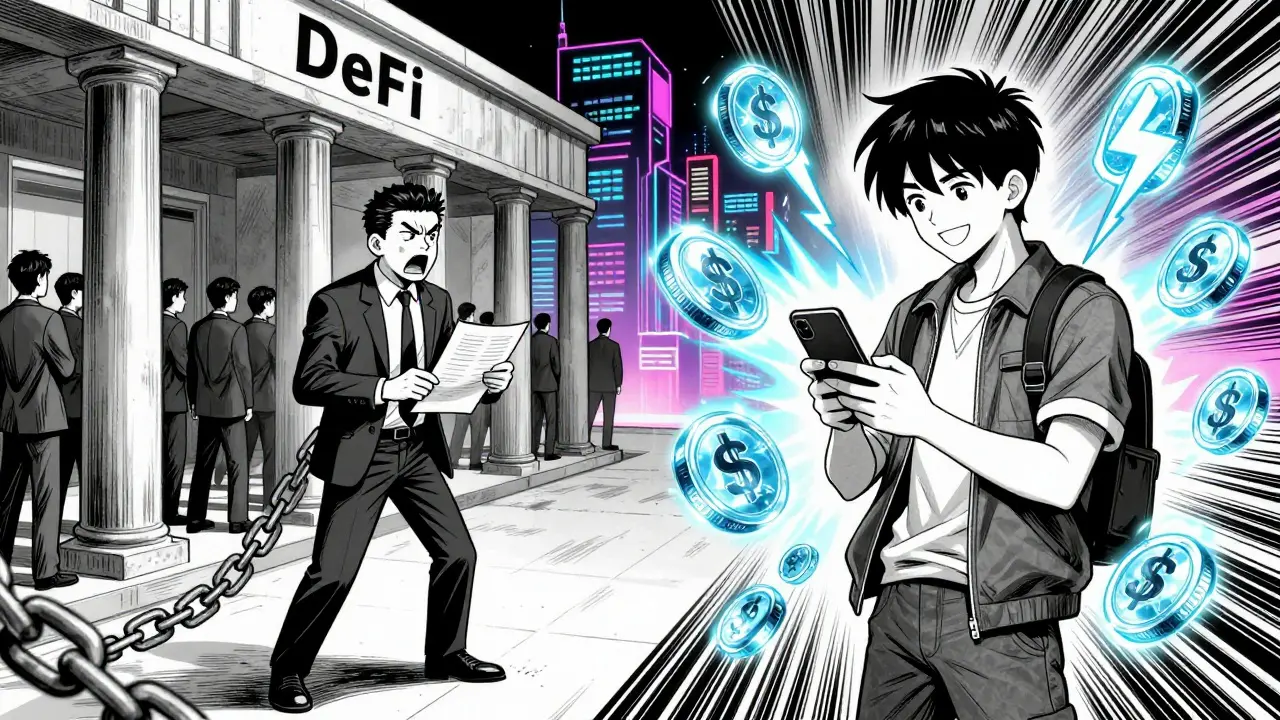
Imagine trying to send money to a friend overseas. You call your bank, fill out forms, wait two or three days for the transfer to clear, and then pay a hefty fee that feels like it covers more than just the transaction. Now imagine doing the same thing in seconds, at any time of day, with a fraction of the cost, without ever speaking to a human. This isn't science fiction; it is the reality of Decentralized Finance (DeFi), which is fundamentally challenging the way we think about money.
For centuries, traditional finance (TradFi) has relied on intermediaries-banks, brokers, and clearinghouses-to manage our assets. These institutions provide security and stability, but they also create bottlenecks, high costs, and exclusion for billions of people who lack access to basic banking services. DeFi removes these middlemen by using code instead of corporate policies. The result is a system that operates 24/7, globally, and transparently. But how exactly does this disruption work, and what does it mean for your wallet?
The Core Difference: Code vs. Institutions
To understand why DeFi is disruptive, you have to look at the architecture beneath the surface. Traditional finance relies on centralized databases managed by trusted third parties. When you deposit money into a bank account, the bank holds that money. They lend it out, invest it, and take a cut of the profits. You trust them not to fail, steal, or make poor decisions. This trust is enforced by regulations and insurance schemes, such as FDIC coverage in the U.S. or RBI deposit insurance in India.
In contrast, DeFi runs on public blockchains like Ethereum, Solana, or Polygon. Instead of trusting a bank, you trust smart contracts, which are self-executing programs stored on the blockchain. These contracts automatically enforce the rules of a transaction. If you want to borrow money, you don’t apply for a loan and wait for approval. You lock up collateral in a protocol like Aave or MakerDAO, and the code instantly releases funds to you. No credit check, no paperwork, no waiting room.
This shift from institutional trust to cryptographic verification changes everything. It means financial services become permissionless. Anyone with an internet connection can participate, regardless of their location, income level, or identity. For the 1.7 billion unbanked adults worldwide, this is not just a convenience; it is a lifeline.
Speed and Settlement: From Days to Seconds
One of the most tangible ways DeFi disrupts traditional finance is through speed. In TradFi, settlement times are notoriously slow. Equity trades typically settle in T+2 cycles (two business days), while bond settlements can take T+3. International wire transfers can take up to five days. This delay ties up capital and creates counterparty risk-the chance that one party defaults before the transaction completes.
DeFi eliminates this lag. Transactions on blockchain networks confirm within minutes or even seconds, depending on the network congestion and layer used. As noted in analyses from early 2025, Ethereum processes over a million transactions daily, with Layer 2 solutions like Polygon reducing confirmation times and costs significantly. When you swap tokens on Uniswap or lend assets on Compound, the settlement is final and immediate. There is no pending status, no reversal window, and no intermediary holding your funds hostage during processing hours.
This near-instantaneous settlement unlocks new possibilities for liquidity. Traders can react to market movements in real-time. Borrowers can access funds immediately when needed. The friction that slows down global commerce is removed, allowing capital to flow freely across borders without the delays imposed by banking hours and time zones.
| Feature | Traditional Finance (TradFi) | Decentralized Finance (DeFi) |
|---|---|---|
| Custody | Third-party (Banks, Brokers) | Self-custody (Non-custodial wallets) |
| Access | Permissioned (KYC/AML required) | Permissionless (Internet connection only) |
| Settlement Time | T+2 to T+3 days | Near-instantaneous (seconds to minutes) |
| Operating Hours | Business hours (9-5, weekdays) | 24/7/365 |
| Transparency | Private records, limited audit | Public ledger, fully auditable |
| Intermediaries | Banks, Clearinghouses, Brokers | None (Smart Contracts) |

Cost Efficiency: Cutting Out the Middleman
Traditional banks charge fees for almost everything: monthly maintenance, wire transfers, foreign exchange spreads, and trading commissions. These fees exist because banks need to cover operational costs, including physical branches, staff salaries, and regulatory compliance. While necessary for their business model, these costs are passed directly to the consumer.
DeFi protocols operate differently. Since there are no physical branches and minimal staff, overhead is drastically lower. Smart contracts automate tasks that would otherwise require armies of employees. This efficiency translates into lower costs for users. For example, cross-border payments via stablecoins on blockchain networks can cost fractions of a cent compared to the $20-$50 often charged by banks.
However, it is important to note that DeFi is not always cheaper. On networks like Ethereum mainnet, "gas fees" (transaction costs paid to validators) can spike during periods of high congestion, sometimes reaching $50-$100 per transaction. This volatility in fees has been a significant barrier to entry. Yet, the rise of Layer 2 scaling solutions like Arbitrum, Optimism, and Polygon has addressed this issue, bringing average transaction costs down to pennies ($0.01-$0.10). As these technologies mature, the cost advantage of DeFi becomes increasingly pronounced, especially for micro-transactions and frequent trading.
Financial Inclusion: Banking the Unbanked
Perhaps the most profound impact of DeFi is its potential to include those excluded by traditional systems. According to the World Bank’s 2023 report, 1.7 billion adults globally remain unbanked. Many live in regions with underdeveloped financial infrastructure, lack formal identification, or earn incomes too low to meet minimum balance requirements.
DeFi requires none of these prerequisites. All you need is a smartphone and an internet connection. You can create a non-custodial wallet like MetaMask or Trust Wallet in minutes, without providing personal data or undergoing background checks. Once connected, you can access lending, borrowing, savings, and insurance products available to anyone else in the world.
Consider a farmer in Bihar, India. Through platforms like Aave or PancakeSwap, they can lend crypto assets to earn yield or trade digital assets without visiting a branch or filling out paperwork. This accessibility democratizes financial opportunity, allowing individuals in emerging markets to participate in the global economy. It shifts power from centralized institutions back to the individual, fostering economic resilience in communities previously ignored by big banks.

Risks and Challenges: The Wild West Reality
Despite its promise, DeFi is not without significant risks. The very features that make it powerful-decentralization and automation-also introduce vulnerabilities. Unlike traditional banks, where deposits are insured and regulated, DeFi offers no such safety nets. If you lose your private key, your funds are gone forever. If a smart contract contains a bug, hackers can exploit it.
Security breaches have plagued the industry. The Poly Network hack in August 2021 resulted in the theft of $600 million worth of assets. While improved audit practices and bug bounty programs have reduced critical vulnerabilities by 37% year-over-year according to Immunefi’s 2024 report, threats remain constant. Users must perform their own due diligence, understanding the protocols they interact with and managing their security hygiene rigorously.
Regulatory uncertainty is another major hurdle. Governments worldwide are grappling with how to classify and regulate DeFi. In the U.S., stricter oversight has led to 32% of DeFi protocols restricting access to American users as of 2025. In India, a flat 30% tax on crypto profits plus a 1% Tax Deducted at Source (TDS) has dampened participation, with 68% of surveyed users reporting reduced activity due to tax complexities. Until regulatory frameworks stabilize, mainstream adoption will face headwinds.
The Future: Convergence of DeFi and TradFi
Rather than completely replacing traditional finance, many experts predict a convergence. JPMorgan’s Onyx blockchain already processes $1 billion daily in wholesale payments, signaling institutional interest in blockchain technology. Asset tokenization is bringing real-world assets like real estate and stocks onto DeFi platforms, increasing liquidity by 40-60% in pilot programs. Decentralized identity solutions aim to balance privacy with compliance, potentially easing regulatory concerns.
Emerging trends like DeFAI (DeFi + AI) promise to further simplify user experiences. AI-powered agents can automate complex interactions, making DeFi accessible to non-technical users. Gartner predicts that by 2028, 20% of traditional financial services will incorporate DeFi components. This hybrid approach leverages the efficiency and innovation of DeFi while retaining the regulatory protections and familiarity of TradFi.
The disruption is real, but it is evolving. DeFi is forcing traditional institutions to innovate, lowering costs, and improving transparency. For consumers, the choice is becoming clearer: do you value the comfort and protection of established banks, or the freedom, speed, and inclusivity of decentralized systems? As technology matures and regulations clarify, the line between the two will continue to blur, creating a more efficient and accessible financial landscape for everyone.
What is the biggest risk of using DeFi?
The biggest risks are smart contract vulnerabilities and user error. Unlike banks, there is no customer support to reverse transactions if you send funds to the wrong address or fall victim to a hack. Additionally, regulatory changes can impact the legality and usability of certain protocols in your region.
Is DeFi safer than traditional banking?
It depends on how you define safety. Traditional banks offer insurance against fraud and failure, but they can freeze accounts or go bankrupt. DeFi gives you full control over your assets, eliminating counterparty risk, but places the burden of security entirely on you. If you manage your keys securely and use audited protocols, DeFi can be highly secure.
How much does it cost to use DeFi?
Costs vary by network. On Ethereum mainnet, gas fees can range from $1 to over $100 depending on congestion. However, using Layer 2 solutions like Polygon, Arbitrum, or Optimism reduces costs to less than $0.10 per transaction, making it significantly cheaper than many traditional banking fees.
Can I get my money back if a DeFi protocol fails?
Generally, no. DeFi is non-custodial and unregulated, meaning there is no insurance fund or government agency to reimburse losses. This is why it is crucial to use well-audited, established protocols and never invest more than you can afford to lose.
Do I need to know coding to use DeFi?
No, you do not need to code. Most DeFi applications have user-friendly interfaces similar to websites. However, you do need to understand basic concepts like wallets, private keys, and gas fees. Educational resources and community guides are widely available to help beginners navigate the ecosystem safely.