Interoperability Solutions in 2025: How Blockchain Systems Talk to Each Other
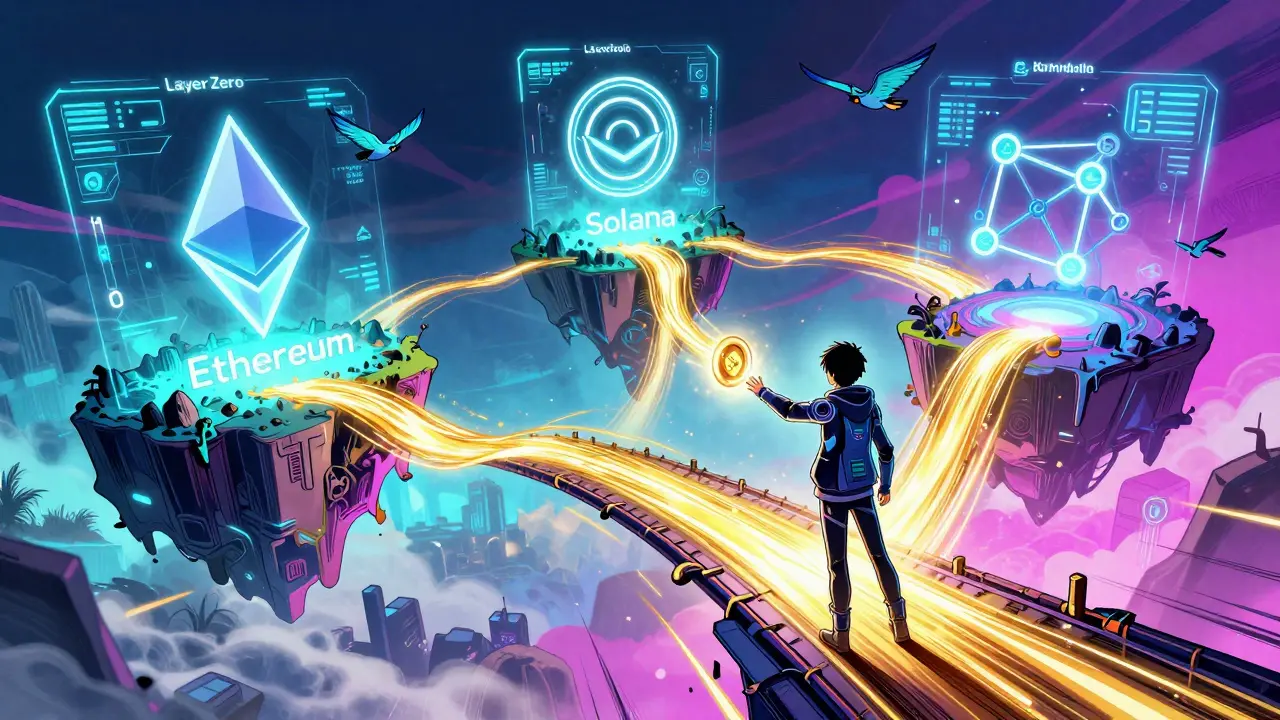
By 2025, blockchain isn’t just about Bitcoin or DeFi anymore. It’s about interoperability-the real, working connection between different blockchains. If you’ve ever tried to send ETH to a Solana wallet and failed, you know the problem. Blockchains were built as walled gardens. Each one has its own rules, its own language, its own way of doing things. But in 2025, that’s no longer acceptable. The future belongs to systems that can talk to each other, not ones that sit alone in the dark.
Why Interoperability Matters More Than Ever
Think of blockchains like different phone networks. If your iPhone can’t text an Android user, you’re stuck. That’s what happened in crypto for years. Ethereum had smart contracts. Solana had speed. Polkadot had parachains. But none could easily share data or assets with the others. Users had to use centralized exchanges as middlemen-adding cost, delay, and risk. In 2025, that’s outdated. Real interoperability means moving tokens, data, and even smart contract logic across chains without third parties. It’s not just about sending crypto. It’s about letting a DeFi loan on Avalanche trigger a prediction market on Polygon, which then updates a NFT on Ethereum-all in seconds. That’s the level of integration now possible. According to a 2025 report by Chainalysis, over 68% of all cross-chain transactions now bypass centralized exchanges. That’s up from just 12% in 2022. The shift is happening because users won’t tolerate friction anymore. They want seamless movement. And the technology is finally catching up.How Blockchain Interoperability Works Today
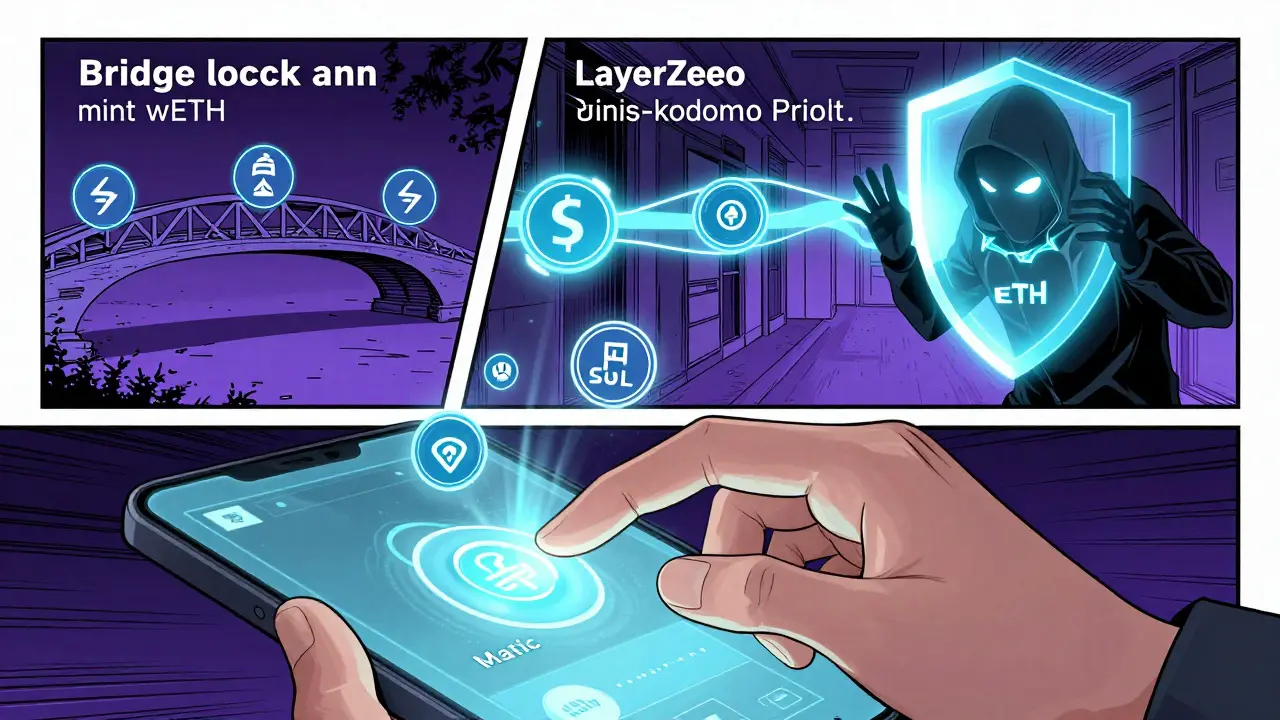
There are three main ways blockchains connect in 2025:- Blockchain Bridges - These are smart contracts that lock assets on one chain and mint equivalent tokens on another. Think of it like a passport stamp: you give your USD on Ethereum, and a wrapped version appears on Solana. But bridges have risks-hackers target them. In 2024 alone, over $1.2 billion was stolen through bridge exploits.
- Relay Chains - Polkadot and Cosmos use this model. Instead of connecting chains directly, they use a central hub (the relay chain) that verifies and routes messages between blockchains. It’s like an airport hub: all flights go through one control center. This adds security but can create bottlenecks.
- Native Cross-Chain Protocols - Newer systems like LayerZero, Wormhole, and Chainlink CCIP don’t rely on wrapped tokens. They pass actual messages between blockchains using decentralized oracles. This lets smart contracts on one chain call functions on another. For example, a game on Arbitrum can check your NFT ownership on Ethereum and unlock a reward-all without moving the NFT.
The most advanced systems in 2025 combine all three. A user might use a relay chain for governance data, a native protocol for smart contract calls, and a bridge only for asset transfers. This layered approach reduces risk and improves efficiency.
Key Technologies Powering Interoperability in 2025
- LayerZero is a cross-chain messaging protocol that uses lightweight oracles and relayers to verify messages between blockchains without requiring a central validator. It powers over 400 dApps in 2025, including major DeFi platforms like Aave and Uniswap.
- Wormhole is a decentralized message-passing system that connects 30+ blockchains, including Solana, Ethereum, and Polygon. It uses a network of 19 guardian nodes to validate cross-chain transactions.
- Chainlink CCIP is a blockchain-agnostic standard for secure cross-chain communication, built by the same team behind Chainlink oracles. It’s designed for enterprise use, with compliance features and audit trails.
- Polkadot is a multi-chain network where independent blockchains (parachains) connect through a central relay chain. It uses a shared security model where all parachains benefit from Polkadot’s validator set.
- Cosmos is a network of independent blockchains that communicate via the Inter-Blockchain Communication (IBC) protocol. It’s designed for sovereignty-each chain keeps its own rules, but can still send data and tokens to others.
These aren’t just tools-they’re building blocks for a new kind of internet. In 2025, you don’t pick one blockchain. You use them all, together.
Real-World Use Cases in 2025
Interoperability isn’t theoretical anymore. Here’s what it looks like in practice:- A user in Brazil buys a property tokenized on Ethereum, pays with stablecoins from Terra Classic, and registers the deed on a government blockchain in Colombia-all in one transaction.
- A DeFi protocol on Arbitrum detects a user’s low credit score from a verified identity system on Polygon and automatically adjusts their loan terms without human review.
- A supply chain tracker on Hyperledger Fabric receives real-time shipment data from a sensor network on Solana, updates inventory on a private Ethereum chain, and triggers a payment via RippleNet-all within 8 seconds.
These aren’t demos. They’re live systems running today. Companies like IBM, Maersk, and Visa are already using interoperable blockchain networks to cut costs and improve transparency. In healthcare, patient records stored on a private blockchain in Germany can be accessed by a specialist in Japan using a cross-chain identity protocol. No more fax machines. No more PDFs.
The Biggest Challenges Still Left
Despite progress, big problems remain:- Security - Bridges are still the weakest link. Even the most trusted ones have been hacked. In 2025, the most secure systems use multi-sig verification across 5+ independent nodes and zero-knowledge proofs to validate cross-chain state changes.
- Standardization - There’s no universal language for blockchain communication. Each protocol has its own message format. Efforts like the Cross-Chain Interoperability Protocol (CCIP) by Chainlink aim to fix this, but adoption is slow.
- Latency - Moving data between chains still takes time. Ethereum’s 12-second block time feels fast, but Solana’s 400ms blocks make delays noticeable. The best systems now use predictive caching and parallel processing to hide latency from users.
- Regulation - Governments don’t know how to classify cross-chain transactions. Is a token sent from Polygon to Avalanche a transfer? A sale? A migration? Legal clarity is lagging behind tech.
Still, the pace of innovation is staggering. In early 2025, Polygon announced its new zkEVM bridge that can verify Ethereum transactions on Polygon in under 3 seconds using zero-knowledge proofs. That’s faster than most bank transfers.

What’s Next After 2025?
The next frontier isn’t just connecting blockchains-it’s connecting blockchains to the real world. Imagine your smart fridge detecting low milk, buying more via a Solana-based microtransaction, and automatically updating your grocery budget on a DeFi ledger tied to your bank account. That’s not sci-fi. It’s the roadmap for 2026.Interoperability is the foundation. Once chains can talk, they can collaborate. Once they collaborate, they can evolve. And once they evolve, they’ll start replacing legacy systems entirely-in finance, logistics, healthcare, even voting.
The blockchains of 2025 aren’t islands. They’re nodes in a global network. And the ones that don’t connect? They’ll fade away.
What’s the difference between a blockchain bridge and a cross-chain protocol?
A blockchain bridge moves assets between chains by locking them on one side and minting wrapped versions on the other. It’s like exchanging cash for a voucher. A cross-chain protocol, like LayerZero or Chainlink CCIP, sends actual messages between smart contracts. It doesn’t move tokens-it tells one chain what another chain did. That allows for more complex interactions, like triggering a loan approval based on data from a different chain.
Are interoperable blockchains safer than isolated ones?
Not inherently. Bridges have been hacked more than any other part of DeFi. But modern interoperability solutions are getting much safer. Systems now use multi-layered verification: zero-knowledge proofs to validate state, decentralized oracles to confirm events, and time-delayed withdrawals to catch fraud. The safest setups combine multiple methods. Isolated chains are easier to hack because they’re predictable. Interoperable chains, when built right, are harder to attack because they require coordination across multiple independent systems.
Can I use one wallet for all blockchains now?
Yes-thanks to interoperability. Wallets like MetaMask, Trust Wallet, and Phantom now support 100+ blockchains. You don’t need separate wallets. Your private key works everywhere. The difference is in the network. When you send ETH from Ethereum to Solana, your wallet uses a bridge or protocol behind the scenes. You just click "Send" and pick the destination chain. The rest happens automatically.
Why do some blockchains refuse to connect to others?
Some chains avoid interoperability for control. Bitcoin, for example, prioritizes decentralization and security over compatibility. Connecting to other chains could introduce new attack surfaces or dilute its value proposition. Other chains, like those built for enterprise use, avoid it because they need strict regulatory compliance and don’t trust public chains. But even these are starting to build private bridges-for example, a bank’s private Ethereum chain connecting to a government’s blockchain for tax reporting.
Is interoperability making DeFi more profitable?
Absolutely. In 2025, yield farms that span multiple chains offer 2-5x higher returns than single-chain ones. Why? Because liquidity is no longer stuck. A farmer can lend on Aave (Ethereum), stake on Solana, and hedge with options on Arbitrum-all in one strategy. This creates better price discovery, deeper liquidity pools, and fewer impermanent losses. The most successful DeFi protocols now operate natively across 5+ chains.
Sean Logue
February 22, 2026 AT 15:10Bro, I just sent some ETH to my Solana wallet last week and it went through in 3 seconds. No bridge, no mess. Just clicked "Swap" and boom - SOL in my wallet. This interoperability stuff isn't future talk anymore, it's Tuesday morning coffee routine.
Carl Gaard
February 24, 2026 AT 08:39OMG YES 🤯 I was so done with having 7 different wallets... now I just use MetaMask and it’s like magic ✨ I sent USDC to Polygon, then it auto-converted to SOL and staked it?? Like how?? I didn’t even know I could do that 😭
bella gonzales
February 26, 2026 AT 03:57Ugh, I read half of this and my brain hurt. Can we just go back to when crypto was just buying Bitcoin and ignoring everyone else? Why does everything have to be so complicated now??
Paul Reinhart
February 27, 2026 AT 20:21I’ve been watching this evolution for years, and honestly, the shift from isolated chains to interconnected networks feels like the internet’s early days all over again - remember when email couldn’t talk to AOL? Or when websites were just HTML with no CSS? This is that moment. The real breakthrough isn’t the tech itself - it’s the cultural shift toward collaboration over competition. We’re moving from "my chain" to "our network," and that’s profound. It’s not just about efficiency anymore - it’s about trust, scalability, and shared sovereignty. And yeah, I know it’s messy, but that’s growth.
Samantha Stultz
February 28, 2026 AT 11:12LayerZero’s oracle architecture is fundamentally flawed because it relies on centralized relayers despite the "decentralized" branding - unless you’re using their multi-sig fallback, you’re still trusting a single point of failure. And don’t get me started on Wormhole’s guardian node set - 19 nodes isn’t decentralized, it’s oligarchic. True interoperability requires permissionless verification, not curated validators. Chainlink CCIP is the only one with real enterprise-grade ZK proofs and compliance hooks. The rest are just glorified APIs with a blockchain sticker.
Robert Conmy
March 1, 2026 AT 11:16You people are delusional. Bridges got hacked for over a billion dollars last year and you’re acting like it’s a feature? You think this "interoperability" is safe? It’s a casino with more slots. The only reason anyone uses this garbage is because they’re too lazy to learn how to use one chain properly. Bitcoin didn’t need this crap and it’s still worth more than all of you combined.
Lilly Markou
March 2, 2026 AT 23:37While the technical advancements referenced are indeed noteworthy, one must not overlook the epistemological implications of cross-chain asset mobility. The ontological status of a token that exists in multiple state spaces simultaneously challenges traditional notions of ownership, provenance, and identity. Furthermore, the reliance on third-party oracles introduces a hermeneutic dependency that may undermine the very decentralization principles upon which blockchain was founded. A rigorous ethical framework must precede widespread adoption.
McKenna Becker
March 3, 2026 AT 03:44It’s not about connecting chains. It’s about connecting people.
Tracy Peterson
March 3, 2026 AT 20:25People keep saying "connect the chains" like it’s a tech problem. It’s not. It’s a human problem. We built walls because we were scared. Now we’re scared of taking them down. But if we don’t, we’re just trading one monopoly for another - just with more blockchains.
aaron marp
March 5, 2026 AT 18:58For anyone new to this - don’t panic. The complexity is real, but so is the opportunity. Start small. Use one bridge you trust. Try sending a tiny amount. Watch how it works. Then try another. The wallets do the heavy lifting now. You don’t need to understand ZK proofs to benefit from them. Just like you don’t need to know how your phone’s antenna works to make a call. This is the internet, evolving. And you’re not behind - you’re just getting started.
Patrick Streeb
March 6, 2026 AT 19:46While the technological paradigm shift described is undeniably significant, one must exercise due diligence regarding the regulatory arbitrage inherent in cross-chain transaction flows. The absence of harmonized legal frameworks across jurisdictions may engender systemic risk, particularly in relation to anti-money laundering compliance and tax reporting obligations. A standardized protocol, such as CCIP, offers a promising avenue for regulatory alignment; however, its adoption must be accompanied by multilateral governance structures to ensure equitable implementation.
Phillip Marson
March 8, 2026 AT 06:59Y’all act like bridges are some new invention. Nah. They’re just the crypto version of a sketchy used car salesman with a clipboard and a smile. And Wormhole? That thing’s got more holes than Swiss cheese. I’ve seen more security on my grandma’s AOL account. Chainlink’s the only one not trying to scam me. The rest? Just vaporware with a whitepaper and a Discord full of bots.
Tracy Whetsel
March 10, 2026 AT 01:43Hey, I was scared of this stuff too at first. But I started small - sent 0.001 ETH to Polygon just to see what happened. And boom - it worked. No drama. No panic. Just magic. Now I use it for everything. You don’t have to be a coder. You just have to be curious. And if you’re reading this? You already are. That’s half the battle. Keep going - you’ve got this 💪
Alyssa Herndon
March 11, 2026 AT 02:58I think the real question isn’t how the chains talk - it’s why we made them stop talking in the first place. Was it fear? Control? Or just laziness? We built these systems to be open, but then we got scared of what happens when they actually are. Maybe interoperability isn’t the solution - maybe it’s the mirror showing us what we’ve been avoiding.
Ifeanyi Uche
March 12, 2026 AT 18:55Interoperability? Lmao. You think Africa is gonna use this? We got people using USSD codes to send money. You think they care about LayerZero? Nah. This is just rich guys playing with toys. Real innovation is when your phone can send crypto without internet. That’s what we need. Not more bridges. Less tech. More access.