MoonSwap (Moonriver) Review: Is It Worth Trading in 2026?

You want to trade crypto without paying Ethereum’s sky-high gas fees. You’ve heard about MoonSwap, the go-to decentralized exchange on the Moonriver network. But does it actually deliver on its promise of cheap, fast swaps? Or is it just another niche platform with too little liquidity for real traders?
In this review, we cut through the hype. We’ll look at how much you really pay in fees, whether there’s enough money in the pools to execute your trades without massive slippage, and who should actually bother using this platform in 2026.
What Is MoonSwap?
MoonSwap is a permissionless automated market maker (AMM) built on the Moonriver blockchain. Think of it as a self-serve vending machine for tokens. Instead of an order book where buyers and sellers match up, you trade against a pool of funds provided by other users.
It launched in late 2021 as part of the Moonriver ecosystem. Moonriver itself is the "canary network" for Moonbeam, which is an Ethereum-compatible smart contract platform on the Polkadot network. This means MoonSwap uses code very similar to Uniswap V2 but runs on a chain designed to be faster and cheaper than Ethereum mainnet.
The key feature here is decentralization. There is no central team approving tokens. If you have the capital, you can create a liquidity pool for any token in minutes. This makes it incredibly popular with developers launching new projects, but it also means you need to do your own homework before swapping obscure coins.
Trading Costs and Speed: The Real Numbers
Let’s talk about what matters most when you click "swap": cost and time.
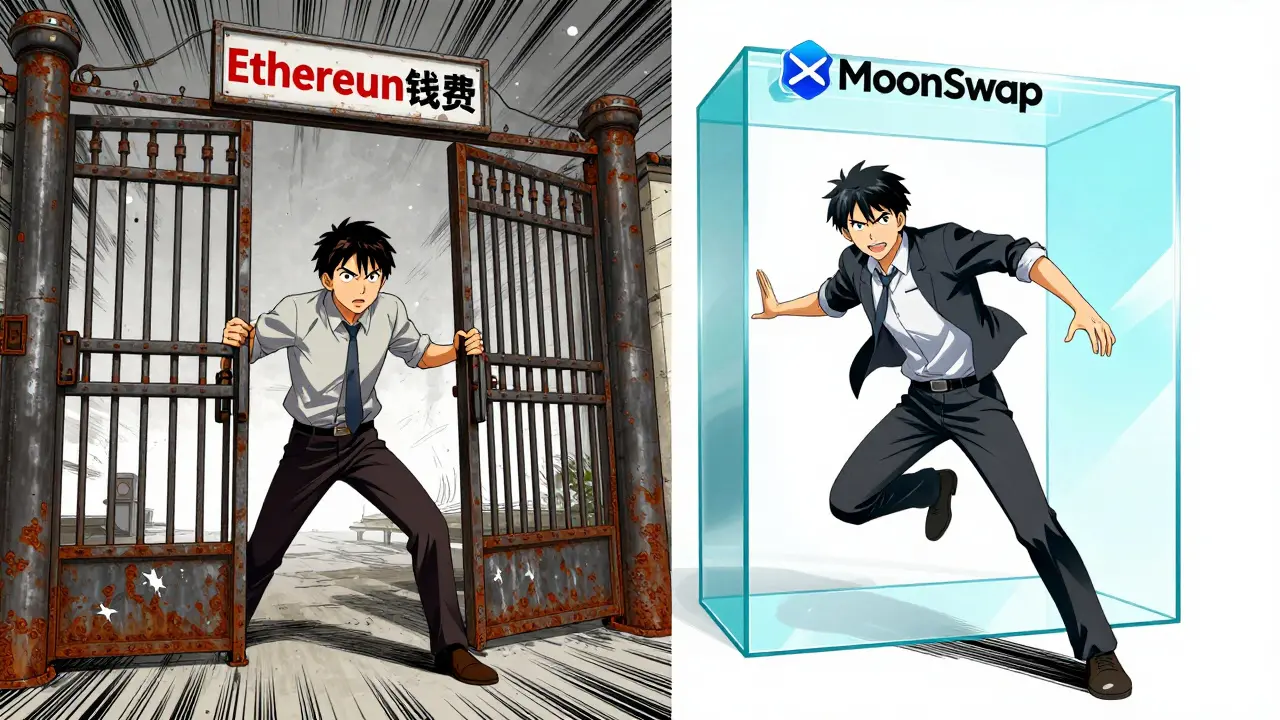
On Ethereum, a simple swap might cost you $5 to $50 depending on network congestion. On MoonSwap, the average transaction fee is roughly $0.00045. That’s because Moonriver charges fees in MOVR, and the base fee is tiny. As of late 2025, the average gas fee sits around 0.00015 MOVR. Even if MOVR price fluctuates, it rarely pushes the dollar cost above a penny.
Speed is decent but not instant. Moonriver has block times of 12 to 15 seconds. So, after you confirm a trade in your wallet, wait about 15 seconds for it to finalize. Compare that to Solana-based exchanges which settle in under a second, or Polygon which averages 2 seconds. MoonSwap isn’t the fastest horse in the race, but for most retail traders, waiting 15 seconds is perfectly acceptable.
| Feature | MoonSwap (Moonriver) | Uniswap (Ethereum) | PancakeSwap (BSC) |
|---|---|---|---|
| Average Gas Fee | $0.00045 | $1.25 - $5.00+ | $0.05 |
| Block Time | 12-15 seconds | 12-15 seconds | 3 seconds |
| Swap Fee (Standard) | 0.3% | 0.3% | 0.25% |
| Cross-Chain Native Support | Yes (via XC-20) | No (requires bridges) | Limited |
Note that the 0.3% swap fee goes mostly to liquidity providers. A tiny fraction (0.05%) helps fund the Moonriver treasury. This structure keeps the protocol sustainable without taxing users heavily.
Liquidity and Slippage: The Hidden Trap
Here is where many users get burned. Low fees are great, but only if you can actually move your money.
MoonSwap’s daily trading volume averages around $8.2 million. Compare that to Uniswap’s $1.2 billion. That gap matters. When you trade major pairs like MOVR/USDC, liquidity is deep enough for small to medium trades. But if you try to swap $50,000 worth of a smaller token, you will likely face slippage exceeding 5%.
Slippage is the difference between the price you expected and the price you got. High slippage means you’re getting ripped off because the pool didn’t have enough cash to absorb your trade size.
- For small trades (<$1,000): MoonSwap works beautifully. Fees are negligible, and prices are fair.
- For medium trades ($1,000 - $10,000): Check the pool depth first. If the pool has less than $1 million in total value, expect some slippage.
- For large trades (>$10,000): Avoid MoonSwap unless you are trading top-tier assets. Use a bridge to Ethereum or BSC instead.
User reviews on Trustpilot and Reddit frequently cite this issue. One user reported 7.2% slippage on a USDC to MOVR swap. That’s unacceptable for serious trading. Always set a maximum slippage tolerance in your wallet settings (usually 0.5% to 1% for stable pairs) to protect yourself.
Who Should Use MoonSwap?
MoonSwap isn’t for everyone. Its strengths align with specific types of users.
1. Developers and Project Launchers This is MoonSwap’s bread and butter. Because listing is permissionless, developers can deploy their token and add liquidity in under five minutes. No applications, no fees paid to a central team. In Q4 2025 alone, 327 new projects used MoonSwap for their initial liquidity. If you are building a dApp on Moonriver, this is your home.
2. Polkadot Ecosystem Enthusiasts If you hold DOT or KSM and want to explore DeFi within the Polkadot/Kusama parachain ecosystem, MoonSwap offers seamless cross-chain swaps. Thanks to the XC-20 standard, you can swap assets from over 15 connected blockchains without manually bridging them back and forth. This saves time and reduces the risk of losing funds during complex bridge transfers.
3. Yield Farmers with Small Capital Liquidity providers on MoonSwap earn APYs ranging from 4.2% to 18.7%. While these numbers aren’t as astronomical as they were in 2021, they are respectable for low-risk pairs. Since entry barriers are low, you can start providing liquidity with just a few hundred dollars.
Who Should Avoid It? High-frequency traders will hate the 15-second block times. Traders looking for deep liquidity on obscure altcoins will find empty pools. And beginners who don’t understand how to configure MetaMask for custom networks will struggle with the setup process.
How to Get Started on MoonSwap
Setting up MoonSwap takes a bit more effort than connecting to a centralized exchange like Coinbase. Here is the step-by-step process:
- Get a Wallet: Download MetaMask, Trust Wallet, or use a Ledger hardware wallet. These are all compatible with Moonriver.
- Add Moonriver Network: You need to manually add Moonriver to your wallet. The Chain ID is 1285. You can usually import this automatically via the Moonbeam website or CoinGecko.
- Buy MOVR: You need MOVR to pay for gas. You can buy it on centralized exchanges like Kraken or Binance and withdraw it to your MetaMask address. Alternatively, use a fiat-on-ramp like MoonPay directly in the browser, though this requires KYC.
- Bridge Assets (Optional): If you have ETH or BTC, use a bridge like Multichain or the native Moonbeam bridge to convert them to Moonriver assets (like wETH or WBTC).
- Connect and Swap: Go to the MoonSwap interface, connect your wallet, select your tokens, and approve the transaction. Remember to keep extra MOVR in your wallet for future gas fees.
Expect the setup to take about 10 minutes if you are familiar with crypto wallets. For complete beginners, it might take closer to 20 minutes. Don’t rush the RPC configuration step; getting the wrong endpoint will prevent your wallet from seeing your balance.

Risks and Limitations
No platform is perfect. MoonSwap faces three main risks right now.
1. Dependency on Moonriver Success MoonSwap lives or dies with the Moonriver/Moonbeam ecosystem. If developers migrate to Arbitrum or Optimism, MoonSwap loses its user base. Currently, 89% of its volume comes from ecosystem-native tokens. This concentration is risky.
2. MOVR Price Volatility Since gas fees are paid in MOVR, a crash in MOVR’s price doesn’t necessarily mean cheaper fees for non-MOVR transactions in dollar terms, depending on how the network adjusts base fees. However, a surge in MOVR price makes trading expensive. Stress tests show a 50% drop in MOVR could drive away nearly 40% of casual users due to perceived complexity and cost fluctuations.
3. Smart Contract Risk Like all DEXs, MoonSwap relies on code. While it is audited, bugs happen. The concentrated liquidity upgrade in 2023 improved efficiency but added complexity. Always verify contract addresses from official sources before interacting.
Final Verdict
MoonSwap is a solid tool for a specific job. It is not trying to be the next Uniswap. It is trying to be the best way to move value within the Polkadot ecosystem.
If you are a developer launching a project, or a trader who already holds assets on Moonriver, MoonSwap is hard to beat. The fees are virtually zero, and the cross-chain features are convenient. But if you are a casual trader looking for deep liquidity on mainstream tokens, you might find better options on Ethereum Layer 2s or BSC.
Use it for what it is: a high-efficiency, low-cost hub for the Moonriver community. Just watch your slippage settings.
Is MoonSwap safe to use?
MoonSwap is generally safe as it is a non-custodial decentralized exchange. Your funds remain in your wallet until you execute a swap. However, you must beware of phishing sites and always double-check the URL. Additionally, smart contract risks exist, so never invest more than you can afford to lose.
Do I need KYC to use MoonSwap?
No. MoonSwap is fully decentralized and permissionless. You do not need to provide identification to swap tokens or provide liquidity. However, if you buy MOVR using a fiat on-ramp like MoonPay within the interface, that specific provider may require KYC.
What is the minimum amount to trade on MoonSwap?
There is no strict minimum set by the protocol, but you need enough MOVR to pay for gas fees (typically less than $0.01). Practically, trading amounts below $10 may result in poor pricing due to fixed fee structures relative to trade size.
Can I bridge Ethereum assets to MoonSwap?
Yes. You can bridge assets like ETH, USDC, or WBTC from Ethereum to Moonriver using the Moonbeam Bridge or third-party bridges like Multichain. Once on Moonriver, you can swap them on MoonSwap.
Why is my transaction stuck on MoonSwap?
Transactions on Moonriver typically finalize in 12-15 seconds. If it appears stuck, check Etherscan or Moonscan for the status. It might be pending due to network congestion or insufficient gas priority fee. Rarely, it could fail entirely, in which case the funds will return to your wallet.