Understanding Cryptocurrency vs Traditional Money in 2026

By 2026, more people are holding cryptocurrency than ever before-but that doesn’t mean they understand how it stacks up against the cash in their wallet or the balance in their bank account. The real question isn’t whether crypto is better than traditional money. It’s: how are they different, and what does that actually mean for you?
What Is Traditional Money?
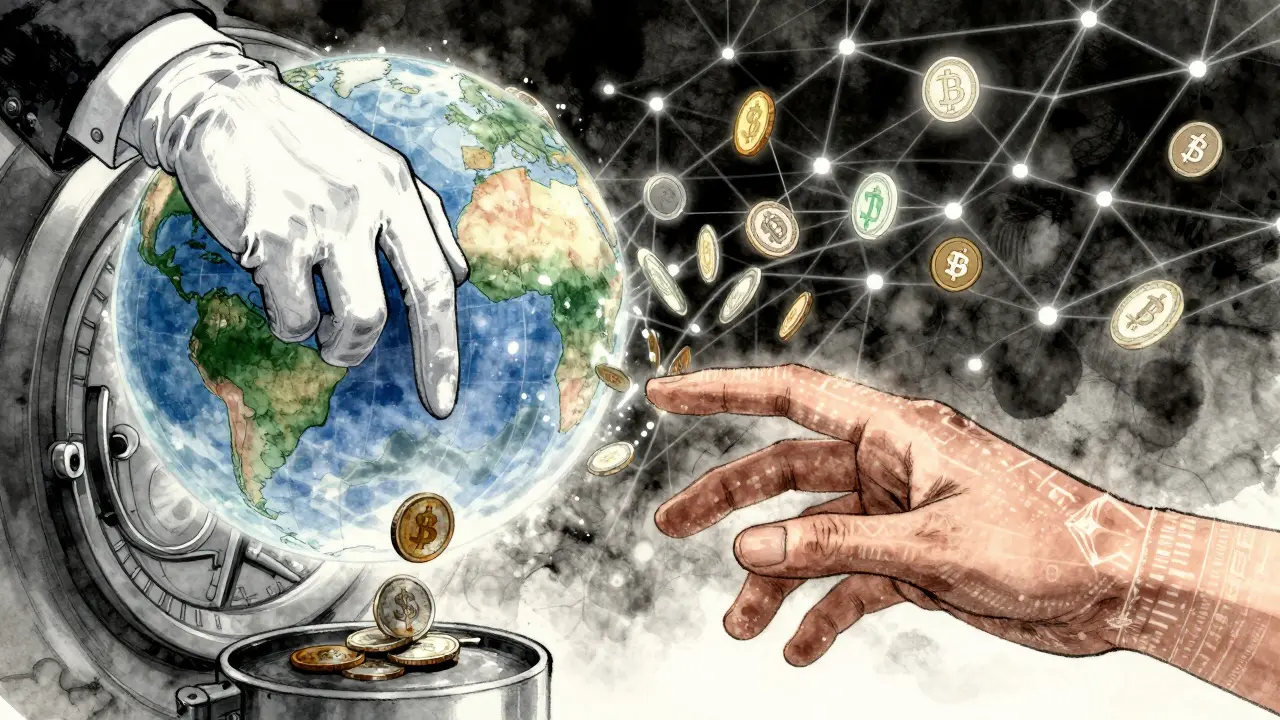
Traditional money, or fiat currency, is what governments back. The New Zealand dollar, the US dollar, the euro-they’re not valuable because they’re made of gold or paper. They’re valuable because the government says they are, and everyone agrees to use them. Banks, ATMs, credit cards, and wire transfers all run on this system. It’s old, it’s slow in some ways, and it’s everywhere.
When you send money internationally, it usually takes 3 to 5 business days. Fees? Often 5% or more when you include exchange rates and intermediary banks. The World Bank found that in 2023, sending $200 from the US to the Philippines cost an average of $12.80. That’s not a typo. Over $860 billion flows globally in remittances every year-and most of it still moves through this expensive system.
What Is Cryptocurrency?
Cryptocurrency is digital money built on blockchain technology. No central bank controls it. No government prints it. Instead, it runs on thousands of computers around the world verifying every transaction. Bitcoin was the first, launched in 2009. Today, there are over 25,000 different crypto projects, but only a handful matter for everyday use.
Bitcoin and Ethereum are the big ones. Bitcoin moves about 7 transactions per second. Ethereum, after switching to proof-of-stake in 2022, handles 30 per second. That sounds slow-but it’s not meant to replace Visa. It’s meant to solve different problems.
Stablecoins are where things get interesting. These are crypto tokens pegged to real money-like the US dollar. Tether (USDT) and USD Coin (USDC) make up 87% of the $300 billion stablecoin market. In September 2025 alone, $772 billion in stablecoin transactions happened on Ethereum and Tron blockchains. That’s more than PayPal’s entire annual volume.
Speed: Minutes vs. Days
Let’s say you’re a freelancer in Wellington and you get paid by a client in Lagos. With traditional banking, you wait 3-5 days for the wire to clear. You pay fees. You deal with currency conversion. You hope the bank doesn’t freeze the transfer because it "looks suspicious."
With crypto? You send it. The transaction confirms in under 3 minutes. Fees? Usually less than $1. Sometimes less than 10 cents. A 2025 Upwork survey found freelancers who got paid in crypto received funds 2.7 days faster on average. For people living paycheck to paycheck, that’s not a luxury-it’s survival.
Cost: The Hidden Tax of Traditional Finance
Traditional cross-border payments are a hidden tax. Banks charge transfer fees. Currency exchanges add spreads. Clearinghouses take their cut. The result? A $200 transfer costs $12-$14 on average.
Crypto flips that. The network fee for sending USDC from New Zealand to Brazil? Around $0.15. The recipient gets $199.85. No middlemen. No delays. No mystery fees. The World Bank reported that crypto remittances saved users an average of $18.75 per $200 transfer in 2025. That’s not a savings-it’s a windfall.
Of course, Ethereum can get expensive during peak times. Gas fees can spike to $50. But that’s why people use Layer 2 networks like Polygon or the Lightning Network. Polygon handles 7,000 transactions per second. Fees? A fraction of a cent. The technology is evolving fast.
Security: No Chargebacks, But No Safety Net Either
Traditional banking gives you chargebacks. If someone scams you, your bank can reverse the transaction. That’s a huge safety net. But it’s also a nightmare for merchants. In 2024, chargeback fraud cost businesses $24.7 billion globally. That’s why so many online stores hate accepting credit cards.
Crypto has no chargebacks. Once a transaction is confirmed, it’s final. That’s great if you’re a merchant. It’s terrifying if you’re a user. If you send crypto to the wrong address? Gone forever. If you lose your private key? No one can recover it. Blockchain.com’s 2025 user survey found 29% of crypto users had trouble recovering lost wallets. No customer service line. No live chat. Just forums and YouTube tutorials.
Traditional systems use passwords, PINs, and two-factor authentication. Crypto uses 256-bit encryption and private keys. One is easier to use. The other is harder to hack. But if you mess up, there’s no one to call.
Access: The Unbanked Aren’t Waiting
One billion four hundred million adults worldwide don’t have a bank account. They can’t get loans. They can’t pay bills online. They can’t save money safely.
Crypto doesn’t care if you have an ID, a credit score, or a physical address. All you need is a smartphone and a Wi-Fi connection. In the Philippines, 43% of overseas workers now use crypto for remittances. In Nigeria, 32% of adults own crypto. In Southeast Asia, 38% of adults hold digital assets-higher than North America’s 27%.
Traditional banks won’t serve them. Crypto does.
Regulation: The Wild West Is Getting a Rulebook
Five years ago, crypto was the Wild West. Now? Governments are stepping in.
The European Union passed MiCA in 2024-the first comprehensive crypto regulation in the world. In March 2025, the US passed the GENIUS Act, creating clear rules for stablecoins. The Financial Stability Board released global standards in June 2025. Even the IMF is now warning that unregulated crypto could destabilize financial systems.
Meanwhile, central banks are building their own digital currencies. The European Central Bank launched its digital euro pilot in January 2025. China’s digital yuan now has 260 million users. These aren’t cryptocurrencies-they’re digital versions of fiat money. They’re centralized. They’re controlled. But they’re built on blockchain tech.
The future isn’t crypto vs. fiat. It’s crypto and fiat working together.

Who’s Winning?
Traditional money still dominates. Over 90% of global transactions still happen in dollars, euros, yen. Banks control trillions in loans, mortgages, and credit. They’re not going away.
But crypto is carving out its space. Stablecoin volume hit $1.25 trillion per month in September 2025. That’s more than half of Visa’s throughput. 63% of Fortune 500 companies now accept crypto payments. Cross-border payments are shifting. Remittances are being rewritten.
Morgan Stanley predicts crypto will handle 15-20% of global payment volume by 2035. That’s not a takeover. It’s a new layer.
What Should You Do?
You don’t have to choose one or the other. Use traditional money for your rent, your groceries, your bills. Use crypto for sending money abroad, paying freelancers, or holding value outside the banking system.
If you’re new to crypto, start small. Get a hardware wallet like the Ledger Nano X ($149 as of January 2025). Learn how private keys work. Don’t store crypto on exchanges. Understand gas fees. Watch for scams.
And remember: crypto isn’t here to replace your bank. It’s here to fix what your bank can’t-or won’t.
Is cryptocurrency safer than traditional money?
It depends on what you mean by "safe." Crypto transactions are encrypted and irreversible, making them resistant to fraud and chargebacks. But if you lose your private key, there’s no way to recover your funds. Traditional banking offers chargeback protection and customer support, but is vulnerable to hacking, identity theft, and account freezes. For most people, traditional money is safer if you’re not tech-savvy. Crypto is safer if you know how to manage your keys.
Can I use cryptocurrency to pay my bills in New Zealand?
Most landlords, utility companies, and government agencies in New Zealand still only accept NZD. But a growing number of small businesses, online services, and freelancers now accept crypto. Platforms like BitPay and Coinbase Commerce let you convert crypto to NZD instantly at checkout. It’s not mainstream yet-but it’s getting easier.
Why do people say crypto has no intrinsic value?
Critics argue that unlike gold or fiat currency (backed by governments), crypto has no physical backing or legal tender status. But value isn’t just about what’s printed on paper. Bitcoin’s value comes from its scarcity (only 21 million will ever exist), its global network of users, and its utility in cross-border transfers. Stablecoins like USDT and USDC are directly backed by real dollars. The debate isn’t over-but crypto’s value is increasingly tied to real-world use, not speculation.
Are stablecoins the future of money?
Many experts think so. Stablecoins combine the stability of fiat currency with the speed and low cost of blockchain. In 2025, they processed over $1.25 trillion monthly-more than PayPal and approaching half of Visa’s volume. Fed Governor Chris Waller even said stablecoins could help extend the dollar’s global role. They’re not replacing fiat-they’re enhancing it.
Should I invest in cryptocurrency?
Investing is different from using crypto. If you’re thinking of buying Bitcoin or Ethereum as a long-term hold, treat it like any high-risk asset. Don’t put in money you can’t afford to lose. But if you’re using crypto to send money, pay freelancers, or avoid high remittance fees, that’s a practical tool-not an investment. Focus on use cases before you focus on price.
Final Thought
Cryptocurrency isn’t about replacing your bank. It’s about giving people options where none existed before. For the unbanked, for freelancers, for families sending money across borders-it’s already changing lives. For the rest of us, it’s just another tool in the wallet. The future isn’t crypto or cash. It’s both.
Jesse Pasichnyk
February 7, 2026 AT 13:30My bank doesn't freeze my transfers. My bank doesn't vanish my money because I fat-fingered a wallet. Crypto is for suckers who think blockchain is magic.
Jordan Axtell
February 9, 2026 AT 01:51And don’t even get me started on "financial freedom." Freedom to lose your life savings because you didn’t backup your seed phrase? That’s not freedom. That’s a trap dressed in crypto bro memes.
James Harris
February 10, 2026 AT 09:15This isn’t about tech. It’s about dignity. People have been left out for too long. Crypto isn’t perfect - but it’s the first thing that actually tried to include them. That’s worth something.
Alex Garnett
February 12, 2026 AT 04:33Meanwhile, the real innovation is digital yuan and digital euro - centralized, regulated, and backed by sovereign power. That’s the future. Not some decentralized delusion where your life savings vanish because you clicked a phishing link.
aryan danial
February 14, 2026 AT 02:54Ryan Chandler
February 14, 2026 AT 23:16This isn’t about Bitcoin prices. This is about people who’ve been ignored for centuries finally being seen. The system didn’t fail them. It was designed to leave them behind. Crypto? It didn’t ask permission. It just showed up.
Ajay Singh
February 16, 2026 AT 01:23Oliver James Scarth
February 17, 2026 AT 02:00Let us not forget: the pound sterling endured because it was backed by the Crown, the Bank of England, and the rule of law. Not by consensus algorithms.
Danica Cheney
February 18, 2026 AT 11:10Matthew Ryan
February 18, 2026 AT 22:07Nathaniel Okubule
February 20, 2026 AT 18:54Shruti Sharma
February 20, 2026 AT 20:34