What Is Token Burning in Cryptocurrency? How It Works and Why It Matters
Token Burn Impact Calculator
Calculate how a token burn might impact price based on reduced supply. Remember: This is a simplified model. Real market dynamics involve many factors beyond supply.
Results will appear here
This calculator uses a simplified supply-demand model. A burn of X% of supply doesn't automatically translate to X% price increase. Real-world factors like market sentiment, adoption, and project fundamentals significantly influence price movement. The token burn calculator shown here is an educational tool and not financial advice.
When you hear about a cryptocurrency project burning millions of tokens, it might sound like a magic trick. But token burning isn’t about illusion-it’s about math, economics, and blockchain mechanics. It’s a deliberate act of destroying digital coins to make the ones left behind potentially more valuable. If you’ve ever wondered why projects like Binance or Ethereum do this, or whether it actually affects prices, you’re not alone. Let’s cut through the hype and explain exactly what token burning is, how it works, and what real impact it has on your holdings.
What Exactly Is Token Burning?
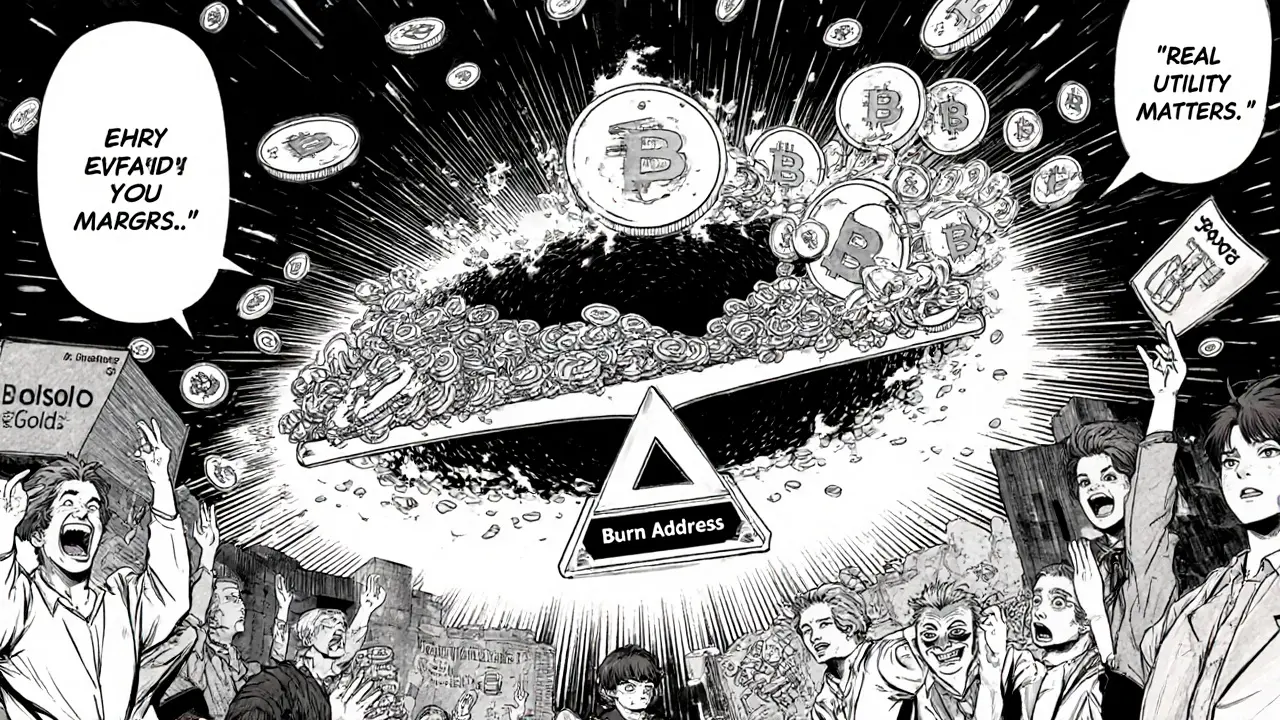
Token burning means permanently removing cryptocurrency tokens from circulation. It’s not just deleting a number in a database-it’s sending tokens to a special wallet address that no one can access. This address, called a burn address, has no private key. That means no one-not even the project’s founders-can ever retrieve those tokens again. Once sent there, they’re gone forever.
Think of it like tearing up cash and throwing the pieces into a volcano. You’re not hiding the money; you’re making sure it can never be used again. In crypto terms, this reduces the total supply of a token. And according to basic economic principles, if demand stays the same while supply drops, the value of what’s left can go up.
This isn’t new. The practice started appearing around 2017 as more projects realized that unlimited token creation leads to inflation. Binance began its quarterly BNB burns in 2017, and since then, over 48.5 million BNB tokens have been destroyed. That’s roughly $34 billion worth of tokens removed from circulation. Other projects followed suit. Today, 78% of the top 100 cryptocurrencies by market cap use some form of token burning.
How Does Token Burning Actually Work?
There are two main ways tokens get burned: manually and automatically.
Manual burning is when a project team decides to destroy tokens at specific times. They simply send a set number of tokens to the burn address and announce it publicly. Binance does this every quarter. They pick a number-say, 20% of their quarterly profits in BNB-and send it to the burn address. Then they post the transaction hash on their blog so anyone can verify it on the blockchain.
Automatic burning uses smart contracts. These are self-executing programs on the blockchain that trigger burns under certain conditions. Ethereum’s EIP-1559, launched in 2021, is the most famous example. Every time someone sends ETH, a portion of the transaction fee is automatically burned. As of October 2023, over 4.2 million ETH-worth about $12.3 billion-have been permanently destroyed this way.
Here’s the step-by-step process:
- A decision is made-either by the team (manual) or by code (automatic)-to burn a specific number of tokens.
- The tokens are sent to a verified burn address. Common burn addresses are publicly listed and used by multiple projects.
- The transaction is recorded on the blockchain. Anyone can look it up using a block explorer like Etherscan.
- The project announces the burn, often with the transaction ID and total value destroyed.
Each burn costs gas-network fees paid to miners or validators. On Ethereum, a single burn transaction can cost between 21,000 and 100,000 gas, depending on network congestion. That’s usually $5 to $20 in fees per burn.
Manual vs. Automatic Burning: Which Is Better?
Both methods have pros and cons. The choice affects trust, transparency, and market perception.
Manual burns give teams flexibility. If the market is crashing, they might skip a burn. If prices are soaring, they might burn extra to boost confidence. Binance did this in 2021, accelerating burns during the bull run. But this flexibility comes with a risk: trust. If a team says they burned 1 million tokens but the transaction isn’t clear, people will question it. That’s what happened with KuCoin in 2020, when users doubted the legitimacy of their burn.
Automatic burns remove human interference. The code does the work. Everything is transparent and unchangeable. Ethereum’s burn system is trusted because it’s predictable and open. A 2023 study by Crypto.com found that tokens with automatic burns had 17.3% less price volatility after burn events than those with manual burns.
But automatic burns lack adaptability. If the market crashes and demand plummets, you can’t pause the burn. The code keeps running. That’s why some projects, like VeChainThor, now use conditional burns-only triggering destruction when trading volume hits a certain level. This blends automation with real-world conditions.
Does Token Burning Actually Increase Price?
This is the big question. Does burning tokens make them more valuable? The answer isn’t simple.
A 2022 MIT study looked at 214 token burns across major cryptocurrencies. They found that burns under 0.5% of total supply had almost no price effect. But burns over 2% of supply led to an average 8.7% price increase over 30 days. That’s significant. The Shiba Inu burn in May 2021 destroyed 410 trillion tokens-about 4% of total supply. The price jumped 230% in the following month.
But correlation isn’t causation. Other factors matter too. Was there hype? Was there new adoption? Was the market bullish? Token burning doesn’t work in a vacuum. If a project has no real use case, burning tokens won’t save it. The TerraUSD collapse in 2022 proved that. UST had a burning mechanism, but it failed because it wasn’t backed by real reserves. The burn couldn’t fix a broken system.
Dr. Garrick Hileman of Blockchain.com puts it bluntly: “Token burns can theoretically increase value, but only if they represent a meaningful portion of supply and the project has real utility.”
Another angle: the total value of burned tokens crossed $52.7 billion by Q3 2023. Binance’s BNB burns alone account for over 65% of that. And yet, BNB’s price doesn’t rise every quarter after a burn. Sometimes it dips. Why? Because markets are complex. Burning tokens helps, but it’s not a magic bullet.
Who Uses Token Burning-and Why?
Not all projects burn tokens the same way. Here are some real-world examples:
- Binance (BNB): Quarterly manual burns using profits. Over 48.5 million BNB burned. Goal: Reduce supply to increase scarcity and reward long-term holders.
- Ethereum (ETH): Automatic burns via EIP-1559. Over 4.2 million ETH burned. Goal: Reduce inflation, make ETH deflationary under high demand.
- Shiba Inu (SHIB): Community-driven burn. Over 410 trillion tokens destroyed in 2021. Goal: Create hype and reward loyal holders.
- Paxos Gold (PAXG): Burn tokens when gold is redeemed. Every PAXG token is backed by one troy ounce of gold. When you redeem it, the token is burned. Goal: Maintain 1:1 peg with physical gold.
- VeChainThor (VET): Conditional burns triggered by transaction volume. Goal: Link supply reduction directly to network activity.
Enterprise adoption is growing too. Deloitte’s 2023 survey found that 63% of enterprise blockchain projects now include burn mechanisms. That’s a shift from “crypto gimmick” to “legitimate economic tool.”
Common Misconceptions and Pitfalls
Many people think token burning is a guaranteed way to make money. It’s not.
Misconception 1: “More burns = higher price.”
False. If you burn 0.1% of supply every month, it won’t move the needle. You need meaningful scale. A 2020 error on the Waves platform burned 100 million more tokens than intended. The team had to vote to reverse it. That’s how small mistakes can cause big problems.
Misconception 2: “Burns are always good for investors.”
Not always. Some projects use burns as marketing fluff. They announce a burn, hype the price up, then dump their own tokens. Investors who bought in late get stuck. Transparency matters. Projects like Binance score 4.7/5 in documentation quality. Most others? Around 3.2/5.
Misconception 3: “Burns fix bad projects.”
No. Burning tokens doesn’t create utility. If a coin has no real-world use, no amount of burning will make it valuable. The UST collapse proved that.
What’s Next for Token Burning?
Token burning is evolving beyond simple supply cuts.
Projects are now experimenting with:
- Dynamic burn rates: Kadena adjusts burn amounts based on market conditions.
- Utility-linked burns: PAXG ties burns directly to gold redemption, creating a verifiable feedback loop.
- Multi-chain burns: New blockchains are building cross-chain burn protocols so tokens burned on one chain affect supply on another.
Gartner predicts that by 2025, 95% of new crypto projects will include token burning. But experts like Dr. Aaron Wright warn: “As burns become common, their impact fades. To matter, they need to be paired with real demand.”
The future isn’t just about burning more. It’s about burning smarter-tying supply reduction to actual usage, real assets, and sustainable economic models.
Final Thoughts: Is Token Burning Worth Paying Attention To?
Yes-but not as a trading signal. Think of it as a signal of project discipline.
A project that burns tokens regularly, transparently, and meaningfully is likely serious about long-term value. It shows they’re not just printing coins to fund development. They’re thinking about scarcity, incentives, and sustainability.
But don’t buy a coin just because it burns tokens. Look at the team, the use case, the community, and the adoption. Burning is one tool in the toolbox. It’s not the whole toolshed.
If you’re holding a token that burns, check how often, how much, and how transparently it’s done. If it’s automatic and verifiable? That’s a good sign. If it’s manual and vague? Be cautious.
Token burning isn’t magic. But when done right, it’s one of the clearest signs a crypto project is thinking like an economist, not a marketer.
What happens to tokens after they’re burned?
Burned tokens are sent to a burn address-a wallet with no private key. Once there, they can never be accessed, spent, or recovered. They’re permanently removed from circulation and no longer counted in the total supply.
Can I burn my own tokens?
Yes, if the token supports it. You can send your tokens to a public burn address listed by the project. But you’ll pay gas fees, and you’ll lose those tokens forever. Only do this if you understand the consequences and are okay with permanently losing them.
Are token burns regulated?
As of 2025, no major regulator has banned token burning. The U.S. SEC has warned that burns could be seen as unregistered securities offerings if used to manipulate prices-but no enforcement actions have been taken. Most burns are treated as technical supply adjustments, not financial instruments.
Do all cryptocurrencies burn tokens?
No. Only about 78% of the top 100 cryptocurrencies by market cap use token burning. Many early coins like Bitcoin and Litecoin have fixed supplies and don’t need burns. Newer projects use burns to create deflationary pressure and incentivize holding.
How can I verify a token burn?
Look up the burn transaction on a blockchain explorer like Etherscan or BscScan. Projects usually publish the transaction hash after a burn. You can paste that hash into the explorer to see the tokens sent to the burn address and confirm they’re permanently locked.