What is Magic Crystal (MC)? A Deep Dive into the Token Behind Tap Fantasy
You’ve probably seen a new crypto ticker pop up on your feed or heard whispers about "gaming coins" that promise to change how you play. One name that keeps surfacing in niche circles is Magic Crystal, often traded under the symbol **MC**. It sounds like something straight out of a fantasy novel, but in the world of blockchain, it’s a utility token with a very specific job: powering the economy inside a game called Tap Fantasy.
If you are wondering whether this is the next big investment or just another fleeting meme coin, you aren't alone. The data around Magic Crystal is messy, contradictory, and frankly, a bit confusing. That confusion is exactly why we need to break it down. We’re going to look at what MC actually does, where it lives on the blockchain, and whether there’s any real substance behind the hype.
The Core Identity: What Is Magic Crystal?
At its heart, Magic Crystal is a utility cryptocurrency token designed specifically for the Tap Fantasy gaming ecosystem. Unlike Bitcoin, which aims to be digital gold, or Ethereum, which powers thousands of decentralized apps, MC has a narrow focus. It exists to facilitate transactions, rewards, and interactions within the Tap Fantasy mobile game.
This places MC firmly in the GameFi sector. GameFi combines traditional gaming mechanics with financial incentives. In this model, players don’t just play for fun; they earn tokens, trade assets, and sometimes even govern parts of the game. Magic Crystal acts as the fuel for this engine. You might use it to buy in-game items, pay for transaction fees within the app, or receive rewards for achieving high scores.
However, the definition gets tricky when you look at the technical specs. There is significant disagreement among major data aggregators about the basic facts of the token. Some sources claim it launched in 2021 on Ethereum, while others say it debuted in 2022 on the BNB Smart Chain. This isn't just a minor detail; it changes everything about how you store and trade the coin.
The Blockchain Confusion: Ethereum vs. BNB Smart Chain
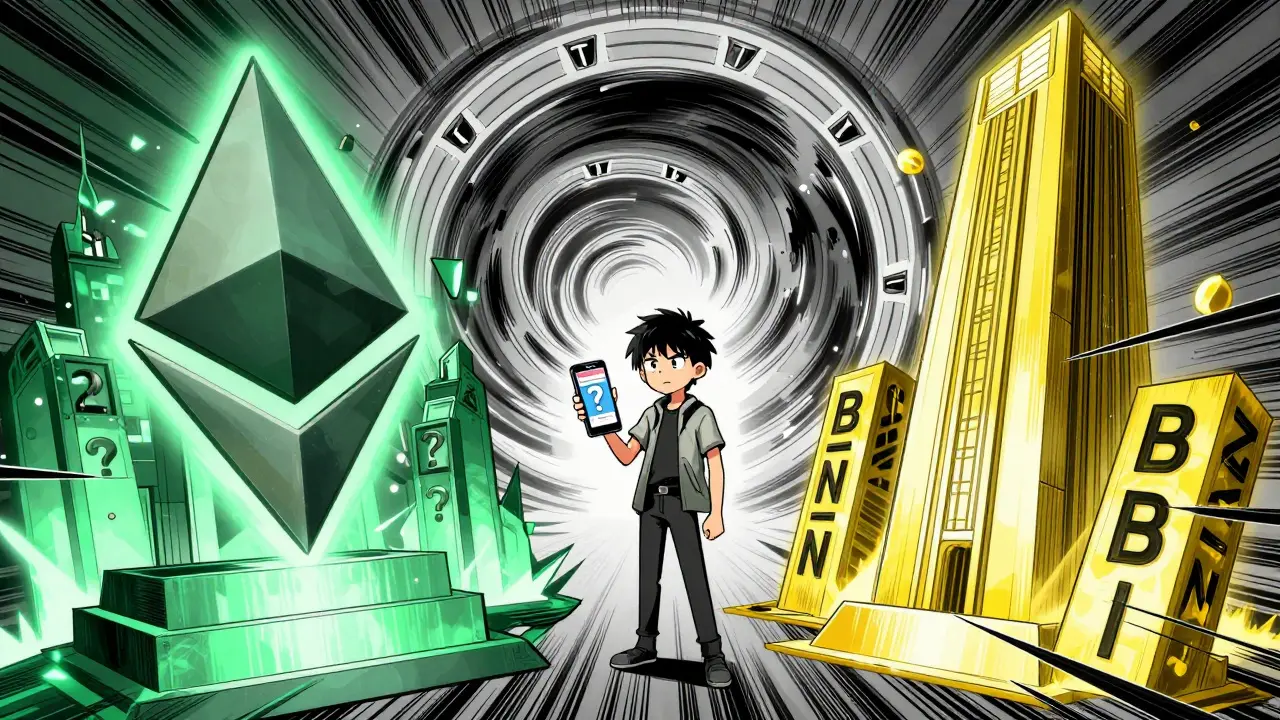
One of the first red flags you’ll notice if you dig into Magic Crystal is the lack of consensus on its underlying technology. Let’s look at the evidence from different platforms:
- CoinPaprika suggests the token operates on Ethereum, leveraging smart contracts for its ecosystem.
- Coinbase and LiveCoinWatch list it as a BEP-20 token, meaning it runs on the BNB Smart Chain (BSC).
- Holder.io points to an official website on the TON domain (
ton.tapfantasy.io) and mentions an IDO on the TON blockchain.
Why does this matter? Because if you try to send MC tokens to the wrong wallet, you could lose them forever. If it’s on BSC, you need a wallet that supports BNB Smart Chain, like Trust Wallet or MetaMask configured for BSC. If it’s on Ethereum, you need an ETH-compatible wallet. The mention of TON (The Open Network) adds another layer of complexity, suggesting the project may have migrated or expanded across multiple chains.
For now, the most consistent data from active trading pairs points toward the BNB Smart Chain. LiveCoinWatch lists the contract address as 0x59C49B54D4425C7fF1E49f40958a14d48cC87c26 on BSC. Always verify this address directly from the official Tap Fantasy channels before making any transactions. Never rely solely on third-party trackers for contract addresses.
Market Reality: Price, Volume, and Volatility
Let’s talk numbers, because that’s usually what brings people to these articles. Magic Crystal is not a household name like Solana or Cardano. It sits deep in the long tail of the crypto market. As of recent data, LiveCoinWatch ranks MC at #6323 by market capitalization. To put that in perspective, there are over 10,000 cryptocurrencies listed on CoinGecko alone. Being ranked 6,000+ means it has a tiny market presence compared to top-tier assets.
The price itself is highly volatile and inconsistent across exchanges. Here is a snapshot of the discrepancies:
| Data Point | CoinGecko | LiveCoinWatch | Coinbase |
|---|---|---|---|
| Price (USD) | $0.1551 | $0.0976 | Varies |
| 24h Volume | $98.48 | $277.00 | $71.88K |
| All-Time High | $2.90 | $2.90 | $4.25 |
| Yearly Performance | +95.2% | N/A | -57.27% |
Look closely at the 24-hour trading volume. On CoinGecko, it’s less than $100. On LiveCoinWatch, it’s around $277. This is extremely low liquidity. Low liquidity means two things: first, it’s hard to buy or sell large amounts without moving the price drastically. Second, it makes the token susceptible to manipulation. A single large trade can spike the price up or crash it down, creating false signals for traders.
The all-time high (ATH) also varies wildly. Did it hit $2.90 or $4.25? This inconsistency suggests that either the token was traded on obscure DEXs (Decentralized Exchanges) with thin order books, or different versions of the token existed at different times. For an investor, buying near an ATH is risky, especially when the current price is a fraction of that peak.
Supply Dynamics and Distribution
Understanding supply is crucial for assessing potential value. Holder.io reports a maximum supply of 10,000,000 MC tokens. Coinbase indicates a circulating supply of roughly 2.84 million tokens. This means a significant portion of the tokens are still locked, held by the team, or reserved for future development.
The distribution method offers some insight into the project’s origins. Magic Crystal conducted a TonUp IDO (Initial DEX Offering). The terms were specific: 40,000,000 MC tokens offered at a rate of 1 MC = 0.2 TON. Liquidity provider (LP) tokens were locked for 90 days. An IDO on TON suggests the project tried to tap into the growing Telegram-based crypto community early on. The 90-day lock-up period is a standard safety measure to prevent immediate dumping by early investors, but once that lock expires, selling pressure can increase.
Importantly, Magic Crystal is not mineable. You cannot run a computer rig to earn MC. It was also reported as not pre-mined, which is unusual for many modern tokens where teams allocate a large percentage to themselves upfront. However, given the contradictions in other data, take this "no pre-mine" claim with a grain of salt until you see an audited tokenomics report from the developers.
The Utility Question: Does Tap Fantasy Actually Work?
A token is only as valuable as the product it supports. In this case, that product is Tap Fantasy. Without a thriving user base playing the game, the token has no intrinsic demand. Currently, public data on Tap Fantasy’s daily active users (DAU) or monthly active users (MAU) is scarce. There are no widespread reviews on major app stores detailing gameplay experiences.
The project’s roadmap, as cited by CoinPaprika, mentioned plans for 2024 to enhance smart contracts and partner with other gaming platforms. But roadmaps are promises, not deliverables. Many GameFi projects announce ambitious plans that never materialize due to lack of funding, developer interest, or market fit.
To evaluate the utility, ask yourself: Why would someone hold MC instead of selling it immediately? If the only reason is speculation that the price will go up, it’s a speculative asset, not a utility token. If players *need* MC to progress in the game, buy rare NFTs, or enter tournaments, then it has utility. Based on available information, the utility seems limited to internal game mechanics, which restricts its appeal to non-players.

Risks and Red Flags
We need to be honest about the risks here. Magic Crystal exhibits several characteristics common to high-risk micro-cap cryptos:
- Data Inconsistency: When major platforms disagree on launch dates, blockchains, and prices, it signals poor project communication or fragmented tracking. This makes due diligence difficult.
- Low Liquidity: With daily volumes under $300 on some trackers, exiting your position quickly can be impossible without slippage (getting a much worse price than expected).
- Limited Analyst Coverage: You won’t find deep-dive reports from firms like Messari or Delphi Digital on MC. This means you are largely on your own to verify claims.
- Competitive Sector: The GameFi space is crowded. Giants like Axie Infinity, StepN, and newer entrants on Solana and Polygon dominate attention. MC struggles to stand out without a unique selling proposition.
Additionally, the social media presence appears minimal. The official Twitter handle @tapfantasy2021 has limited engagement metrics publicly visible. In crypto, community strength often correlates with price resilience. A weak community means fewer advocates to defend the project during bear markets.
How to Approach Magic Crystal Safely
If you are still interested in exploring Magic Crystal, follow these steps to protect yourself:
- Verify the Contract Address: Use the BSC address
0x59C49B54D4425C7fF1E49f40958a14d48cC87c26only after cross-referencing with the official Tap Fantasy website or verified social media links. Scammers often create fake tokens with similar names. - Use a Non-Custodial Wallet: Store your tokens in a wallet you control, such as Trust Wallet or MetaMask. Do not leave them on exchanges unless necessary for trading.
- Start Small: Given the low liquidity and high volatility, only invest an amount you are willing to lose entirely. Treat it as experimental capital.
- Monitor Official Channels: Follow the official Twitter and check the TON-based website for updates. Ignore unofficial Telegram groups that promise guaranteed returns.
- Check Liquidity Before Buying: Look at the depth chart on the DEX where you plan to trade. If the spread between buy and sell orders is wide, expect high slippage.
Final Thoughts on Magic Crystal
Magic Crystal (MC) is a niche utility token tied to the Tap Fantasy game. It operates primarily on the BNB Smart Chain, though conflicting data suggests a complex history involving Ethereum and TON. Its market position is weak, with low trading volumes and a high ranking number, indicating limited adoption. While the concept of GameFi remains popular, MC lacks the visibility, liquidity, and clear utility to compete with established leaders in the space.
For casual gamers, it might offer a way to engage with a specific mobile title. For investors, it represents a high-risk, speculative play with significant informational gaps. Proceed with caution, do your own verification, and never let FOMO (Fear Of Missing Out) drive your decisions in the micro-cap crypto market.
Is Magic Crystal (MC) a scam?
There is no definitive proof that Magic Crystal is a scam, but it exhibits many red flags associated with high-risk projects. These include inconsistent data across major tracking platforms, extremely low trading volumes, and limited transparency regarding the development team. Always treat such tokens with extreme caution and verify all contract addresses independently.
Which blockchain does Magic Crystal use?
Most current trading data points to the BNB Smart Chain (BEP-20). However, some sources mention Ethereum and TON. This discrepancy suggests the project may have moved chains or has multiple versions. Always confirm the specific contract address for the network you are using before transacting.
Can I mine Magic Crystal?
No, Magic Crystal is not mineable. It was distributed through an Initial DEX Offering (IDO) and likely other mechanisms like partnerships or direct sales. You can only acquire it by purchasing it on supported exchanges or decentralized trading platforms.
What is the total supply of MC?
According to Holder.io, the maximum supply is 10,000,000 tokens. The circulating supply is significantly lower, around 2.84 million tokens according to Coinbase. This means a large portion of tokens are still unissued or held in reserve.
Where can I buy Magic Crystal?
Due to its low market cap and liquidity, MC is likely not available on major centralized exchanges like Binance or Coinbase Pro. It is primarily traded on decentralized exchanges (DEXs) connected to the BNB Smart Chain or TON network. Be prepared for high slippage and limited order book depth.